

Health Library
Pneumonia in adults - discharge
Bronchopneumonia adults - discharge; Lung infection adults - discharge
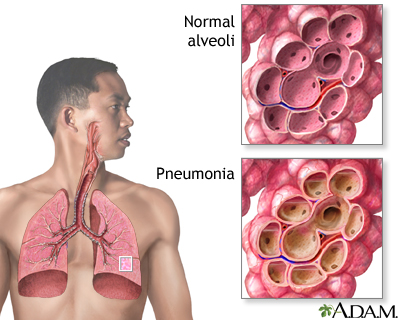
You have pneumonia, which is an infection in your lungs. Now that you are going home, it is important to follow your health care provider's instructions on taking care of yourself at home. Use the information below as a reminder.
Images
I Would Like to Learn About:
When You're in the Hospital
In the hospital, your providers helped you breathe better. They also gave you medicine to help your body get rid of the germs that cause pneumonia. They also made sure you got enough liquids and nutrients.
What to Expect at Home
You will still have symptoms of pneumonia after you leave the hospital.
- Your cough will slowly get better over 7 to 14 days.
- Sleeping and eating may take up to a week to return to normal.
- Your energy level may take 2 weeks or more to return to normal.
You will need to take time off work. For a while, you might not be able to do other things that you are used to doing.
Self-care
Breathing warm, moist air helps loosen the sticky mucus that may make you feel like you are choking. Other things that may also help include:
- Placing a warm, wet washcloth loosely near your nose and mouth.
- Filling a humidifier with warm water and breathing in the warm mist.
Coughing helps clear your airways. Take a couple of deep breaths, 2 to 3 times every hour. Deep breaths help open up your lungs.
While lying down, tap your chest gently a few times a day. This helps bring up mucus from the lungs.
If you smoke, now is the time to quit. Do not allow smoking in your home.
Drink plenty of liquids, as long as your provider says it is OK.
- Drink water, juice, or weak tea.
- Drink at least 6 to 10 cups (c) or 1.4 to 2.4 liters (L) a day.
- Do not drink alcohol.
Get plenty of rest when you go home. If you have trouble sleeping at night, take naps during the day.
Medicines
Your provider may prescribe antibiotics for you. These are medicines that kill the bacteria that cause pneumonia. Antibiotics help most people with pneumonia get better. Do not miss any doses. Take the full duration of the prescription medicine, even if you start to feel better.
Do not take cough or cold medicines unless your provider says it is OK. Coughing helps your body get rid of mucus from your lungs.
Your provider will tell you if it is OK to use acetaminophen (Tylenol) or ibuprofen (Advil or Motrin) for fever or pain. If these medicines are OK to use, your provider will tell you how much to take and how often to take them.
Avoid Infections
To prevent pneumonia in the future:
- Get a flu (influenza) shot every year.
- Ask your provider if you need to get the pneumococcal (pneumonia) vaccine.
- Get a COVID-19 vaccine on the recommended schedule schedule especially if you are considered high-risk for complications from COVID-19.
- Wash your hands often.
- Stay away from crowds.
- Ask visitors who have a cold to wear a mask.
Going Home With Oxygen
Your provider may prescribe oxygen for you to use at home. Oxygen helps you breathe better.
- Never change how much oxygen is flowing without asking your provider.
- Always have a back-up supply of oxygen at home or with you when you go out.
- Keep the phone number of your oxygen supplier with you at all times.
- Learn how to use oxygen safely at home.
- Never smoke near an oxygen tank.
When to Call the Doctor
Contact your provider or call 911 or the local emergency number if your breathing is:
- Getting harder
- Faster than before
- Shallow and you cannot get a deep breath
Also contact your provider or call 911 or the local emergency number if you have any of the following:
- Need to lean forward when sitting to breathe more easily
- Have chest pain when you take a deep breath
- Headaches more often than usual
- Feel sleepy or confused
- Fever returns
- Coughing up dark mucus or blood
- Fingertips or the skin around your fingernails is blue
Related Information
Viral pneumoniaAtypical pneumonia
Flu
Mycoplasma pneumonia
Aspiration pneumonia
Community-acquired pneumonia in adults
Hospital-acquired pneumonia
Legionnaires disease
CMV pneumonia
Pneumocystis jirovecii pneumonia
Tips on how to quit smoking
Pneumonia in children - discharge
Using oxygen at home
Oxygen safety
Using oxygen at home - what to ask your doctor
References
Daly JS, Haessler S, Ellison RT. Acute pneumonia. In: Blaser MJ, Cohen JI, Holland SM, et al, eds. Mandell, Douglas, and Bennett's Principles and Practice of Infectious Diseases. 10th ed. Philadelphia, PA: Elsevier; 2026:chap 69.
File TM. Streptococcus pneumoniae pulmonary infections. In: Goldman L, Cooney KA, eds. Goldman-Cecil Medicine. 27th ed. Philadelphia, PA: Elsevier; 2024:chap 268.
BACK TO TOPReview Date: 3/1/2026
Reviewed By: Jatin M. Vyas, MD, PhD, Roy and Diana Vagelos Professor in Medicine, Columbia University Vagelos College of Physicians and Surgeons, Division of Infectious Diseases, Department of Medicine, New York, NY. Also reviewed by David C. Dugdale, MD, Medical Director, Brenda Conaway, Editorial Director, and the A.D.A.M. Editorial team.
 | A.D.A.M., Inc. is accredited by URAC, for Health Content Provider (www.urac.org). URAC's accreditation program is an independent audit to verify that A.D.A.M. follows rigorous standards of quality and accountability. A.D.A.M. is among the first to achieve this important distinction for online health information and services. Learn more about A.D.A.M.'s editorial policy, editorial process and privacy policy. A.D.A.M. is also a founding member of Hi-Ethics. This site complies with the HONcode standard for trustworthy health information: verify here. |
The information provided herein should not be used during any medical emergency or for the diagnosis or treatment of any medical condition. A licensed medical professional should be consulted for diagnosis and treatment of any and all medical conditions. Links to other sites are provided for information only -- they do not constitute endorsements of those other sites. No warranty of any kind, either expressed or implied, is made as to the accuracy, reliability, timeliness, or correctness of any translations made by a third-party service of the information provided herein into any other language.
© 1997-
2026 A.D.A.M., a business unit of Ebix, Inc. Any duplication or distribution of the information contained herein is strictly prohibited.
All content on this site including text, images, graphics, audio, video, data, metadata, and compilations is protected by copyright and other intellectual property laws. You may view the content for personal, noncommercial use. Any other use requires prior written consent from Ebix. You may not copy, reproduce, distribute, transmit, display, publish, reverse-engineer, adapt, modify, store beyond ordinary browser caching, index, mine, scrape, or create derivative works from this content. You may not use automated tools to access or extract content, including to create embeddings, vectors, datasets, or indexes for retrieval systems. Use of any content for training, fine-tuning, calibrating, testing, evaluating, or improving AI systems of any kind is prohibited without express written consent. This includes large language models, machine learning models, neural networks, generative systems, retrieval-augmented systems, and any software that ingests content to produce outputs. Any unauthorized use of the content including AI-related use is a violation of our rights and may result in legal action, damages, and statutory penalties to the fullest extent permitted by law. Ebix reserves the right to enforce its rights through legal, technological, and contractual measures.
