

Health Library
Pneumonia in children - discharge
Lung infection - children discharge; Bronchopneumonia - children discharge
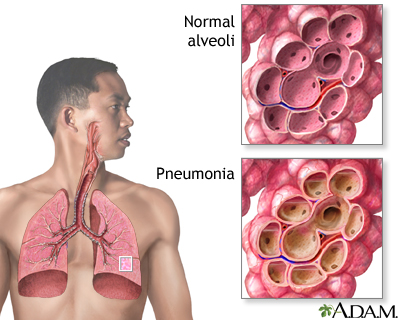
Your child has pneumonia, which is an infection in the lungs. Now that your child is going home, it is important to follow your health care provider's instructions on helping your child continue healing at home. Use the information below as a reminder.
Images
I Would Like to Learn About:
When You're in the Hospital
In the hospital, your providers helped your child breathe better. They also gave your child medicine to help get rid of the germs that cause pneumonia. They also made sure your child got enough liquids.
What to Expect at Home
Your child will probably still have some symptoms of pneumonia after leaving the hospital.
- Coughing will slowly get better over 7 to 14 days.
- Sleeping and eating may take up to a week to return to normal.
- You may need to take time off work to care for your child.
Home Care
Breathing warm, moist (wet) air helps loosen the sticky mucus that may be choking your child. Other things that may help include:
- Placing a warm, wet washcloth loosely near your child's nose and mouth
- Filling a humidifier with warm water and having your child breathe in the warm mist
Do not use steam vaporizers because they can cause burns.
To bring up mucus from the lungs, tap your child's chest gently a few times a day. This can be done as your child is lying down.
Make sure everyone washes their hands with warm water and soap or an alcohol-based hand cleanser before they touch your child. Try to keep other children away from your child.
Do not allow anyone to smoke in the house, the car, or anywhere near your child.
Ask your child's provider about vaccines to prevent other infections, such as:
Also, make sure all your child's vaccines are up to date.
Eating and Drinking
Make sure your child drinks enough:
- Breast milk or formula if they are younger than 12 months
- Whole milk if they are older than 12 months
Some drinks may help relax the airway and loosen the mucus, such as:
- Warm tea
- Lemonade
- Apple juice
- Chicken broth for children over age 1
Eating or drinking may make your child tired. Offer small amounts, but more often than usual.
If your child throws up because of coughing, wait a few minutes and try to feed your child again.
Medicines
Antibiotics help most children with pneumonia get better. So, if your provider gives you antibiotics for your child:
- Do not miss any doses.
- Have your child take the full duration of the prescription, even if they start to feel better.
Do not give your child cough or cold medicines unless your provider says it is OK. Your child's coughing helps get rid of mucus from the lungs.
Your provider will tell you if it is OK to use acetaminophen (Tylenol) or ibuprofen (Advil, Motrin) for fever or pain. If these medicines are OK to use, your provider will tell you how often to give them to your child. Do not give aspirin to your child.
When to Call the Doctor
Contact your child's provider or call 911 or the local emergency number if your child has any of the following:
- Hard time breathing
- Chest muscles are pulling in with each breath
- Breathing faster than 50 to 60 breaths per minute (when not crying)
- Making a grunting noise
- Sitting with shoulders hunched over
- Skin, nails, gums, or lips are a blue or gray color
- The area around your child's eyes is a blue or gray color
- Very tired or fatigued
- Not moving around much
- Has a limp or floppy body
- Nostrils are flaring out when breathing
- Does not feel like eating or drinking
- Irritable
- Has trouble sleeping
Related Information
Viral pneumoniaAtypical pneumonia
Flu
Community-acquired pneumonia in adults
Traveling with breathing problems
Pneumonia in adults - discharge
Using oxygen at home
Oxygen safety
Using oxygen at home - what to ask your doctor
References
Kelly MS, Sandora TJ. Community-acquired pneumonia. In: Kliegman RM, St. Geme JW, Blum NJ, et al, eds. Nelson Textbook of Pediatrics. 22nd ed. Philadelphia, PA: Elsevier; 2025:chap 449.
Statile AM, Williams DJ, Shah SS. Pediatric community-acquired pneumonia. In: Cherry JD, Kaplan SL, Harrison GJ, Steinbach WJ, Hotez PJ, Williams JV, eds. Feigin and Cherry's Textbook of Pediatric Infectious Diseases. 9th ed. Philadelphia, PA: Elsevier; 2025:chap 22.
BACK TO TOPReview Date: 3/1/2026
Reviewed By: Jatin M. Vyas, MD, PhD, Roy and Diana Vagelos Professor in Medicine, Columbia University Vagelos College of Physicians and Surgeons, Division of Infectious Diseases, Department of Medicine, New York, NY. Also reviewed by David C. Dugdale, MD, Medical Director, Brenda Conaway, Editorial Director, and the A.D.A.M. Editorial team.
 | A.D.A.M., Inc. is accredited by URAC, for Health Content Provider (www.urac.org). URAC's accreditation program is an independent audit to verify that A.D.A.M. follows rigorous standards of quality and accountability. A.D.A.M. is among the first to achieve this important distinction for online health information and services. Learn more about A.D.A.M.'s editorial policy, editorial process and privacy policy. A.D.A.M. is also a founding member of Hi-Ethics. This site complies with the HONcode standard for trustworthy health information: verify here. |
The information provided herein should not be used during any medical emergency or for the diagnosis or treatment of any medical condition. A licensed medical professional should be consulted for diagnosis and treatment of any and all medical conditions. Links to other sites are provided for information only -- they do not constitute endorsements of those other sites. No warranty of any kind, either expressed or implied, is made as to the accuracy, reliability, timeliness, or correctness of any translations made by a third-party service of the information provided herein into any other language.
© 1997-
2026 A.D.A.M., a business unit of Ebix, Inc. Any duplication or distribution of the information contained herein is strictly prohibited.
All content on this site including text, images, graphics, audio, video, data, metadata, and compilations is protected by copyright and other intellectual property laws. You may view the content for personal, noncommercial use. Any other use requires prior written consent from Ebix. You may not copy, reproduce, distribute, transmit, display, publish, reverse-engineer, adapt, modify, store beyond ordinary browser caching, index, mine, scrape, or create derivative works from this content. You may not use automated tools to access or extract content, including to create embeddings, vectors, datasets, or indexes for retrieval systems. Use of any content for training, fine-tuning, calibrating, testing, evaluating, or improving AI systems of any kind is prohibited without express written consent. This includes large language models, machine learning models, neural networks, generative systems, retrieval-augmented systems, and any software that ingests content to produce outputs. Any unauthorized use of the content including AI-related use is a violation of our rights and may result in legal action, damages, and statutory penalties to the fullest extent permitted by law. Ebix reserves the right to enforce its rights through legal, technological, and contractual measures.
