

Health Library
High blood cholesterol levels
Cholesterol - high; Lipid disorders; Hyperlipoproteinemia; Hyperlipidemia; Dyslipidemia; Hypercholesterolemia
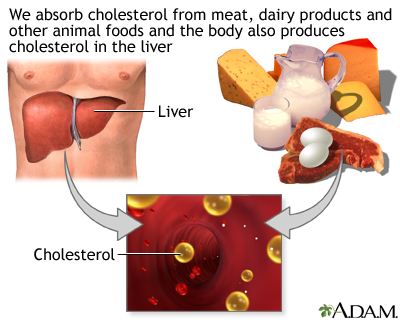
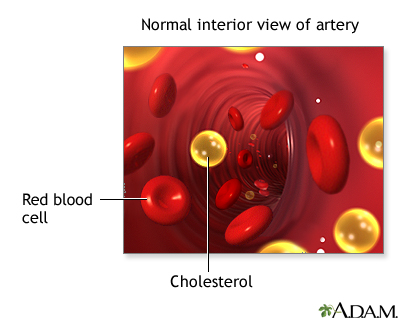
Cholesterol is a type of fat (called a lipid) that your body needs to work properly. There are "good" and "bad" types of cholesterol. Too much bad cholesterol in your blood can increase your chance of getting heart disease, stroke, and other health problems.
Common medical terms for high blood cholesterol are:
- Lipid disorder
- Hyperlipidemia
- Hypercholesterolemia
Images
I Would Like to Learn About:
Causes
There are many types of cholesterol. The most commonly discussed are:
- Total cholesterol -- a measurement of all types of cholesterol together
- Low density lipoprotein (LDL) cholesterol -- often called bad cholesterol
- Very low density lipoprotein cholesterol (VLDL) -- similar to LDL cholesterol
- High density lipoprotein (HDL) cholesterol -- often called good cholesterol
For many people, abnormal cholesterol levels are partly due to lifestyle factors:
- Eating a diet that is high in fat
- Having overweight or having obesity
- Low physical activity
- Smoking, which can reduce your HDL (good cholesterol)
Some health conditions can also lead to abnormal cholesterol levels, including:
- Diabetes
- Kidney disease
- Polyendocrine metabolic ovarian syndrome
- Pregnancy and other conditions that increase levels of female hormones
- Underactive thyroid gland
Some medicines also may raise cholesterol levels, such as certain types of:
- Birth control pills
- Diuretics (water pills)
- Beta-blockers
- Antidepressants
Several diseases that are passed down through families lead to abnormal cholesterol and triglyceride levels. They include:
- Familial combined hyperlipidemia
- Familial dysbetalipoproteinemia
- Familial hypercholesterolemia
- Familial hypertriglyceridemia
Exams and Tests
A cholesterol test called a lipid profile is done to diagnose a lipid disorder. The American College of Cardiology/American Heart Association guidelines call for everyone to have their first lipid profile by age 19. Children ages 9 to 11 years old should have their cholesterol tested once to check for familial hypercholesterolemia or other lipid problems.
Follow-up testing should be done:
- Every 5 years for adults with normal cholesterol levels
- Sooner if lifestyle changes occur, including weight gain or a change in diet
- More often for adults with a history of elevated cholesterol, diabetes, kidney problems, heart disease, and other blood vessel conditions
It is important to work with your health care provider to set your cholesterol goals.
General targets are:
LDL:
- Less than 100 mg/dL (2.59 mmol/L) for people at moderate risk for heart disease and stroke (primary prevention)
- Less than 70 mg/dL if you are at high risk, have diabetes, or have other risk factors (primary prevention)
- Less than 55 mg/dL if you have had a heart attack or stroke (secondary prevention)
HDL:
- 60 mg/dL (1.55 mmol/L) or higher
- Higher numbers are better
Total cholesterol:
- Less than 200 mg/dL (5.18 mmol/L)
- Lower numbers are better
Triglycerides:
- Less than 150 mg/dL (1.69 mmol/L)
- Lower numbers are better
If your cholesterol results are abnormal, you may also have other tests such as:
- Blood sugar (glucose) test to look for diabetes
- Kidney function tests
- Thyroid function tests to look for an underactive thyroid gland
Treatment
Steps you can take to improve your cholesterol levels and to help prevent heart disease and a heart attack include:
- Quit smoking. This is the single biggest change you can make to reduce your risk of heart attack and stroke.
- Eat a heart-healthy diet. This includes foods that are naturally low in fat such as vegetables, fruits and whole-grains.
- Use low-fat toppings, sauces, and dressings.
- Avoid foods that are high in saturated fat.
- Exercise regularly.
- Lose weight if you are overweight or have obesity.
Your provider may want you to take medicine for your cholesterol if lifestyle changes do not work. This will depend on:
- Your age
- Whether or not you have heart disease, diabetes, or other blood vessel problems
- Whether you smoke or are overweight
- Whether you have high blood pressure or diabetes
You are more likely to need medicine to lower your cholesterol:
- If you have heart disease or diabetes
- If you are at high risk for heart disease (even if you do not yet have any heart problems)
- If your LDL cholesterol is 160 mg/dL (4.14 mmol/L) or higher
- Your lipoprotein (a) [(lp(a)] level is 125 nmol/L or 50 mg/dL or higher
There are several types of medicines to help lower blood cholesterol levels. The medicines work in different ways. Statins are one kind of medicine that lowers cholesterol and has been proven to reduce the chance of heart disease. Other medicines are available if your risk is high and statins do not lower your cholesterol levels enough. These include ezetimibe, bempedoic acid, and PCSK9 inhibitors. Check with your provider about what is best for you.
Outlook (Prognosis)
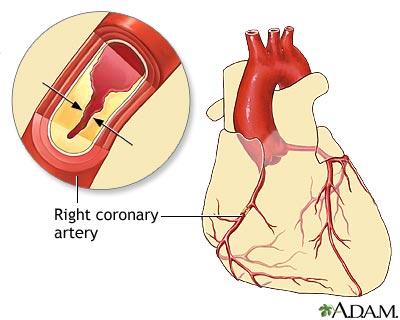
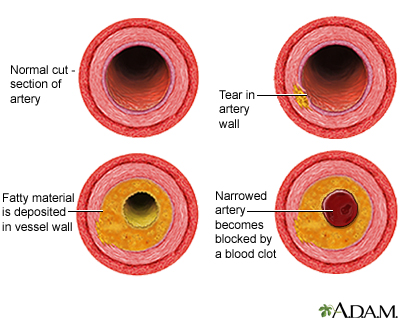
High cholesterol levels can lead to hardening of the arteries, also called atherosclerosis. This occurs when fat, cholesterol, and other substances build up in the walls of arteries and form hard structures called plaques.
Over time, these plaques can narrow the arteries and cause heart disease, and other symptoms or problems throughout the body.
Sometimes the plaques can rupture or break loose and a clot can form and block blood flow and cause a heart attack or stroke.
Disorders that are passed down through families often lead to higher cholesterol levels that are harder to control.
Related Information
Triglyceride levelAtherosclerosis
Hypothyroidism
Cushing syndrome
Acute kidney failure
Alcohol use and safe drinking
Overweight
Coronary heart disease
Stroke
Cholesterol - what to ask your doctor
Type 2 diabetes - what to ask your doctor
Cholesterol - drug treatment
Diabetes - preventing heart attack and stroke
Angina - discharge
Heart attack - discharge
Angioplasty and stent - heart - discharge
Aspirin and heart disease
Being active after your heart attack
Being active when you have heart disease
Butter, margarine, and cooking oils
Cardiac catheterization - discharge
Heart pacemaker - discharge
Cholesterol and lifestyle
Antiplatelet medicines - P2Y12 inhibitors
Controlling your high blood pressure
Heart bypass surgery - discharge
Heart bypass surgery - minimally invasive - discharge
Dietary fats explained
Fast food tips
Heart disease - risk factors
How to read food labels
Low-salt diet
Mediterranean diet
Heart failure - fluids and diuretics
Heart failure - home monitoring
Stroke - discharge
References
American Diabetes Association Professional Practice Committee for Diabetes*. 10. Cardiovascular Disease and Risk Management: Standards of Care in Diabetes-2026. Diabetes Care. 2026 Jan 1;49(Supplement_1):S216-S245. PMID: 41358899; PMCID: PMC12690187. pubmed.ncbi.nlm.nih.gov/41358899/.
Blumenthal RS, Morris PB, Gaudino M, et al.. 2026 ACC/AHA/AACVPR/ABC/ACPM/ADA/AGS/APhA/ASPC/NLA/PCNA Guideline on the Management of Dyslipidemia: A Report of the American College of Cardiology/American Heart Association Joint Committee on Clinical Practice Guidelines. Circulation. 2026 Apr 28;153(17):e1154-e1276. Epub 2026 Mar 13. PMID: 41824552. pubmed.ncbi.nlm.nih.gov/41824552/.
Libby P. The vascular biology of atherosclerosis. In: Bonow RO, Mann DL, Tomaselli GF, et al, eds. Braunwald's Heart Disease: A Textbook of Cardiovascular Medicine. 13th ed. Philadelphia, PA: Elsevier; 2026:chap 22.
Mora S, Martin SS. Measurement of low-density lipoprotein cholesterol, non–high-density lipoprotein cholesterol, apolipoprotein B, and low-density lipoprotein particle concentration. In: Ballantyne CM, ed. Clinical Lipidology:A Companion to Braunwald's Heart Disease. 3rd ed. Philadelphia, PA: Elsevier; 2024:chap 3.
Robinson JG. Disorders of lipid metabolism. In: Goldman L, Cooney KA, eds. Goldman-Cecil Medicine. 27th ed. Philadelphia, PA: Elsevier; 2024:chap 190.
Tokgözoglu L, Libby P. Lipoprotein disorders and cardiovascular disease. In: Bonow RO, Mann DL, Tomaselli GF, et al, eds. Braunwald's Heart Disease: A Textbook of Cardiovascular Medicine. 13th ed. Philadelphia, PA: Elsevier; 2026:chap 25.
US Preventive Services Task Force; Mangione CM, Barry MJ, et al. Statin use for the primary prevention of cardiovascular disease in adults: US Preventive Services Task Force Recommendation Statement. JAMA. 2022;328(8):746-753. PMID: 35997723 pubmed.ncbi.nlm.nih.gov/35997723/.
US Preventive Services Task Force; Barry MJ, Nicholson WK, et al. Screening for lipid disorders in children and adolescents: US Preventive Services Task Force Recommendation Statement. JAMA. 2023;330(3):253-260. PMID: 37462699 pubmed.ncbi.nlm.nih.gov/37462699/.
BACK TO TOPReview Date: 7/21/2026
Reviewed By: Michael A. Chen, MD, PhD, Associate Professor of Medicine, Division of Cardiology, Harborview Medical Center, University of Washington Medical School, Seattle, WA. Also reviewed by David C. Dugdale, MD, Medical Director, Brenda Conaway, Editorial Director, and the A.D.A.M. Editorial team.
 | A.D.A.M., Inc. is accredited by URAC, for Health Content Provider (www.urac.org). URAC's accreditation program is an independent audit to verify that A.D.A.M. follows rigorous standards of quality and accountability. A.D.A.M. is among the first to achieve this important distinction for online health information and services. Learn more about A.D.A.M.'s editorial policy, editorial process and privacy policy. A.D.A.M. is also a founding member of Hi-Ethics. This site complies with the HONcode standard for trustworthy health information: verify here. |
The information provided herein should not be used during any medical emergency or for the diagnosis or treatment of any medical condition. A licensed medical professional should be consulted for diagnosis and treatment of any and all medical conditions. Links to other sites are provided for information only -- they do not constitute endorsements of those other sites. No warranty of any kind, either expressed or implied, is made as to the accuracy, reliability, timeliness, or correctness of any translations made by a third-party service of the information provided herein into any other language.
© 1997-
2026 A.D.A.M., a business unit of Ebix, Inc. Any duplication or distribution of the information contained herein is strictly prohibited.
All content on this site including text, images, graphics, audio, video, data, metadata, and compilations is protected by copyright and other intellectual property laws. You may view the content for personal, noncommercial use. Any other use requires prior written consent from Ebix. You may not copy, reproduce, distribute, transmit, display, publish, reverse-engineer, adapt, modify, store beyond ordinary browser caching, index, mine, scrape, or create derivative works from this content. You may not use automated tools to access or extract content, including to create embeddings, vectors, datasets, or indexes for retrieval systems. Use of any content for training, fine-tuning, calibrating, testing, evaluating, or improving AI systems of any kind is prohibited without express written consent. This includes large language models, machine learning models, neural networks, generative systems, retrieval-augmented systems, and any software that ingests content to produce outputs. Any unauthorized use of the content including AI-related use is a violation of our rights and may result in legal action, damages, and statutory penalties to the fullest extent permitted by law. Ebix reserves the right to enforce its rights through legal, technological, and contractual measures.
