

Citric acid urine test
Urine - citric acid test; Renal tubular acidosis - citric acid test; Kidney stones - citric acid test; Urolithiasis - citric acid test
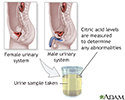
Citric acid urine test measures the level of citric acid in urine.
How the Test is Performed
You will need to collect your urine at home over 24 hours. Your health care provider will tell you how to do this. Follow instructions exactly so that the results are accurate.

How to Prepare for the Test
No special preparation is necessary for this test. But the results are affected by your diet, and this test is usually done while you are on a normal diet. Ask your provider for more information.
How the Test will Feel
The test involves only normal urination, and there is no discomfort.
Why the Test is Performed
The test is used to diagnose renal tubular acidosis and evaluate kidney stone disease.


Normal Results
The normal range is greater than 320 mg per 24 hours.
Normal value ranges may vary slightly among different labs. Some labs use different measurements or test different samples. Talk to your provider about the meaning of your specific test results.
What Abnormal Results Mean
A low level of citric acid may mean renal tubular acidosis and a tendency to form calcium kidney stones.
The following may decrease urine citric acid levels:
- Long-term (chronic) kidney failure
- Diabetes
- Excessive muscle activity
- Medicines called angiotensin converting enzyme (ACE) inhibitors
- Parathyroid glands do not produce enough of its hormone (hypoparathyroidism)
- Too much acid in the body fluids (acidosis)


The following may increase urine citric acid levels:
- A high carbohydrate diet
- Estrogen therapy
- Vitamin D


Risks
There are no risks with this test.
References
Bushinsky BA. Nephrolithiasis. In: Goldman L, Cooney KA, eds. Goldman-Cecil Medicine. 27th ed. Philadelphia, PA: Elsevier; 2024:chap 111.
Hanna MG, Dixon BP. Renal tubular acidosis. In: Kliegman RM, St. Geme JW, Blum NJ, et al, eds. Nelson Textbook of Pediatrics. 22nd ed. Philadelphia, PA: Elsevier; 2025:chap 569.
Pearle MS, Antonelli JA, Lotan Y. Urinary lithiasis: etiology, epidemiology, and pathogenesis. In: Dmochowski RR, Partin AW, Dmochowski RR, Kavoussi LR, Peters CA, eds. Campbell-Walsh-Wein Urology. 13th ed. Philadelphia, PA: Elsevier; 2026:chap 95.
Seifter JL. Acid-base disorders. In: Goldman L, Cooney KA, eds. Goldman-Cecil Medicine. 27th ed. Philadelphia, PA: Elsevier; 2024:chap 104.
Review Date: 10/23/2025
Reviewed By: Walead Latif, MD, Nephrologist and Clinical Associate Professor, Rutgers Medical School, Newark, NJ. Review provided by VeriMed Healthcare Network. Also reviewed by David C. Dugdale, MD, Medical Director, Brenda Conaway, Editorial Director, and the A.D.A.M. Editorial team.
© 1997- A.D.A.M., a business unit of Ebix, Inc. Any duplication or distribution of the information contained herein is strictly prohibited.
 All rights reserved.