

Nasal flaring
Flaring of the alae nasi (nostrils); Nostrils - flaring
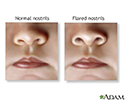
Nasal flaring occurs when the nostrils widen while breathing. It is often a sign of trouble breathing.

Considerations
Nasal flaring is seen mostly in infants and younger children.
Any condition that causes difficulty breathing can cause nasal flaring. Many causes of nasal flaring are not serious, but some can be life threatening.
In young infants, nasal flaring can be a sign of respiratory distress. This is a serious lung condition that prevents enough oxygen from getting to the lungs and into the blood.
Causes
Nasal flaring may be caused by any of the following:
- Asthma flare-up
- Blocked airway (any cause)
- Swelling and mucus buildup in the smallest air passages in the lungs (bronchiolitis)
- Problem breathing and a barking cough (croup)
- Swollen or inflamed tissue in the area that covers the windpipe (epiglottitis)
- Lung problems, such as infection or long-term damage (bronchopulmonary dysplasia)
- Breathing disorder in newborns (transient tachypnea of the newborn)


Home Care
Seek emergency help right away if you or your child has signs of a breathing difficulty.
When to Contact a Medical Professional
Contact your health care provider if:
- There is any persistent, unexplained nasal flaring, especially in a young child.
- A bluish color develops in the lips, nail beds, or skin. This is a sign that breathing difficulty is severe. It may mean that an emergency condition is developing.
- You think that your child is having trouble breathing.

What to Expect at Your Office Visit
Your provider will perform a physical exam and ask about the symptoms and medical history. Questions may include:
- When did the symptoms start?
- Are they getting better or worse?
- Is the breathing noisy, or are there wheezing sounds?
- What other symptoms are there, such as sweating or feeling tired?
- Do the muscles of the stomach, shoulders, or rib cage pull inward during breathing?

Your child's provider will listen carefully to their breath sounds. This is called auscultation.

Tests that may be done include:
- Arterial blood gas analysis
- Complete blood count (CBC)
- Electrocardiogram (ECG) to check the heart
- Pulse oximetry to measure blood oxygen level
- X-rays of the chest


Oxygen may be given if there is a breathing problem.
References
Rodrigues KK, Roosevelt GE. Acute inflammatory upper airway obstruction (croup, epiglottitis, laryngitis, and bacterial tracheitis). In: Kliegman RM, St. Geme JW, Blum NJ, et al, eds. Nelson Textbook of Pediatrics. 22nd ed. Philadelphia, PA: Elsevier; 2025:chap 433.
Rotta AT, Kneyber MCJ, Sarnaik AP. Acute care of respiratory distress and failure. In: Kliegman RM, St. Geme JW, Blum NJ, et al, eds. Nelson Textbook of Pediatrics. 22nd ed. Philadelphia, PA: Elsevier; 2025:chap 86.
Review Date: 4/18/2026
Reviewed By: Charles I. Schwartz, MD, FAAP, Clinical Assistant Professor of Pediatrics, Regional Medical Director of Penn Medicine Primary and Specialty Care, Perelman School of Medicine at the University of Pennsylvania, General Pediatrician at PennCare for Kids, Phoenixville, PA. Also reviewed by David C. Dugdale, MD, Medical Director, Brenda Conaway, Editorial Director, and the A.D.A.M. Editorial team.
© 1997- A.D.A.M., a business unit of Ebix, Inc. Any duplication or distribution of the information contained herein is strictly prohibited.
 All rights reserved.