

Croup
Viral croup; Laryngotracheobronchitis; Spasmodic croup; Barking cough; Laryngotracheitis
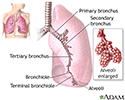
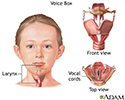
Croup is due to an infection of the upper airways that causes breathing difficulty and a barking cough. The cough of croup results from swelling around the vocal cords. It is common in infants and children.

Causes
Croup affects children ages 3 months to 5 years. It can occur at any age. Some children are more likely to get croup and may get it several times. It is most common between October and April, but can occur at any time of the year.
Croup is most often caused by viruses such as:
- Parainfluenza
- Influenza
- Respiratory syncytial virus (RSV)
- Measles
- Adenovirus


More severe cases of croup may be caused by bacteria. This condition is called bacterial tracheitis.
A type of croup called spasmodic croup may also be caused by:
- Allergies
- Breathing in something that irritates the airway
- Acid reflux

This type of croup comes on suddenly and does not cause a fever. Treating the cause will often relieve the croup symptoms.
Symptoms
The main symptom of croup is a cough that sounds like a seal barking.
Most children will have a mild cold and a low grade fever for several days before having a barking cough and a hoarse voice. As the cough gets more frequent, the child may have trouble breathing or stridor (a harsh, crowing noise made when breathing in).

Croup is typically much worse at night. It most often lasts up to 3 nights but may last up to 7 nights. The first night or two are most often the worst. Rarely, croup can last for weeks. Talk to your child's health care provider if croup lasts longer than a week or comes back often.
Exams and Tests
Your provider will take a medical history and ask about your child's symptoms. Your provider will examine your child's chest to check for:
- Difficulty breathing in and out
- Whistling sound (wheezing)
- Decreased breath sounds
- Chest retractions with breathing
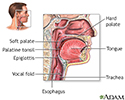
An exam of the throat may reveal a red epiglottis. In a few cases, x-rays or other tests may be needed.
A neck x-ray may reveal a foreign object or narrowing of the trachea.

Treatment
Most cases of croup can be safely managed at home with telephone support from your provider. However, if you are worried about your child's symptoms, you should contact your provider for advice, even in the middle of the night.
Steps you can take at home include:
- Make your child more comfortable by giving acetaminophen. This medicine also lowers a fever so your child will not have to breathe as hard. Ibuprofen can be used for fever in children older than 6 months.
- Avoid cough medicines, which won't help and may be harmful.
- Expose your child to cool or warm moist air, such as in a steamy bathroom or cool night air. This may help your child feel better, but no studies show that it helps reduce symptoms.
Your provider may prescribe medicines, such as:
- Epinephrine given with a nebulizer
- Steroid medicines taken by mouth or through an inhaler
- Antibiotic medicine
Your child may need to be treated in the emergency room or to stay in the hospital if they:
- Have breathing problems that do not go away or get worse
- Become too tired because of breathing problems
- Have bluish skin color of the lips, mouth, or fingernails (cyanosis)
- Are not drinking enough fluids

Medicines and treatments used at the hospital may include:
- Epinephrine given with a nebulizer
- Steroid medicines, inhaled, taken orally, or given through a vein (intravenous or IV)
- Oxygen given in a tent over a crib or through a mask or a tube near the nose
- IV fluids for dehydration
- Antibiotics (rarely)

Rarely, a breathing tube through the nose or mouth will be needed to help your child breathe.
Outlook (Prognosis)
Croup is most often mild, but it can still be dangerous. It most often goes away in 3 to 7 days.
In some cases of croup that do not require emergency care, a short course of oral steroids may be useful to reduce swelling and improve symptoms.
The tissue that covers the trachea (windpipe) is called the epiglottis. If the epiglottis becomes infected, the entire windpipe can swell shut. This is a life-threatening condition called epiglottitis.

If an airway blockage is not treated promptly, the child can have severe trouble breathing or breathing may stop completely.

When to Contact a Medical Professional
Contact your provider if your child is not responding to home treatment or is acting more irritable.
Call 911 or the local emergency number right away if:
- Croup symptoms may have been caused by an insect sting or inhaled object.
- Your child has bluish lips or skin color (cyanosis).
- Your child is drooling.
- Your child is having trouble swallowing.
- There is stridor (a noise when breathing in) that is getting worse or that occurs at rest.
- There is a tugging-in of the muscles between the ribs when breathing in.
- Your child is struggling to breathe.

Prevention
Some of the steps to be taken to prevent infection are:
- Wash your hands frequently and avoid close contact with people who have a respiratory infection.
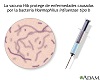
- Timely immunizations with the diphtheria, influenza (Hib), and measles vaccines protect children from some of the most dangerous forms of croup.


References
American Academy of Pediatrics Healthy Children website. Croup in young children. www.healthychildren.org/english/health-issues/conditions/chest-lungs/pages/croup-treatment.aspx. Updated May 10, 2024. Accessed June 24, 2026.
Aregbesola A, Tam CM, Kothari A, Le ML, Ragheb M, Klassen TP. Glucocorticoids for croup in children. Cochrane Database Syst Rev. 2023;1(1):CD001955. PMID: 36626194 pubmed.ncbi.nlm.nih.gov/36626194/.
Chi DH, Tobey A. Otolaryngology. In: Zitelli BJ, McIntire SC, Nowalk AJ, Garrison J, eds. Zitelli and Davis' Atlas of Pediatric Physical Diagnosis. 8th ed. Philadelphia, PA: Elsevier; 2023:chap 24.
Elluru R, Patel A. Pediatric infectious disease. In: Francis HW, Haughey BH, Hillel AT, et al, eds. Cummings Otolaryngology: Head and Neck Surgery. 8th ed. Philadelphia, PA: Elsevier; 2026:chap 192.
Rodrigues KK, Roosevelt GE. Acute inflammatory upper airway obstruction (croup, epiglottitis, laryngitis, and bacterial tracheitis). In: Kliegman RM, St. Geme JW, Blum NJ, et al, eds. Nelson Textbook of Pediatrics. 22nd ed. Philadelphia, PA: Elsevier; 2025:chap 433.]
Rose E. Pediatric upper airway obstruction and infections. In: Walls RM, ed. Rosen's Emergency Medicine: Concepts and Clinical Practice. 10th ed. Philadelphia, PA: Elsevier; 2023:chap 162.
Review Date: 1/1/2026
Reviewed By: Charles I. Schwartz, MD, FAAP, Clinical Assistant Professor of Pediatrics, Regional Medical Director of Penn Medicine Primary and Specialty Care, Perelman School of Medicine at the University of Pennsylvania, General Pediatrician at PennCare for Kids, Phoenixville, PA. Also reviewed by David C. Dugdale, MD, Medical Director, Brenda Conaway, Editorial Director, and the A.D.A.M. Editorial team. Editorial update 06/27/2026.
© 1997- A.D.A.M., a business unit of Ebix, Inc. Any duplication or distribution of the information contained herein is strictly prohibited.
 All rights reserved.