

Health Library
Apolipoprotein B
ApoB100; Apoprotein B100; Hypercholesterolemia - apolipoprotein B100; Apolipoprotein B100; ApoB
Apolipoprotein B (ApoB) is a protein that plays a role in moving cholesterol around your body. It is a form of low density lipoprotein (LDL).
Variants in the gene that directs the body's production of ApoB100 can cause a condition called familial hypercholesterolemia. This is a form of high blood cholesterol that is passed down in families (inherited).
This article discusses the test used to measure the level of ApoB100 in the blood.
Images
I Would Like to Learn About:
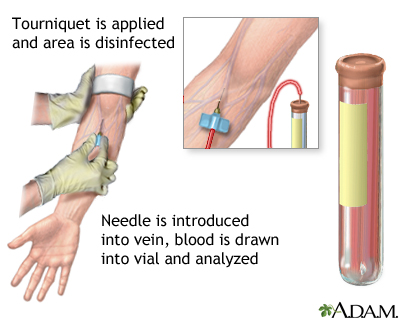
How the Test is Performed
How to Prepare for the Test
Your health care provider may tell you not to eat or drink anything for 4 to 6 hours before the test.
How the Test will Feel
When the needle is inserted to draw blood, you may feel moderate pain, or only a prick or stinging sensation. Afterward, there may be some throbbing.
Why the Test is Performed
Most often, this test is done to help determine the cause or specific type of high blood cholesterol. How much this test adds to standard cholesterol testing is not known, but it is recommended by the American College of Cardiology and American Heart Association to help guide your treatment.
Normal Results
The normal range is about 50 to 150 mg/dL.
Normal value ranges may vary slightly among different laboratories. Some laboratories use different measurements or may test different specimens. Talk to your provider about the meaning of your specific test results.
What Abnormal Results Mean
An abnormal result may mean you have high lipid (fat) levels in your blood. A medical term for this is hyperlipidemia. An abnormal result may indicate you have a high risk of heart disease even if your cholesterol levels are at a target level with treatment.
Other disorders that may be associated with high ApoB levels include atherosclerotic vascular disease such as angina pectoris (chest pain that occurs with activity or stress) and heart attack.
Risks
Risks linked with having blood drawn are slight, but may include:
- Excessive bleeding
- Fainting or feeling lightheaded
- Hematoma (blood buildup under the skin)
- Infection (a slight risk any time the skin is broken)
- Multiple punctures to locate veins
Considerations
ApoB measurements may provide more detail about your risk for heart disease. The results may lead to intensification of lipid therapies, especially in patients with atherosclerotic heart disease or to aid in risk assessment prior to starting lipid therapy and to evaluate for inherited lipid disorders.
Related Information
Triglyceride levelMetabolism
High blood cholesterol levels
Familial combined hyperlipidemia
Angina
Heart attack
References
Bredefeld CL, Lau R, Hussain MM. Lipids and dyslipoproteinemia. In: McPherson RA, Pincus MR, eds. Henry's Clinical Diagnosis and Management by Laboratory Methods. 24th ed. St Louis, MO: Elsevier; 2022:chap 18.
Mora S, Martin SS. Measurement of low-density lipoprotein cholesterol, non-high-density lipoprotein cholesterol, apolipoprotein B, and low-density lipoprotein particle concentration. In: Ballantyne CM, ed. Clinical Lipidology: A Companion to Braunwald's Heart Disease. 3rd ed. Philadelphia, PA: Elsevier; 2024:chap 3.
Robinson JG. Disorders of lipid metabolism. In: Goldman L, Cooney KA, eds. Goldman-Cecil Medicine. 27th ed. Philadelphia, PA: Elsevier; 2024:chap 190.
Tokgözoglu L, Libby P. Lipoprotein disorders and cardiovascular disease. In: Bonow RO, Mann DL, Tomaselli GF, et al, eds. Braunwald's Heart Disease: A Textbook of Cardiovascular Medicine. 13th ed. Philadelphia, PA: Elsevier; 2026:chap 25.
Writing Committee Members, Blumenthal RS, Morris PB, et al. 2026 ACC/AHA/AACVPR/ABC/ACPM/ADA/AGS/APhA/ASPC/NLA/PCNA Guideline on the management of dyslipidemia: a report of the American College of Cardiology/American Heart Association Joint Committee on Clinical Practice Guidelines. Circulation. 2026;153(17):e1154-e1276. PMID: 41824552 pubmed.ncbi.nlm.nih.gov/41824552/.
BACK TO TOPReview Date: 7/21/2026
Reviewed By: Michael A. Chen, MD, PhD, Associate Professor of Medicine, Division of Cardiology, Harborview Medical Center, University of Washington Medical School, Seattle, WA. Also reviewed by David C. Dugdale, MD, Medical Director, Brenda Conaway, Editorial Director, and the A.D.A.M. Editorial team.
 | A.D.A.M., Inc. is accredited by URAC, for Health Content Provider (www.urac.org). URAC's accreditation program is an independent audit to verify that A.D.A.M. follows rigorous standards of quality and accountability. A.D.A.M. is among the first to achieve this important distinction for online health information and services. Learn more about A.D.A.M.'s editorial policy, editorial process and privacy policy. A.D.A.M. is also a founding member of Hi-Ethics. This site complies with the HONcode standard for trustworthy health information: verify here. |
The information provided herein should not be used during any medical emergency or for the diagnosis or treatment of any medical condition. A licensed medical professional should be consulted for diagnosis and treatment of any and all medical conditions. Links to other sites are provided for information only -- they do not constitute endorsements of those other sites. No warranty of any kind, either expressed or implied, is made as to the accuracy, reliability, timeliness, or correctness of any translations made by a third-party service of the information provided herein into any other language.
© 1997-
2026 A.D.A.M., a business unit of Ebix, Inc. Any duplication or distribution of the information contained herein is strictly prohibited.
All content on this site including text, images, graphics, audio, video, data, metadata, and compilations is protected by copyright and other intellectual property laws. You may view the content for personal, noncommercial use. Any other use requires prior written consent from Ebix. You may not copy, reproduce, distribute, transmit, display, publish, reverse-engineer, adapt, modify, store beyond ordinary browser caching, index, mine, scrape, or create derivative works from this content. You may not use automated tools to access or extract content, including to create embeddings, vectors, datasets, or indexes for retrieval systems. Use of any content for training, fine-tuning, calibrating, testing, evaluating, or improving AI systems of any kind is prohibited without express written consent. This includes large language models, machine learning models, neural networks, generative systems, retrieval-augmented systems, and any software that ingests content to produce outputs. Any unauthorized use of the content including AI-related use is a violation of our rights and may result in legal action, damages, and statutory penalties to the fullest extent permitted by law. Ebix reserves the right to enforce its rights through legal, technological, and contractual measures.
