

Health Library
Cardiac catheterization
Catheterization - cardiac; Heart catheterization; Angina - cardiac catheterization; CAD - cardiac catheterization; Coronary artery disease - cardiac catheterization; Heart valve - cardiac catheterization; Heart failure - cardiac catheterization
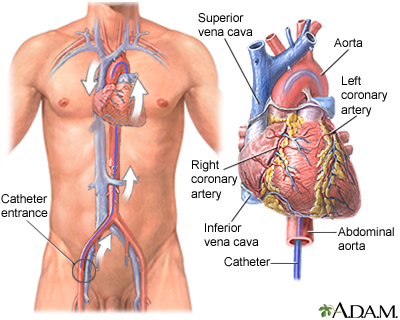
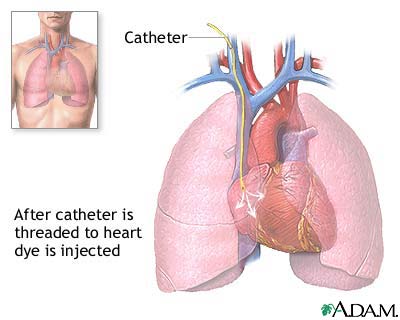
Cardiac catheterization involves passing a thin flexible tube (catheter) into the right or left side of the heart. The catheter is most often inserted from the groin or the arm.
Images
I Would Like to Learn About:
How the Test is Performed
You will get medicine before the test to help you relax.
A member of the team doing this procedure will clean a site on your arm, neck, or groin and insert a small catheter into one of your veins. This is called an intravenous (IV) line.
A larger thin plastic tube called a sheath is placed into a vein or artery in your leg or arm. Then longer plastic tubes called catheters are carefully moved up into the heart using live x-rays (fluoroscopy) as a guide. Then the doctor (usually a cardiologist or heart specialist) doing the cardiac catheterization can:
- Collect blood samples from the heart
- Measure pressure and blood flow in the heart's chambers and in the large arteries around the heart
- Measure the oxygen levels in different parts of your heart
- Examine the arteries of the heart
- Perform a biopsy of the heart muscle
For some procedures, you may be injected with a dye that helps your doctor to visualize the structures and vessels within the heart.
If you have a blockage of one of the heart arteries, you may have angioplasty and a stent placed during the procedure.
The test may last 30 to 60 minutes. If you also need special procedures, the test may take longer. If the catheter is placed in your groin, you will often be asked to lie flat on your back for a few to several hours after the test to avoid bleeding.
You will be told how to take care of yourself when you go home after the procedure is done.
How to Prepare for the Test
You should not eat or drink for 6 to 8 hours before the test. The test takes place in a hospital or specialized procedure unit and you will be asked to wear a hospital gown. Sometimes, you will need to spend the night before or after the test in the hospital. Otherwise, you will come to the hospital the morning of the procedure.
Your doctor will explain the procedure and its risks. A witnessed, signed consent form for the procedure is required.
Tell your doctor if you:
- Are allergic to seafood or any medicines
- Have had a bad reaction to contrast dye or iodine in the past
- Take any medicines, including Viagra or other medicines for erectile dysfunction
- Might be pregnant
How the Test will Feel
The test is done by cardiologists and a trained health care team.
You will be awake and able to follow instructions during the test.
You may feel some discomfort or pressure where the catheter is placed. You may have some discomfort from lying still during the test or from lying flat on your back after the procedure.
Why the Test is Performed
This procedure is most often done to get information about the heart or its blood vessels. It may also be done to treat some types of heart conditions or to find out if you need heart surgery.
Your doctor may perform cardiac catheterization to diagnose or evaluate:
- Causes of congestive heart failure or cardiomyopathy
- Coronary artery disease
- Heart defects that are present at birth (congenital)
- High blood pressure in the lungs (pulmonary hypertension)
- Problems with the heart valves
The following procedures may also be done using cardiac catheterization:
- Repair certain types of heart defects
- Open a narrowed (stenotic) heart valve (valvuloplasty)
- Open blocked arteries or grafts in the heart (angioplasty with or without stenting)
Risks
Cardiac catheterization carries a slightly higher risk than other heart tests. However, it is very safe when done by an experienced team.
The risks include:
- Cardiac tamponade
- Heart attack
- Injury to a coronary artery
- Irregular heartbeat
- Low blood pressure
- Reaction to the contrast dye
- Stroke
Possible complications of any type of catheterization include the following:
- Bleeding, infection, and pain at the IV or sheath insertion site
- Damage to the blood vessels
- Blood clots
- Kidney damage due to the contrast dye (more common in people with diabetes or kidney problems)
Related Information
X-rayStable angina
Aneurysm
Pulmonary hypertension
Pulmonic valve stenosis
Pulmonary veno-occlusive disease
Tetralogy of Fallot
Transposition of the great arteries
Tricuspid regurgitation
Ventricular septal defect
Cardiac intravascular ultrasound
References
Dangas GD, Mehran R. Coronary angiography and intravascular imaging. In: Bonow RO, Mann DL, Tomaselli GF, et al, eds. Braunwald's Heart Disease: A Textbook of Cardiovascular Medicine. 13th ed. Philadelphia, PA: Elsevier; 2026:chap 19.
Kern MJ, Seto AH. Invasive hemodynamic diagnosis of cardiac disease. In: Bonow RO, Mann DL, Tomaselli GF, et al, eds. Braunwald's Heart Disease: A Textbook of Cardiovascular Medicine. 13th ed. Philadelphia, PA: Elsevier; 2026:chap 20.
Kumbhani DJ, Bhatt DL. Percutaneous coronary intervention. In: Bonow RO, Mann DL, Tomaselli GF, et al, eds. Braunwald's Heart Disease: A Textbook of Cardiovascular Medicine. 13th ed. Philadelphia, PA: Elsevier; 2026:chap 38.
Teirstein PS, Kirtane AJ. Interventional diagnosis and treatment of coronary artery disease. In: Goldman L, Cooney KA, eds. Goldman-Cecil Medicine. 27th ed. Philadelphia, PA: Elsevier; 2024:chap 59.
BACK TO TOPReview Date: 4/28/2026
Reviewed By: Michael A. Chen, MD, PhD, Associate Professor of Medicine, Division of Cardiology, Harborview Medical Center, University of Washington Medical School, Seattle, WA. Also reviewed by David C. Dugdale, MD, Medical Director, Brenda Conaway, Editorial Director, and the A.D.A.M. Editorial team.
 | A.D.A.M., Inc. is accredited by URAC, for Health Content Provider (www.urac.org). URAC's accreditation program is an independent audit to verify that A.D.A.M. follows rigorous standards of quality and accountability. A.D.A.M. is among the first to achieve this important distinction for online health information and services. Learn more about A.D.A.M.'s editorial policy, editorial process and privacy policy. A.D.A.M. is also a founding member of Hi-Ethics. This site complies with the HONcode standard for trustworthy health information: verify here. |
The information provided herein should not be used during any medical emergency or for the diagnosis or treatment of any medical condition. A licensed medical professional should be consulted for diagnosis and treatment of any and all medical conditions. Links to other sites are provided for information only -- they do not constitute endorsements of those other sites. No warranty of any kind, either expressed or implied, is made as to the accuracy, reliability, timeliness, or correctness of any translations made by a third-party service of the information provided herein into any other language.
© 1997-
2026 A.D.A.M., a business unit of Ebix, Inc. Any duplication or distribution of the information contained herein is strictly prohibited.
All content on this site including text, images, graphics, audio, video, data, metadata, and compilations is protected by copyright and other intellectual property laws. You may view the content for personal, noncommercial use. Any other use requires prior written consent from Ebix. You may not copy, reproduce, distribute, transmit, display, publish, reverse-engineer, adapt, modify, store beyond ordinary browser caching, index, mine, scrape, or create derivative works from this content. You may not use automated tools to access or extract content, including to create embeddings, vectors, datasets, or indexes for retrieval systems. Use of any content for training, fine-tuning, calibrating, testing, evaluating, or improving AI systems of any kind is prohibited without express written consent. This includes large language models, machine learning models, neural networks, generative systems, retrieval-augmented systems, and any software that ingests content to produce outputs. Any unauthorized use of the content including AI-related use is a violation of our rights and may result in legal action, damages, and statutory penalties to the fullest extent permitted by law. Ebix reserves the right to enforce its rights through legal, technological, and contractual measures.
