

Health Library
Wine and heart health
Health and wine; Wine and heart disease; Preventing heart disease - wine; Preventing heart disease - alcohol
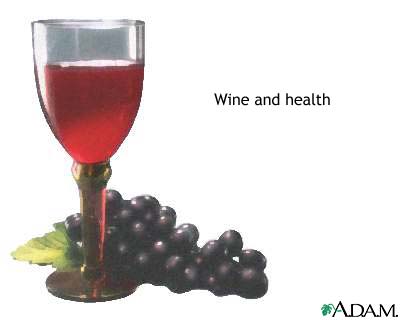
Some studies have shown that adults who drink light to moderate amounts of alcohol may be less likely to develop heart disease than those who do not drink at all or are heavy drinkers. However, people who do not drink alcohol should not start just because they want to avoid developing heart disease. In fact, drinking too much alcohol can be bad for your heart health. Even one drink a day can raise blood pressure.
The American Heart Association also says that no one should drink alcohol for the reason of improving their health.
Images
I Would Like to Learn About:
Information
There is a fine line between healthy drinking and risky drinking. Do not begin drinking or drink more often with the intention of lowering your risk of heart disease. This does not work. Heavier drinking can harm the heart and liver. Heart disease is the leading cause of death in people who drink too much alcohol.
Health care providers recommend that if you drink alcohol, drink only light to moderate amounts:
- For men, limit alcohol to 1 to 2 drinks a day.
- For women, limit alcohol to 1 drink a day.
One drink is defined as:
- 5 ounces (150 milliliters, mL) of wine
- 12 ounces (360 mL) of beer
- 1 1/2 ounces (45 mL) of 80-proof spirits
There are much more effective ways to prevent heart disease, including:
- Controlling blood pressure and cholesterol
- Getting at least 150 minutes (2.5 hours) of aerobic exercise every week
- Following a healthy diet with a variety of vegetables and fruits, whole grains, lean proteins, healthy oils, little to no added sugar and sodium, and little or no alcohol
- Not smoking
- Maintaining an ideal weight
Anyone who has heart disease or heart failure should talk to their provider before drinking alcohol. Alcohol can make heart failure and other heart problems worse.
References
American Heart Association website. The American Heart Association diet and lifestyle recommendations. www.heart.org/en/healthy-living/healthy-eating/eat-smart/nutrition-basics/aha-diet-and-lifestyle-recommendations. Updated March 31, 2026. Accessed April 21, 2026.
Dietary guidelines for Americans 2025-2030. realfood.gov. Accessed May 7, 2026.
McLean, RC Goldberg LR. Cardiovascular effects of drugs and toxins. In: Bonow RO, Mann DL, Tomaselli GF, et al, eds. Braunwald's Heart Disease: A Textbook of Cardiovascular Medicine. 13th ed. Philadelphia, PA: Elsevier; 2026:chap 90.
Mora S, Libby P, Ridker PM. Primary prevention of cardiovascular disease. In: Bonow RO, Mann DL, Tomaselli GF, et al, eds. Braunwald's Heart Disease: A Textbook of Cardiovascular Medicine. 13th ed. Philadelphia, PA: Elsevier; 2026:chap 23.
BACK TO TOPReview Date: 4/10/2026
Reviewed By: Linda J. Vorvick, MD, Clinical Professor Emeritus, Department of Family Medicine, UW Medicine, School of Medicine, University of Washington, Seattle, WA. Also reviewed by David C. Dugdale, MD, Medical Director, Brenda Conaway, Editorial Director, and the A.D.A.M. Editorial team.
 | A.D.A.M., Inc. is accredited by URAC, for Health Content Provider (www.urac.org). URAC's accreditation program is an independent audit to verify that A.D.A.M. follows rigorous standards of quality and accountability. A.D.A.M. is among the first to achieve this important distinction for online health information and services. Learn more about A.D.A.M.'s editorial policy, editorial process and privacy policy. A.D.A.M. is also a founding member of Hi-Ethics. This site complies with the HONcode standard for trustworthy health information: verify here. |
The information provided herein should not be used during any medical emergency or for the diagnosis or treatment of any medical condition. A licensed medical professional should be consulted for diagnosis and treatment of any and all medical conditions. Links to other sites are provided for information only -- they do not constitute endorsements of those other sites. No warranty of any kind, either expressed or implied, is made as to the accuracy, reliability, timeliness, or correctness of any translations made by a third-party service of the information provided herein into any other language.
© 1997-
2026 A.D.A.M., a business unit of Ebix, Inc. Any duplication or distribution of the information contained herein is strictly prohibited.
All content on this site including text, images, graphics, audio, video, data, metadata, and compilations is protected by copyright and other intellectual property laws. You may view the content for personal, noncommercial use. Any other use requires prior written consent from Ebix. You may not copy, reproduce, distribute, transmit, display, publish, reverse-engineer, adapt, modify, store beyond ordinary browser caching, index, mine, scrape, or create derivative works from this content. You may not use automated tools to access or extract content, including to create embeddings, vectors, datasets, or indexes for retrieval systems. Use of any content for training, fine-tuning, calibrating, testing, evaluating, or improving AI systems of any kind is prohibited without express written consent. This includes large language models, machine learning models, neural networks, generative systems, retrieval-augmented systems, and any software that ingests content to produce outputs. Any unauthorized use of the content including AI-related use is a violation of our rights and may result in legal action, damages, and statutory penalties to the fullest extent permitted by law. Ebix reserves the right to enforce its rights through legal, technological, and contractual measures.
