

Health Library
Takayasu arteritis
Pulseless disease; Large-vessel vasculitis
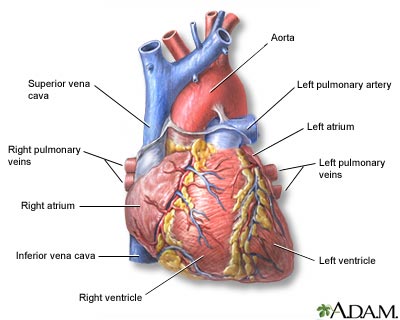
Takayasu arteritis is an inflammation of large arteries such as the aorta and its major branches. The aorta is the artery that carries blood from the heart to the rest of the body.
Images
I Would Like to Learn About:
Causes
The cause of Takayasu arteritis is not known. The disease occurs mainly in women between the ages of 20 and 40 years old. It is more common in people of East Asian, Indian or Mexican descent. However, it is now being seen more often in other parts of the world. Several genes that increase the chance of having this problem were recently found.
Takayasu arteritis appears to be an autoimmune condition. This means the body's immune system mistakenly attacks healthy tissue in the blood vessel wall. The condition may also involve other organ systems.
This condition has many features that are similar to giant cell arteritis or temporal arteritis in older people.
Symptoms
Symptoms may include:
- Arm weakness or pain with use
- Chest pain
- Dizziness
- Fatigue
- Fever
- Lightheadedness
- Muscle or joint pain
- Skin rash
- Night sweats
- Vision changes
- Weight loss
- Decreased radial pulses (at the wrist)
- Difference in blood pressure between the two arms
- High blood pressure (hypertension)
There may also be signs of inflammation (pericarditis or pleuritis).
Exams and Tests
There is no blood test available to make a definite diagnosis. The diagnosis is made when a person has symptoms and imaging tests show blood vessel abnormalities suggesting inflammation.
Possible tests include:
- Angiogram, including coronary angiography
- Complete blood count (CBC)
- C-reactive protein (CRP)
- Electrocardiogram (ECG)
- Erythrocyte sedimentation rate (ESR)
- Magnetic resonance angiography (MRA)
- Magnetic resonance imaging (MRI)
- Computed tomography angiography (CTA)
- Positron emission tomography (PET)
- Ultrasound
- X-ray of the chest
Treatment
Treatment of Takayasu arteritis is difficult. However, people who have the right treatment can improve. It is important to identify the condition early. The disease tends to be chronic, requiring long-term use of anti-inflammatory medicines.
MEDICINES
Most people are first treated with high doses of corticosteroids such as prednisone. As the disease is controlled the dose of prednisone is decreased.
In almost all cases, immunosuppressive medicines are added to reduce the need for long-term use of corticosteroids and yet maintain control of the disease.
Conventional immunosuppressive medicines such as methotrexate, azathioprine, mycophenolate, cyclophosphamide, or leflunomide are often added.
Biologic medicines may also be effective. These include TNF inhibitors such as infliximab, etanercept, and tocilizumab.
SURGERY
Surgery or angioplasty may be used to open up narrowed arteries to supply blood or open up the constriction.
Aortic valve replacement may be needed in some cases.
Outlook (Prognosis)
This disease can be fatal without treatment. However, a combined treatment approach using medicines and surgery has reduced death rates. Adults have a better chance of survival than children.
Possible Complications
Complications may include:
- Blood clot
- Heart attack
- Heart failure
- Pericarditis
- Aortic valve insufficiency
- Pleuritis
- Stroke
- Gastrointestinal bleeding or pain from blockage of bowel blood vessels
When to Contact a Medical Professional
Contact your health care provider if you have symptoms of this condition. Immediate care is needed if you have:
- Weak pulse
- Chest pain
- Breathing difficulty
Related Information
PulseAneurysm
Systemic
Pleurisy
Pericarditis
Heart attack
References
Beckman JA. Diseases of the aorta. In: Goldman L, Cooney KA, eds. Goldman-Cecil Medicine. 27th ed. Philadelphia, PA: Elsevier; 2024:chap 63.
Ehlert BA. Takayasu disease. In: Sidawy AN, Perler BA, eds. Rutherford's Vascular Surgery and Endovascular Therapy. 10th ed. Philadelphia, PA: Elsevier; 2023:chap 140.
Miller JB, Hellmann DB. Giant cell arteritis, polymyalgia rheumatica, and Takayasu's arteritis. In: Firestein GS, McInnes IB, Koretzky GA, Mikuls TR, Neogi T, O'Dell JR, eds. Firestein & Kelley's Textbook of Rheumatology. 12th ed. Philadelphia, PA: Elsevier; 2025:chap 89.
BACK TO TOPReview Date: 10/9/2025
Reviewed By: Diane M. Horowitz, MD, Rheumatology and Internal Medicine, Northwell Health, Great Neck, NY. Review provided by VeriMed Healthcare Network. Also reviewed by David C. Dugdale, MD, Medical Director, Brenda Conaway, Editorial Director, and the A.D.A.M. Editorial team.
 | A.D.A.M., Inc. is accredited by URAC, for Health Content Provider (www.urac.org). URAC's accreditation program is an independent audit to verify that A.D.A.M. follows rigorous standards of quality and accountability. A.D.A.M. is among the first to achieve this important distinction for online health information and services. Learn more about A.D.A.M.'s editorial policy, editorial process and privacy policy. A.D.A.M. is also a founding member of Hi-Ethics. This site complies with the HONcode standard for trustworthy health information: verify here. |
The information provided herein should not be used during any medical emergency or for the diagnosis or treatment of any medical condition. A licensed medical professional should be consulted for diagnosis and treatment of any and all medical conditions. Links to other sites are provided for information only -- they do not constitute endorsements of those other sites. No warranty of any kind, either expressed or implied, is made as to the accuracy, reliability, timeliness, or correctness of any translations made by a third-party service of the information provided herein into any other language.
© 1997-
2026 A.D.A.M., a business unit of Ebix, Inc. Any duplication or distribution of the information contained herein is strictly prohibited.
All content on this site including text, images, graphics, audio, video, data, metadata, and compilations is protected by copyright and other intellectual property laws. You may view the content for personal, noncommercial use. Any other use requires prior written consent from Ebix. You may not copy, reproduce, distribute, transmit, display, publish, reverse-engineer, adapt, modify, store beyond ordinary browser caching, index, mine, scrape, or create derivative works from this content. You may not use automated tools to access or extract content, including to create embeddings, vectors, datasets, or indexes for retrieval systems. Use of any content for training, fine-tuning, calibrating, testing, evaluating, or improving AI systems of any kind is prohibited without express written consent. This includes large language models, machine learning models, neural networks, generative systems, retrieval-augmented systems, and any software that ingests content to produce outputs. Any unauthorized use of the content including AI-related use is a violation of our rights and may result in legal action, damages, and statutory penalties to the fullest extent permitted by law. Ebix reserves the right to enforce its rights through legal, technological, and contractual measures.
