

Health Library
Hypervitaminosis A
Vitamin A toxicity
Hypervitaminosis A is a disorder in which there is too much vitamin A in the body.
Images
I Would Like to Learn About:
Causes
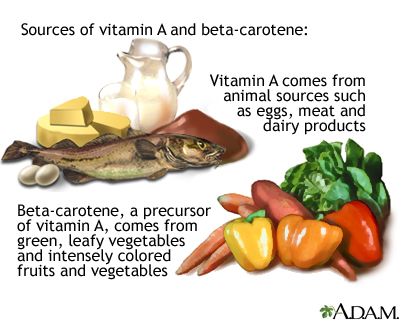
Vitamin A is a fat-soluble vitamin that is stored in the liver. Many foods contain vitamin A, including:
- Meat, fish, and egg yolks
- Dairy products
- Some fruits and vegetables
Some dietary supplements also contain vitamin A.
Taking too many supplements is the most common cause of vitamin A toxicity. It only rarely occurs just from eating vitamin A-rich foods.
Too much vitamin A can make you sick. Taking large doses during pregnancy can cause birth defects.
- Acute vitamin A poisoning occurs quickly. It can happen when an adult takes several hundred thousand international units (IUs) of vitamin A.
- Chronic vitamin A poisoning may occur over time in adults who regularly take more than 50,000 IUs a day.
- Babies and children are more sensitive to vitamin A. They can become sick after taking smaller doses of it (20,000 IUs a day for children). Swallowing products that contain vitamin A, such as skin cream with retinol in it, can also cause vitamin A poisoning.
Symptoms
Symptoms may include:
- Abnormal softening of the skull bone (in infants and children)
- Blurred vision
- Bone pain or swelling
- Bulging of the soft spot in an infant's skull (fontanelle)
- Changes in alertness or consciousness
- Decreased appetite
- Dizziness
- Double vision (in young children)
- Drowsiness
- Hair changes, such as hair loss and oily hair
- Headache
- Irritability
- Liver damage
- Nausea and vomiting
- Poor weight gain (in infants and children)
- Skin changes, such as cracking at corners of the mouth, higher sensitivity to sunlight, oily skin, peeling, itching, and yellow color to the skin
- Vision changes
Exams and Tests
These tests may be done if a high vitamin A level is suspected:
- Bone x-rays
- Blood calcium test
- Cholesterol test
- Liver function test
- Blood test to check vitamin A level
- Blood test to check other vitamin levels
Treatment
The treatment involves simply stopping supplements (or in rare cases, foods) that contain vitamin A.
Outlook (Prognosis)
Most people fully recover.
Possible Complications
Complications can include:
- Very high blood calcium level
- Faltering weight (in infants)
- Kidney damage due to high calcium
- Liver damage
Taking too much vitamin A during pregnancy may cause birth defects. Talk to your health care provider about eating a proper diet while you are pregnant.
When to Contact a Medical Professional
You should contact your provider:
- If you think that you or your child may have taken too much vitamin A
- You have symptoms of excess vitamin A
Prevention
How much vitamin A you need depends on your age and sex. Other factors, such as pregnancy and your overall health, are also important. Ask your provider what amount is best for you.
To avoid hypervitaminosis A, don't take more than the recommended daily allowance of this vitamin. Check the ingredients of all your medicines to be sure you are not taking vitamin A from more than one source.
Some people take vitamin A and beta carotene supplements in the belief it will help prevent cancer. This may lead to chronic hypervitaminosis A if people take more than is recommended.
Related Information
Vitamin ABrain tumor - children
Idiopathic intracranial hypertension
Vision problems
Nausea and vomiting – adults
Drowsiness
Chronic
Bone pain or tenderness
Appetite - decreased
Weight gain – unintentional
Seborrheic dermatitis
Increased intracranial pressure
Faltering weight
Osteoporosis
References
James WD. Nutritional diseases. In: James WD, ed. Andrews' Diseases of the Skin. 14th ed. Philadelphia, PA: Elsevier; 2026:chap 17.
Mason JB, Booth SL. Vitamins, trace minerals, and other micronutrients. In: Goldman L, Cooney KA, eds. Goldman-Cecil Medicine. 27th ed. Philadelphia, PA: Elsevier; 2024:chap 199.
Office of Disease Prevention and Health Promotion website. Dietary reference intakes. odphp.health.gov/our-work/nutrition-physical-activity/dietary-guidelines/dietary-reference-intakes. Updated November 19, 2025. Accessed February 18, 2026.
Sodi R. Vitamins and trace elements. In: Rifai N, Chiu RWK, Young I, Burnham Carey-Ann D, Wittwer CT, eds. Tietz Textbook of Laboratory Medicine. 7th ed. St Louis, MO: Elsevier; 2023:chap 39.
Tan L, Ross C. Vitamin A deficiencies and excess. In: Kliegman RM, St. Geme JW, Blum NJ, et al, eds. Nelson Textbook of Pediatrics. 22nd ed. Philadelphia, PA: Elsevier; 2025:chap 66.
BACK TO TOPReview Date: 1/25/2026
Reviewed By: Sandeep K. Dhaliwal, MD, board-certified in Diabetes, Endocrinology, and Metabolism, Springfield, VA. Also reviewed by David C. Dugdale, MD, Medical Director, Brenda Conaway, Editorial Director, and the A.D.A.M. Editorial team.
 | A.D.A.M., Inc. is accredited by URAC, for Health Content Provider (www.urac.org). URAC's accreditation program is an independent audit to verify that A.D.A.M. follows rigorous standards of quality and accountability. A.D.A.M. is among the first to achieve this important distinction for online health information and services. Learn more about A.D.A.M.'s editorial policy, editorial process and privacy policy. A.D.A.M. is also a founding member of Hi-Ethics. This site complies with the HONcode standard for trustworthy health information: verify here. |
The information provided herein should not be used during any medical emergency or for the diagnosis or treatment of any medical condition. A licensed medical professional should be consulted for diagnosis and treatment of any and all medical conditions. Links to other sites are provided for information only -- they do not constitute endorsements of those other sites. No warranty of any kind, either expressed or implied, is made as to the accuracy, reliability, timeliness, or correctness of any translations made by a third-party service of the information provided herein into any other language.
© 1997-
2026 A.D.A.M., a business unit of Ebix, Inc. Any duplication or distribution of the information contained herein is strictly prohibited.
All content on this site including text, images, graphics, audio, video, data, metadata, and compilations is protected by copyright and other intellectual property laws. You may view the content for personal, noncommercial use. Any other use requires prior written consent from Ebix. You may not copy, reproduce, distribute, transmit, display, publish, reverse-engineer, adapt, modify, store beyond ordinary browser caching, index, mine, scrape, or create derivative works from this content. You may not use automated tools to access or extract content, including to create embeddings, vectors, datasets, or indexes for retrieval systems. Use of any content for training, fine-tuning, calibrating, testing, evaluating, or improving AI systems of any kind is prohibited without express written consent. This includes large language models, machine learning models, neural networks, generative systems, retrieval-augmented systems, and any software that ingests content to produce outputs. Any unauthorized use of the content including AI-related use is a violation of our rights and may result in legal action, damages, and statutory penalties to the fullest extent permitted by law. Ebix reserves the right to enforce its rights through legal, technological, and contractual measures.
