

Health Library
Vitamin A blood test
Retinol test
The vitamin A test measures the level of vitamin A in the blood.
Images
I Would Like to Learn About:
How the Test is Performed
How to Prepare for the Test
Follow your health care provider's instructions about not eating or drinking anything for up to 24 hours before the test.
How the Test will Feel
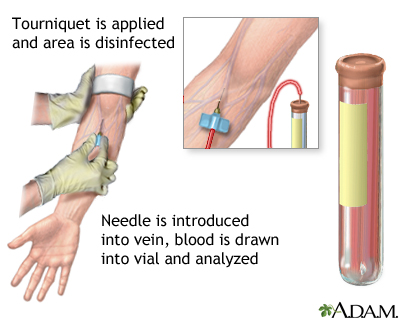
When the needle is inserted to draw blood, some people feel moderate pain. Others feel only a prick or stinging. Afterwards, there may be some throbbing or slight bruising. This soon goes away.
Why the Test is Performed
This test is done to check if you have too much or too little vitamin A in your blood. (This is unusual in the United States.)
Normal Results
Normal values range from 30 to 120 micrograms per deciliter (mcg/dL) or 1.1 to 4.2 micromoles per liter (micromol/L).
Normal value ranges may vary slightly among different labs. Some labs use different measurements or test different samples. Talk to your provider about the meaning of your specific test results.
What Abnormal Results Mean
A lower than normal value means you do not have enough vitamin A in your blood. This may cause:
- Bones or teeth that do not develop correctly
- Dry or inflamed eyes
- Feeling more irritable
- Hair loss
- Loss of appetite
- Night blindness
- Recurring infections
- Skin rashes
A higher than normal value means you have excess vitamin A in your blood (toxic levels). This may cause:
- Anemia
- Bone and muscle pain
- Diarrhea
- Double vision
- Hair loss
- Increased pressure in the brain (pseudotumor cerebri)
- Lack of muscle coordination (ataxia)
- Liver and spleen enlargement
- Loss of appetite
- Nausea
Vitamin A deficiency may occur if your body has trouble absorbing fats through the digestive tract. This may occur if you have:
- Chronic lung disease called cystic fibrosis
- Pancreas problems, such as swelling and inflammation (pancreatitis) or the organ not producing enough enzymes (pancreatic insufficiency)
- Small intestine disorders that reduce nutrient absorption, such as celiac disease
Risks
There is little risk involved with having your blood taken. Veins and arteries vary in size from one person to another and from one side of the body to the other. Taking blood from some people may be more difficult than from others.
Other risks associated with having blood drawn are slight but may include:
- Excessive bleeding
- Fainting or feeling lightheaded
- Hematoma (blood accumulating under the skin)
- Infection (a slight risk any time the skin is broken)
- Multiple punctures to locate veins
Related Information
Beta-carotene blood testVitamin A
Malabsorption
Celiac disease - sprue
Vision - night blindness
References
Markell M, Siddiqui HA. Vitamins and trace elements. In: McPherson RA, Pincus MR, eds. Henry's Clinical Diagnosis and Management by Laboratory Methods. 24th ed. Philadelphia, PA: Elsevier; 2022:chap 27.
Mason JB, Booth SL. Vitamins, trace minerals, and other micronutrients. In: Goldman L, Cooney KA, eds. Goldman-Cecil Medicine. 27th ed. Philadelphia, PA: Elsevier; 2024:chap 210.
Tan L, Ross AC. Vitamin A deficiencies and excess. In: Kliegman RM, St. Geme JW, Blum NJ, et al, eds. Nelson Textbook of Pediatrics. 22nd ed. Philadelphia, PA: Elsevier; 2025:chap 66.
BACK TO TOPReview Date: 10/1/2025
Reviewed By: Frank D. Brodkey , MD, FCCM, Associate Professor, Section of Pulmonary and Critical Care Medicine, University of Wisconsin School of Medicine and Public Health, Madison, WI. Also reviewed by David C. Dugdale, MD, Medical Director, Brenda Conaway, Editorial Director, and the A.D.A.M. Editorial team.
 | A.D.A.M., Inc. is accredited by URAC, for Health Content Provider (www.urac.org). URAC's accreditation program is an independent audit to verify that A.D.A.M. follows rigorous standards of quality and accountability. A.D.A.M. is among the first to achieve this important distinction for online health information and services. Learn more about A.D.A.M.'s editorial policy, editorial process and privacy policy. A.D.A.M. is also a founding member of Hi-Ethics. This site complies with the HONcode standard for trustworthy health information: verify here. |
The information provided herein should not be used during any medical emergency or for the diagnosis or treatment of any medical condition. A licensed medical professional should be consulted for diagnosis and treatment of any and all medical conditions. Links to other sites are provided for information only -- they do not constitute endorsements of those other sites. No warranty of any kind, either expressed or implied, is made as to the accuracy, reliability, timeliness, or correctness of any translations made by a third-party service of the information provided herein into any other language.
© 1997-
2026 A.D.A.M., a business unit of Ebix, Inc. Any duplication or distribution of the information contained herein is strictly prohibited.
All content on this site including text, images, graphics, audio, video, data, metadata, and compilations is protected by copyright and other intellectual property laws. You may view the content for personal, noncommercial use. Any other use requires prior written consent from Ebix. You may not copy, reproduce, distribute, transmit, display, publish, reverse-engineer, adapt, modify, store beyond ordinary browser caching, index, mine, scrape, or create derivative works from this content. You may not use automated tools to access or extract content, including to create embeddings, vectors, datasets, or indexes for retrieval systems. Use of any content for training, fine-tuning, calibrating, testing, evaluating, or improving AI systems of any kind is prohibited without express written consent. This includes large language models, machine learning models, neural networks, generative systems, retrieval-augmented systems, and any software that ingests content to produce outputs. Any unauthorized use of the content including AI-related use is a violation of our rights and may result in legal action, damages, and statutory penalties to the fullest extent permitted by law. Ebix reserves the right to enforce its rights through legal, technological, and contractual measures.
