

How to use an inhaler - no spacer
Metered-dose inhaler (MDI) administration - no spacer; Bronchial nebulizer; Wheezing - nebulizer; Reactive airway - nebulizer; COPD - nebulizer; Chronic bronchitis - nebulizer; Emphysema - nebulizer
Using a metered-dose inhaler (MDI) seems simple. But many people do not use them the best way. If you use your MDI the wrong way, less medicine gets to your lungs, and most remains in the back of your mouth. If you have a spacer, use it. It helps get more medicine into your airways.
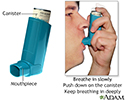
MDIs usually have 3 parts:
- A mouthpiece
- A cap that goes over the mouthpiece
- A canister full of medicine
(The instructions below are not for dry powder inhalers. They have different instructions.)
Getting Ready
- If you have not used the inhaler in a while, you may need to prime it. See the instructions that came with your inhaler for when and how to do this.
- Take the cap off the inhaler.
- Look inside the mouthpiece and make sure there is nothing in it.
- Shake the inhaler hard 10 to 15 times before each use.
- Breathe out gently to empty your lungs. Try to push out as much air as you can.
Breathe in Slowly
- Hold the inhaler with the mouthpiece down. Place your lips around the mouthpiece so that you form a tight seal.
- As you start to slowly breathe in through your mouth, press down on the inhaler one time.
- Keep breathing in slowly, as deeply as you can.
Hold Your Breath
- Take the inhaler out of your mouth. If you can, hold your breath as you slowly count to 10. This lets the medicine reach deep into your lungs.
- Pucker your lips and breathe out slowly through your mouth.
- If you are using inhaled, quick-relief medicine (beta-agonists), wait 1 to 2 minutes before you take your next puff. You do not need to wait between puffs for other medicines.
- Put the cap back on the mouthpiece and make sure it is firmly closed.
- After using your inhaler, rinse your mouth with water, gargle, and spit. Do not swallow the water. This helps reduce side effects from your medicine.

Keep Your Inhaler Clean
Look at the hole where the medicine sprays out of your inhaler. If you see powder in or around the hole, clean your inhaler.
- Remove the metal canister from the L-shaped plastic mouthpiece.
- Rinse only the mouthpiece and cap in warm water.
- Let them air-dry overnight.
- In the morning, put the canister back inside. Put the cap on.
- Do not rinse any other parts.
Replacing Your Inhaler
Many inhalers come with counters on the canister. Keep an eye on the counter and replace the inhaler before you run out of medicine.
Do not put your canister in water to see if it is empty. This does not work.
Bring your inhaler to your clinic appointments. Your health care provider can make sure you are using it the right way.
Storing Your Inhaler
Store your inhaler at room temperature. It may not work well if it is too cold. The medicine in the canister is under pressure. So, make sure you do not get it too hot or puncture it.
References
Laube BL, Dolovich MB. Aerosols and aerosol drug delivery systems. In: Burks AW, Holgate ST, O'Hehir RE, et al, eds. Middleton's Allergy Principles and Practice. 9th ed. Philadelphia, PA: Elsevier; 2020:chap 63.
Lugogo N, Que LG, Carr TF, Kraft M. Asthma: diagnosis and management. In: Broaddus VC, Ernst JD, King TE, et al, eds. Murray and Nadel's Textbook of Respiratory Medicine. 7th ed. Philadelphia, PA: Elsevier; 2022:chap 62.
National Heart, Lung, and Blood Institute website. How to use a metered-dose inhaler fact sheet. www.nhlbi.nih.gov/resources/how-use-metered-dose-inhaler-fact-sheet. Updated October 2021. Accessed March 11, 2026.
Waller DG. Asthma and chronic obstructive pulmonary disease. In: Waller DG, ed. Medical Pharmacology and Therapeutics. 6th ed. Philadelphia, PA: Elsevier; 2022:chap 12.
Review Date: 2/27/2026
Reviewed By: Jacob Berman, MD, MPH, Associate Professor of Medicine, Division of General Internal Medicine, University of Washington School of Medicine, Seattle, WA. Also reviewed by David C. Dugdale, MD, Medical Director, Brenda Conaway, Editorial Director, and the A.D.A.M. Editorial team.
© 1997- A.D.A.M., a business unit of Ebix, Inc. Any duplication or distribution of the information contained herein is strictly prohibited.
 All rights reserved.