

Total protein
The total protein test measures the total amount of two classes of proteins found in the fluid portion of your blood. These are albumin and globulin.
Proteins are important parts of all cells and tissues.
- Albumin helps prevent fluid from leaking out of blood vessels. It also carries chemicals in your blood.
- Globulins are an important part of your immune system.
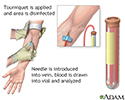
A blood sample is needed. Most of the time blood is drawn from a vein located on the inside of the elbow or the back of the hand.

How to Prepare for the Test
Many medicines can interfere with blood test results.
- Your health care provider will tell you if you need to stop taking any medicines before you have this test.
- DO NOT stop or change your medicines without talking to your provider first.
Why the Test is Performed
This test is often done to diagnose nutritional problems, kidney disease or liver disease.

If total protein is abnormal, you may need more tests to look for the exact cause of the problem.
Normal Results
The normal range is 6.5 to 8.1 grams per deciliter (g/dL) or 65 to 81 g/L.
Normal value ranges may vary slightly among different laboratories. Talk to your provider about the meaning of your specific test results.
The examples above show the common measurements for results for these tests. Some laboratories use different measurements or may test different specimens.
What Abnormal Results Mean
Higher-than-normal levels may be due to:
- Chronic inflammation or infection, including HIV and hepatitis B or C
- Multiple myeloma
- Waldenström disease


Lower-than-normal levels may be due to:
- Agammaglobulinemia
- Bleeding (hemorrhage)
- Burns (extensive)
- Glomerulonephritis
- Liver disease
- Malabsorption
- Malnutrition
- Nephrotic syndrome
- Protein-losing enteropathy


Considerations
Total protein measurement may be increased during pregnancy.
References
Gharavi AG, Landry DW. Approach to the patient with renal disease. In: Goldman L, Cooney KA, eds. Goldman-Cecil Medicine. 27th ed. Philadelphia, PA: Elsevier; 2024:chap 100.
Manary MJ, Trehan I. Severe malnutrition. In: Goldman L, Cooney KA, eds. Goldman-Cecil Medicine. 27th ed. Philadelphia, PA: Elsevier; 2024:chap 197.
Pincus MR, Abraham NZ, Bluth M. Interpreting laboratory results. In: McPherson RA, Pincus MR, eds. Henry's Clinical Diagnosis and Management by Laboratory Methods. 24th ed. Philadelphia, PA: Elsevier; 2022:chap 9.
Review Date: 5/19/2025
Reviewed By: Jacob Berman, MD, MPH, Clinical Assistant Professor of Medicine, Division of General Internal Medicine, University of Washington School of Medicine, Seattle, WA. Also reviewed by David C. Dugdale, MD, Medical Director, Brenda Conaway, Editorial Director, and the A.D.A.M. Editorial team.
© 1997- A.D.A.M., a business unit of Ebix, Inc. Any duplication or distribution of the information contained herein is strictly prohibited.
 All rights reserved.