

Health Library
Blood differential test
Differential; Diff; White blood cell differential count
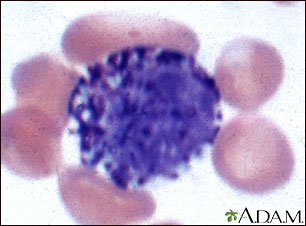
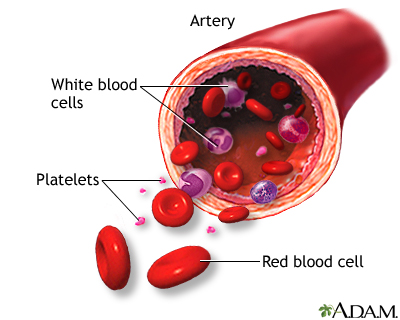
The blood differential test measures the percentage of each type of white blood cell (WBC) that you have in your blood. It also reveals if there are any abnormal or immature cells.
Images
Presentation

I Would Like to Learn About:
How the Test is Performed
A blood sample is needed.
A lab specialist takes a drop of blood from your sample and smears it onto a glass slide. The smear is stained with a special dye, which helps tell the difference between various types of white blood cells.
Five types of white blood cells, also called leukocytes, normally appear in the blood:
- Neutrophils
- Lymphocytes (B cells and T cells)
- Monocytes
- Eosinophils
- Basophils
A special machine counts the number of each type of cell. The test shows if the number of cells are in proper proportion with one another, and if there is more or less of one cell type.
How to Prepare for the Test
No special preparation is necessary.
How the Test will Feel
When the needle is inserted to draw blood, some people feel moderate pain. Others feel only a prick or stinging. Afterward, there may be some throbbing or slight bruising. This soon goes away.
Why the Test is Performed
This test is done to diagnose an infection, anemia, or leukemia. It may also be used to monitor one of these conditions or to see if treatment is working.
Normal Results
The different types of white blood cells are given as a percentage of all white cells:
- Neutrophils: 40% to 60%
- Lymphocytes: 20% to 40%
- Monocytes: 2% to 8%
- Eosinophils: 1% to 4%
- Basophils: 0.5% to 1%
- Band (young neutrophil): 0% to 3%
What Abnormal Results Mean
Any infection or acute stress increases your number of white blood cells. High white blood cell counts may be due to inflammation, an immune response, or blood diseases such as leukemia. Abnormal or immature white blood cells may indicate leukemia or bone marrow invasion by cancer or infection.
It is important to realize that an abnormal increase in one type of white blood cell can cause a decrease in the percentage of other types of white blood cells.
An increased percentage of neutrophils may be due to:
- Acute infection
- Inflammation
- Acute stress
- Eclampsia (seizures or coma in a pregnant woman)
- Gout (type of arthritis due to uric acid buildup in the blood)
- Acute or chronic forms of leukemia
- Myeloproliferative diseases
- Rheumatoid arthritis
- Rheumatic fever (disease due to an infection with group A streptococcus bacteria)
- Thyroiditis (a thyroid disease)
- Trauma
- Cigarette smoking
A decreased percentage of neutrophils may be due to:
- Aplastic anemia
- Chemotherapy
- Influenza (flu) or other viral infections
- Radiation therapy or exposure
- Widespread severe bacterial infection (sepsis)
An increased percentage of lymphocytes may be due to:
- Chronic bacterial infection
- Infectious hepatitis (liver swelling and inflammation from bacteria or viruses)
- Infectious mononucleosis, or mono (viral infection that causes fever, sore throat, and swollen lymph glands)
- Tuberculosis
- Lymphocytic leukemia (a type of blood cancer)
- Multiple myeloma (a type of blood cancer) causes an elevation in a type of white cell called plasma cells
- Viral infection (such as mumps or measles)
A decreased percentage of lymphocytes may be due to:
- Chemotherapy
- HIV/AIDS infection
- Leukemia
- Radiation therapy or exposure
- Sepsis (severe, inflammatory response to bacteria or other germs)
- Steroid use
- Aging
An increased percentage of monocytes may be due to:
- Chronic inflammatory disease
- Leukemia
- Parasitic infection
- Tuberculosis, or TB (bacterial infection that involves the lungs)
- Viral infection (for example, infectious mononucleosis, mumps, or measles)
An increased percentage of eosinophils may be due to:
- Addison disease (adrenal glands do not produce enough hormones)
- Allergic reaction
- Cancer
- Chronic myelogenous leukemia
- Collagen vascular disease
- Hypereosinophilic syndromes
- Parasitic infection
An increased percentage of basophils may be due to:
- After splenectomy
- Allergic reaction
- Chronic myelogenous leukemia (a type of bone marrow cancer)
- Collagen vascular disease
- Myeloproliferative diseases (group of bone marrow diseases)
- Chickenpox
A decreased percentage of basophils may be due to:
- Acute infection
- Cancer
- Severe injury
Risks
There is little risk involved with having your blood taken. Veins and arteries vary in size from one person to another, and from one side of the body to the other. Taking blood from some people may be more difficult than from others.
Other risks associated with having blood drawn are slight, but may include:
- Excessive bleeding
- Fainting or feeling lightheaded
- Multiple punctures to locate veins
- Hematoma (blood accumulating under the skin)
- Infection (a slight risk any time the skin is broken)
Related Information
CBC blood testEosinophil count - absolute
Anemia
Antibody
Protein in diet
Vasoconstriction
Acute
WBC count
Immune response
Eclampsia
Gout
Chronic myelogenous leukemia (CML)
Rheumatoid arthritis
Rheumatic fever
Chronic thyroiditis (Hashimoto disease)
Hemolytic anemia
Chemotherapy
Flu
Radiation therapy
Chronic
Hepatitis
Mononucleosis
Acute lymphoblastic leukemia (ALL)
Multiple myeloma
Mumps
Measles
Sepsis
Pulmonary tuberculosis
Allergic reactions
Hodgkin lymphoma
References
Bain BJ. The peripheral blood smear. In: Goldman L, Cooney KA , eds. Goldman-Cecil Medicine. 27th ed. Philadelphia, PA: Elsevier; 2024:chap 143.
Marcogliese AN, Hensch L. Resources for the hematologist: interpretive comments and selected reference values for neonatal, pediatric, and adult populations. In: Hoffman R, Benz EJ, Silberstein LE, et al, eds. Hematology: Basic Principles and Practice. 8th ed. Philadelphia, PA: Elsevier; 2023:chap 159.
Nasr MR, Hutchison RE. Leukocytic disorders. In: McPherson RA, Pincus MR, eds. Henry's Clinical Diagnosis and Management by Laboratory Methods. 24th ed. Philadelphia, PA: Elsevier; 2022:chap 34.
Tsai FD, Khanna-Gupta A, Berliner N. Granulocytopoiesis and monocytopoiesis. In: Hoffman R, Benz EJ, Silberstein LE, et al, eds. Hematology: Basic Principles and Practice. 8th ed. Philadelphia, PA: Elsevier; 2023:chap 28.
BACK TO TOPReview Date: 2/3/2025
Reviewed By: Warren Brenner, MD, Oncologist, Lynn Cancer Institute, Boca Raton, FL. Review provided by VeriMed Healthcare Network. Also reviewed by David C. Dugdale, MD, Medical Director, Brenda Conaway, Editorial Director, and the A.D.A.M. Editorial team.
 | A.D.A.M., Inc. is accredited by URAC, for Health Content Provider (www.urac.org). URAC's accreditation program is an independent audit to verify that A.D.A.M. follows rigorous standards of quality and accountability. A.D.A.M. is among the first to achieve this important distinction for online health information and services. Learn more about A.D.A.M.'s editorial policy, editorial process and privacy policy. A.D.A.M. is also a founding member of Hi-Ethics. This site complies with the HONcode standard for trustworthy health information: verify here. |
The information provided herein should not be used during any medical emergency or for the diagnosis or treatment of any medical condition. A licensed medical professional should be consulted for diagnosis and treatment of any and all medical conditions. Links to other sites are provided for information only -- they do not constitute endorsements of those other sites. No warranty of any kind, either expressed or implied, is made as to the accuracy, reliability, timeliness, or correctness of any translations made by a third-party service of the information provided herein into any other language.
© 1997-
2026 A.D.A.M., a business unit of Ebix, Inc. Any duplication or distribution of the information contained herein is strictly prohibited.
All content on this site including text, images, graphics, audio, video, data, metadata, and compilations is protected by copyright and other intellectual property laws. You may view the content for personal, noncommercial use. Any other use requires prior written consent from Ebix. You may not copy, reproduce, distribute, transmit, display, publish, reverse-engineer, adapt, modify, store beyond ordinary browser caching, index, mine, scrape, or create derivative works from this content. You may not use automated tools to access or extract content, including to create embeddings, vectors, datasets, or indexes for retrieval systems. Use of any content for training, fine-tuning, calibrating, testing, evaluating, or improving AI systems of any kind is prohibited without express written consent. This includes large language models, machine learning models, neural networks, generative systems, retrieval-augmented systems, and any software that ingests content to produce outputs. Any unauthorized use of the content including AI-related use is a violation of our rights and may result in legal action, damages, and statutory penalties to the fullest extent permitted by law. Ebix reserves the right to enforce its rights through legal, technological, and contractual measures.
