

Pressure injuries - what to ask your doctor
What to ask your health care provider about pressure ulcers; Bedsores - what to ask your health care provider
Pressure injuries are also called bedsores, or pressure sores. They can form when your skin and soft tissue press against a harder surface, such as a chair or bed for a prolonged time. This pressure reduces the blood supply to that area. Lack of blood supply can cause the skin tissue in this area to become damaged or die. When this happens, a pressure injury may occur.
Below are some questions you may want to ask your health care provider to help you or the person taking care of you to prevent and take care of pressure injuries.

Questions
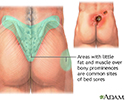
Which parts of the body are more likely to get pressure injuries?
- How often do these areas need to be looked at?
- What are the signs that a pressure injury is beginning to occur?
What is the best way to take care of my skin every day?
- What types of lotions, creams, ointments, and powders are best to use?
- What type of clothing is best to wear?
What type of diet is best to prevent pressure injuries or to help them heal?
When lying in bed:
- What positions are best when lying down?
- What types of padding or cushioning should I use?
- Should I use special mattresses or mattress covers? Sheets? Pajamas or other clothing?
- How often should I change my position?
- What is the best way to move or be moved around while I am in bed?
- What is the best way to transfer from bed to a wheelchair or chair?
If there is leakage of stool or urine, what else should be done to prevent pressure injuries?
What is best way to keep areas dry?
If using a wheelchair:
- How often should someone make sure the wheelchair is the right size?
- What type of cushions should I use?
- What is the best way to transfer into and out of the wheelchair?
- How often should I change position?
If a pressure injury is present:
- What type of dressing should I use?
- How often does the dressing need to be changed?
- What are the signs that the injury is getting worse or is infected?
When should the provider be contacted?
What are the common signs of infection?
References
James WD. Dermatoses resulting from physical factors. In: James WD, ed. Andrews' Diseases of the Skin. 14th ed. Philadelphia, PA: Elsevier; 2026:chap 3.
Qaseem A, Humphrey LL, Forciea MA, Starkey M, Denberg TD; Clinical Guidelines Committee of the American College of Physicians. Treatment of pressure ulcers: a clinical practice guideline from the American College of Physicians. Ann Intern Med. 2015;162(5):370-379. PMID: 25732279 pubmed.ncbi.nlm.nih.gov/25732279/.
Walston JD. Common clinical sequelae of aging. In: Goldman L, Cooney KA, eds. Goldman-Cecil Medicine. 27th ed. Philadelphia, PA: Elsevier; 2024:chap 24.
Woelfel SL, Armstrong DG, Shin L. Wound care. In: Sidawy AN, Perler BA, eds. Rutherford's Vascular Surgery and Endovascular Therapy. 10th ed. Philadelphia, PA: Elsevier; 2023:chap 118.
Review Date: 4/9/2026
Reviewed By: Elika Hoss, MD, Assistant Professor of Dermatology, Mayo Clinic, Scottsdale, AZ. Also reviewed by David C. Dugdale, MD, Medical Director, Brenda Conaway, Editorial Director, and the A.D.A.M. Editorial team.
© 1997- A.D.A.M., a business unit of Ebix, Inc. Any duplication or distribution of the information contained herein is strictly prohibited.
 All rights reserved.