
Lima Memorial Health System Logo
Approximate ER WAIT TIME WAIT TIME MACRO

Health Library

Hereditary amyloidosis
     
Print-Friendly
Bookmarks

Hereditary amyloidosis

Amyloidosis - hereditary; Familial amyloidosis


Hereditary amyloidosis is a condition in which abnormal protein deposits (called amyloid) form in almost every tissue in the body. Harmful deposits most often form in the heart, kidneys, and nervous system. These protein deposits damage the tissues and interfere with how organs work.

Causes


Hereditary amyloidosis is passed down from parents to their children (inherited). Genes may also play a role in primary amyloidosis.

Other types of amyloidosis are not inherited. They include:

  • Senile systemic: seen in people older than 70
  • Primary: occurs without a known cause
  • Secondary: results from diseases such as cancer of certain blood cells (myeloma)

Specific conditions include:

  • Cardiac amyloidosis
  • Cerebral amyloidosis
  • Secondary systemic amyloidosis


Treatment


Treatment to improve the function of damaged organs will help relieve some symptoms of hereditary amyloidosis. A liver transplant may be helpful to reduce the creation of harmful amyloid proteins. Talk to your health care provider about treatments.


References

Gertz MA, Dispenzieri A. Amyloidosis. In: Goldman L, Cooney KA, eds. Goldman-Cecil Medicine. 27th ed. Philadelphia, PA: Elsevier; 2024:chap 174.

Lachmann HJ, Sharpley FA. Amyloidosis. In: Firestein GS, McInnes IB, Koretzky GA, Mikuls TR, Neogi T, O'Dell JR, eds. Firestein & Kelley's Textbook of Rheumatology. 12th ed. Philadelphia, PA: Elsevier; 2025:chap 121.
BACK TO TOPText only

 
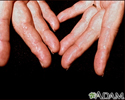
  • Amyloidosis of the fingers

    Amyloidosis of the fingers

    illustration

    • Amyloidosis of the fingers

      Amyloidosis of the fingers

      illustration

    A Closer Look


      Tests for Hereditary amyloidosis


        Review Date: 11/6/2025

        Reviewed By: Jacob Berman, MD, MPH, Associate Professor of Medicine, Division of General Internal Medicine, University of Washington School of Medicine, Seattle, WA. Also reviewed by David C. Dugdale, MD, Medical Director, Brenda Conaway, Editorial Director, and the A.D.A.M. Editorial team.

        The information provided herein should not be used during any medical emergency or for the diagnosis or treatment of any medical condition. A licensed medical professional should be consulted for diagnosis and treatment of any and all medical conditions. Links to other sites are provided for information only -- they do not constitute endorsements of those other sites. No warranty of any kind, either expressed or implied, is made as to the accuracy, reliability, timeliness, or correctness of any translations made by a third-party service of the information provided herein into any other language.

        © 1997- A.D.A.M., a business unit of Ebix, Inc. Any duplication or distribution of the information contained herein is strictly prohibited.

        All content on this site including text, images, graphics, audio, video, data, metadata, and compilations is protected by copyright and other intellectual property laws. You may view the content for personal, noncommercial use. Any other use requires prior written consent from Ebix. You may not copy, reproduce, distribute, transmit, display, publish, reverse-engineer, adapt, modify, store beyond ordinary browser caching, index, mine, scrape, or create derivative works from this content. You may not use automated tools to access or extract content, including to create embeddings, vectors, datasets, or indexes for retrieval systems. Use of any content for training, fine-tuning, calibrating, testing, evaluating, or improving AI systems of any kind is prohibited without express written consent. This includes large language models, machine learning models, neural networks, generative systems, retrieval-augmented systems, and any software that ingests content to produce outputs. Any unauthorized use of the content including AI-related use is a violation of our rights and may result in legal action, damages, and statutory penalties to the fullest extent permitted by law. Ebix reserves the right to enforce its rights through legal, technological, and contractual measures.
        © 1997- adam.comAll rights reserved.