

Metastatic pleural tumor
Tumor - metastatic pleural
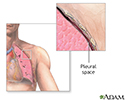
Metastatic pleural tumor is a type of cancer that has spread from another organ to the thin membrane (pleura) surrounding the lungs and lining the inside of the chest cavity.

Causes
The blood and lymph systems can carry cancer cells to other organs in the body. There, they can produce new growths or tumors.
Almost any type of cancer can spread to the lungs and involve the pleura.
Symptoms
Symptoms may include any of the following:
- Chest pain, especially when taking a deep breath
- Cough
- Wheezing
- Coughing up blood (hemoptysis)
- General discomfort, uneasiness, or ill feeling (malaise)
- Shortness of breath
- Weight loss
- Loss of appetite




Exams and Tests
Your health care provider will examine you and ask about your medical history and symptoms. Tests that may be done include:
- Chest x-ray
- CT of the chest
- PET scan
- Procedure to remove and examine part of the pleura (open pleural biopsy)
- Test that examines a sample of fluid that has collected in the pleural space (pleural fluid analysis)
- Procedure that uses a needle to remove a sample of the pleura (pleural needle biopsy)
- Removal of fluid from around the lungs (thoracentesis)


Treatment
Pleural tumors usually can't be removed with surgery. The original (primary) cancer should be treated. Chemotherapy may be used, depending on the type of primary cancer.

Your provider may recommend thoracentesis if you have a lot of fluid collecting around your lungs and you have shortness of breath or low blood oxygen levels. After the fluid is removed, your lungs will be able to expand more. This allows you to breathe easier.
To prevent the fluid from collecting again, medicine may be placed directly into your chest space through a tube, called a catheter. Or, your surgeon may spray a medicine or talc on the lung surface during the procedure. This procedure is called pleurodesis and may help seal the space around your lungs to prevent the fluid from returning.
Support Groups
You can ease the stress of illness by joining a support group where members share common experiences and problems.
Outlook (Prognosis)
The survival time varies greatly from one month to, infrequently, several years. The outlook depends on:
- The location of pleural tumors
- The cell type of pleural tumors
- The person's age and general health
- Whether surgery is an option
- The person's response to treatment
You and your family may want to start thinking about end-of-life planning, such as:

The 1-year survival rate (number of people who live for more than 1 year after diagnosis) is around 25% for people with pleural tumors that have spread from other parts of the body.
Possible Complications
Health problems that may result include:
- Side effects of chemotherapy or radiation therapy
- Continued spread of the cancer
Prevention
Early detection and treatment of primary cancers may prevent metastatic pleural tumors in some people.
References
Arenberg DA, Reddy RM. Metastatic malignant tumors. In: Broaddus VC, Ernst JD, King TE, et al, eds. Murray and Nadel's Textbook of Respiratory Medicine. 7th ed. Philadelphia, PA: Elsevier; 2022:chap 79.
Davies HE, Sterman D, Lee YCG. Pleural malignancy. In: Broaddus VC, Ernst JD, King TE, et al, eds. Murray and Nadel's Textbook of Respiratory Medicine. 7th ed. Philadelphia, PA: Elsevier; 2022:chap 114.
Kaider-Person O, Zagar T, Haithcock BE, Weiss J. Diseases of the pleura and mediastinum. In: Niederhuber JE, Armitage JO, Kastan MB, Doroshow JH, Tepper JE, eds. Abeloff's Clinical Oncology. 6th ed. Philadelphia, PA: Elsevier; 2020:chap 70.
McCool FD. Diseases of the diaphragm, chest wall, pleura, and mediastinum. In: Goldman L, Cooney KA, eds. Goldman-Cecil Medicine. 27th ed. Philadelphia, PA: Elsevier; 2024:chap 86.
National Cancer Institute website. Metastatic cancer: When cancer spreads. www.cancer.gov/types/metastatic-cancer. Updated January 17, 2025. Accessed May 31, 2026.
Rossetti NE, Tohmasi S, Onaitis MW, Kozower BD. Lung, chest wall, pleura, and mediastinum. In: Tyler DS, Hayes-Dixon A, Hines OJ, et al, eds. Sabiston Textbook of Surgery: The Biological Basis of Modern Surgical Practice. 22nd ed. Philadelphia, PA: Elsevier; 2026:chap 110.
Review Date: 5/1/2026
Reviewed By: Warren Brenner, MD, Oncologist, Lynn Cancer Institute, Boca Raton, FL. Review provided by VeriMed Healthcare Network. Also reviewed by David C. Dugdale, MD, Medical Director, Brenda Conaway, Editorial Director, and the A.D.A.M. Editorial team.
© 1997- A.D.A.M., a business unit of Ebix, Inc. Any duplication or distribution of the information contained herein is strictly prohibited.
 All rights reserved.