

Health Library
Pneumothorax - infants
Pulmonary air leak; Pneumothorax - neonatal
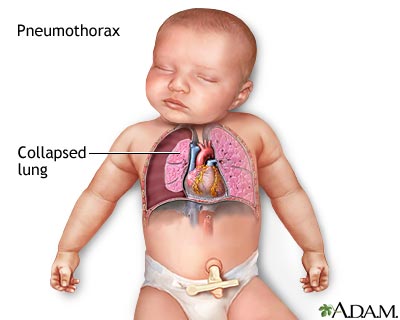
Pneumothorax is when air or gas collects in the space inside the chest around the lungs. This may lead to lung collapse.
This article discusses pneumothorax in infants.
Images
I Would Like to Learn About:
Causes
A pneumothorax occurs when some of the tiny air sacs (alveoli) in a baby's lung become overinflated and burst. This causes air to leak into the space between the lung and chest wall (pleural space).
The most common cause of pneumothorax is respiratory distress syndrome. This is a condition that occurs in babies who are born too early (premature).
- The baby's lungs lack the slippery substance (surfactant) that helps them stay open (inflated). Therefore, the tiny air sacs are not able to expand as easily as normal.
- If the baby needs a breathing machine (mechanical ventilator), extra pressure on the baby's lungs, from the machine can sometimes burst the air sacs.
Meconium aspiration syndrome is another cause of pneumothorax in newborns.
- Before or during birth, the baby may breathe in their first bowel movement, called meconium. This may obstruct the airways and cause breathing problems.
Other causes include pneumonia (infection of the lung) or underdeveloped lung tissue.
Less commonly, otherwise healthy infants can develop an air leak when they take the first few breaths after birth. This occurs because of the pressure needed to expand the lungs for the first time. There may be genetic factors which contribute to this problem.
Symptoms
Many infants with pneumothorax do not have symptoms. When symptoms do occur, they can include:
- Bluish skin color (cyanosis)
- Fast breathing
- Flaring of the nostrils
- Grunting with breathing
- Irritability
- Restlessness
- Use of additional chest and abdominal muscles to aid breathing (retractions)
Exams and Tests
The health care provider may have difficulty hearing breath sounds when listening to the infant's lungs with a stethoscope. The heart or lung sounds may seem as if they are coming from a different part of the chest than is normal.
Tests for pneumothorax include:
- Chest x-ray
- Light probe placed against the baby's chest, also known as "transillumination" (pockets of air may show up as lighter areas)
- Ultrasound of the chest
Treatment
Babies without symptoms may not need treatment. The health care team will monitor your baby's breathing, heart rate, oxygen level, and skin color. Supplemental oxygen will be provided if needed.
If your baby is having symptoms, the provider will place a needle or a thin tube called a catheter into the baby's chest to remove the air that has leaked into the chest space.
Since treatment will also depend on the lung issues that led to the pneumothorax, it may last for days to weeks.
Outlook (Prognosis)
Some air leaks will go away within a few days without treatment. Infants who have the air removed with a needle or catheter often do well after treatment if there are no other lung problems.
Possible Complications
As air builds up in the chest, it can push the heart toward the other side of the chest. This puts pressure on both the lung that hasn't collapsed and the heart. This condition is called tension pneumothorax. It is a medical emergency because it can affect heart and lung function and be life-threatening.
When to Contact a Medical Professional
A pneumothorax is often discovered shortly after birth. Contact your child's provider if your infant has symptoms of pneumothorax.
Prevention
The providers in the newborn intensive care unit (NICU) should watch your infant carefully for signs of an air leak.
References
Crowley MA. Spectrum of neonatal respiratory disorders. In: Martin RJ, Fanaroff AA, eds. Fanaroff and Martin's Neonatal-Perinatal Medicine: Diseases of the Fetus and Infant. 12th ed. Philadelphia, PA: Elsevier; 2025:chap 67.
Haider SK, Vemana AP. Pneumothorax. In: Kliegman RM, St. Geme JW, Blum NJ, et al, eds. Nelson Textbook of Pediatrics. 22nd ed. Philadelphia, PA: Elsevier; 2025:chap 461.
BACK TO TOPReview Date: 10/3/2025
Reviewed By: Mary Terrell, MD, NABBLM-C, IBCLC, Neonatologist, Cape Fear Valley Medical Center, Fayetteville, NC. Review provided by VeriMed Healthcare Network. Also reviewed by David C. Dugdale, MD, Medical Director, Brenda Conaway, Editorial Director, and the A.D.A.M. Editorial team.
 | A.D.A.M., Inc. is accredited by URAC, for Health Content Provider (www.urac.org). URAC's accreditation program is an independent audit to verify that A.D.A.M. follows rigorous standards of quality and accountability. A.D.A.M. is among the first to achieve this important distinction for online health information and services. Learn more about A.D.A.M.'s editorial policy, editorial process and privacy policy. A.D.A.M. is also a founding member of Hi-Ethics. This site complies with the HONcode standard for trustworthy health information: verify here. |
The information provided herein should not be used during any medical emergency or for the diagnosis or treatment of any medical condition. A licensed medical professional should be consulted for diagnosis and treatment of any and all medical conditions. Links to other sites are provided for information only -- they do not constitute endorsements of those other sites. No warranty of any kind, either expressed or implied, is made as to the accuracy, reliability, timeliness, or correctness of any translations made by a third-party service of the information provided herein into any other language.
© 1997-
2026 A.D.A.M., a business unit of Ebix, Inc. Any duplication or distribution of the information contained herein is strictly prohibited.
All content on this site including text, images, graphics, audio, video, data, metadata, and compilations is protected by copyright and other intellectual property laws. You may view the content for personal, noncommercial use. Any other use requires prior written consent from Ebix. You may not copy, reproduce, distribute, transmit, display, publish, reverse-engineer, adapt, modify, store beyond ordinary browser caching, index, mine, scrape, or create derivative works from this content. You may not use automated tools to access or extract content, including to create embeddings, vectors, datasets, or indexes for retrieval systems. Use of any content for training, fine-tuning, calibrating, testing, evaluating, or improving AI systems of any kind is prohibited without express written consent. This includes large language models, machine learning models, neural networks, generative systems, retrieval-augmented systems, and any software that ingests content to produce outputs. Any unauthorized use of the content including AI-related use is a violation of our rights and may result in legal action, damages, and statutory penalties to the fullest extent permitted by law. Ebix reserves the right to enforce its rights through legal, technological, and contractual measures.
