

Health Library
Non-small cell lung cancer
Cancer - lung - non-small cell; Non-small cell lung cancer; NSCLC; Adenocarcinoma - lung; Squamous cell carcinoma - lung; Large cell carcinoma - lung
Non-small cell lung cancer is the most common type of lung cancer. It usually grows and spreads more slowly than small cell lung cancer.
There are three common types of non-small cell lung cancer (NSCLC):
- Adenocarcinomas are often found in an outer area of the lung.
- Squamous cell carcinomas are usually found in the center of the lung next to an air tube (bronchus).
- Large cell carcinomas can occur in any part of the lung.
There are other uncommon types of lung cancer that are also called non-small cell cancer.
Images
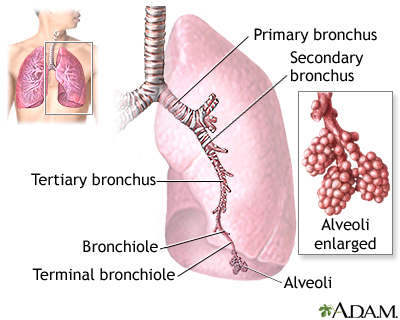
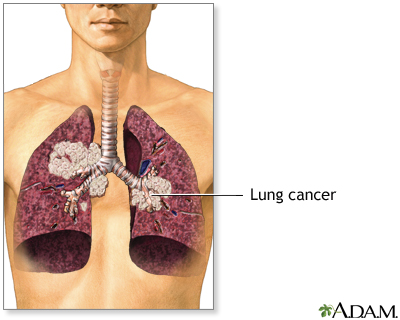
I Would Like to Learn About:
Causes
Lung cancer is the most common cause of cancer death for both men and women. Each year, more people die of lung cancer than of breast, colon, and prostate cancers combined.
Lung cancer is more common in older adults. It is rare in people under age 45.
Smoking causes around 80% of non-small cell lung cancer. The risk depends on the number of cigarettes you smoke each day and for how long you have smoked. Being around the smoke from other people (secondhand smoke) also raises your risk of lung cancer. The risk decreases with time after you stop smoking. There is no evidence that smoking low-tar cigarettes lowers the risk. Some people who have never smoked do develop lung cancer.
Research shows that smoking marijuana may help cancer cells grow. But there is no direct link between smoking marijuana and developing lung cancer.
Constant exposure to high levels of air pollution and drinking water that has a high level of arsenic can increase your risk of lung cancer. A history of radiation therapy to the lungs can also increase risk.
Working with or living near cancer-causing chemicals or materials can also increase the risk of developing lung cancer. Such chemicals include:
- Arsenic
- Asbestos
- Radon
- Chemicals such as uranium, beryllium, vinyl chloride, nickel chromates, coal products, mustard gas, chloromethyl ethers, gasoline, and diesel exhaust
- Certain alloys, paints, pigments, and preservatives
- Products using chloride and formaldehyde
Symptoms
The symptoms may include:
- Chest pain
- Cough that does not go away
- Coughing up blood
- Fatigue
- Loss of appetite
- Losing weight without trying
- Shortness of breath
- Wheezing
Early lung cancer may not cause any symptoms.
Other symptoms that may be due to NSCLC, often in the late stages:
- Bone pain or tenderness
- Eyelid drooping
- Hoarseness or changing voice
- Joint pain
- Nail problems
- Shoulder pain or weakness
- Swallowing difficulty
- Swelling of the face
- Weakness
These symptoms can be due to other, less serious conditions. It is important to talk to your health care provider if you have symptoms.
Exams and Tests
Your provider will perform a physical exam and ask about your medical history. You will be asked if you smoke, and if so, how much you smoke and for how long you have smoked. You will also be asked about other things that may have put you at risk of lung cancer, such as exposure to certain chemicals.
When listening to your chest with a stethoscope, your provider may hear fluid around your lungs. This may suggest cancer.
Tests that may be done to diagnose lung cancer or to see if it has spread include:
- Bone scan
- Chest x-ray
- Complete blood count (CBC)
- Comprehensive metabolic panel
- CT scan of the chest and abdomen
- Positron emission tomography (PET) scan
- Sputum test to look for cancer cells
- Thoracentesis (sampling of fluid buildup around the lung)
In most cases, a piece of tissue is removed from your lungs for examination under a microscope. This is called a biopsy. There are several ways to do this:
- Bronchoscopy combined with biopsy
- CT-scan-directed needle biopsy
- Endoscopic bronchoscopy ultrasound (EBUS) with biopsy
- Mediastinoscopy with biopsy
- Open lung biopsy
- Pleural biopsy
If the biopsy shows cancer, it will be checked for certain genetic changes that may lead to specific treatment. More imaging tests are done to find out the stage of the cancer. Stage means how big the tumor is and how far it has spread. NSCLC is divided into 5 stages:
- Stage 0 -- The cancer has not spread beyond the inner lining of the lung.
- Stage I -- The cancer is small and has not spread to the lymph nodes.
- Stage II -- The cancer has spread to some lymph nodes near the original tumor.
- Stage III -- The cancer has spread to nearby tissue or to far away lymph nodes.
- Stage IV -- The cancer has spread to other organs of the body, such as the other lung, brain, liver, or bone.
Treatment
There are many different types of treatment for NSCLC. The treatment depends on the stage of the cancer and whether the cancer cells have genetic changes that create target molecules in or on the cells.
Surgery is the common treatment for NSCLC that has not spread beyond nearby lymph nodes. This may allow a cure of the cancer. The surgeon may remove:
- One of the lobes of the lung (lobectomy)
- Only a small part of the lung (wedge or segment removal)
- The entire lung (pneumonectomy)
Some people need chemotherapy. Chemotherapy uses medicines to kill cancer cells and stop new cells from growing. Treatment may be done in the following ways:
- Chemotherapy is often used when the cancer has spread outside the lung (stage IV).
- It may also be given before surgery. This is called neoadjuvant therapy.
- It may be given after surgery to kill any remaining cancer. This is called adjuvant therapy.
- Chemotherapy is usually given through a vein (by IV).
Controlling symptoms and preventing complications during and after chemotherapy is an important part of care.
Immunotherapy can be given by itself or with chemotherapy. This is now being used frequently prior to surgery.
Targeted therapy may be used to treat NSCLC. Targeted therapy uses medicines to zero in on specific target molecules in or on cancer cells. These targets play a role in how cancer cells grow and survive. Using these targets, the medicine disables the cancer cells so they cannot spread.
Radiation therapy can be used with chemotherapy if surgery is not possible. Radiation therapy uses powerful x-rays or other forms of radiation to kill cancer cells. Radiation may be used to:
- Treat the cancer, sometimes along with chemotherapy, if surgery is not possible
- Help relieve symptoms caused by the cancer, such as breathing problems and swelling
- Treat smaller tumors as a definitive treatment, especially in older and less fit people
- Help relieve cancer pain when the cancer has spread to the bones
Controlling symptoms during and after radiation to the chest is an important part of care.
The following treatments are mostly used to relieve symptoms caused by NSCLC:
- Laser therapy -- A small beam of light burns and kills cancer cells.
- Photodynamic therapy -- Uses a light to activate a medicine in the body, which then kills cancer cells.
Support Groups
You can ease the stress of illness by joining a support group. Sharing with others who have common experiences and problems can help you not feel alone.
Outlook (Prognosis)
The outlook varies. Most often, NSCLC grows slowly. In some cases, it can grow and spread quickly and cause rapid death. The cancer may spread to other parts of the body, including the bone, liver, lymph nodes, other areas of the lung, and brain.
Chemotherapy, immunotherapy, and targeted therapy have been shown to prolong life and improve the quality of life in some people with stage IV NSCLC.
Cure rates are related to the stage of the disease and whether you are able to have surgery.
- Stage I and II cancers have the highest survival and cure rates.
- Stage III cancer can be cured in some cases.
- Stage IV cancer is almost never cured. The goals of therapy are to extend and improve the quality of life.
When to Contact a Medical Professional
Contact your provider if you have symptoms of lung cancer, particularly if you smoke.
Prevention
If you smoke, now is the time to quit. If you are having trouble quitting, talk with your provider. There are many methods to help you quit, from support groups to prescription medicines. Also, try to avoid secondhand smoke.
If you are age 50 to 80 years and have a 20 pack-year smoking history and currently smoke or have quit within the past 15 years, ask your provider about being screened for lung cancer by low-dose CT scan of your chest.
Related Information
TumorLung cancer - small cell
Lung cancer
Lung surgery - discharge
Chest radiation - discharge
References
American Cancer Society website. Lung cancer risk factors. www.cancer.org/cancer/types/lung-cancer/causes-risks-prevention/risk-factors.html. Updated January 29, 2024. Accessed April 16, 2026.
American Lung Association website. Lung cancer trends brief. www.lung.org/research/trends-in-lung-disease/lung-cancer-trends-brief. Accessed April 16, 2026.
Araujo LH, Horn L, Merritt RE, Shilo K, Xu-Welliver M, Carbone DP. Cancer of the lung: non-small cell lung cancer and small cell lung cancer. In: Niederhuber JE, Armitage JO, Kastan MB, Doroshow JH, Tepper JE, eds. Abeloff's Clinical Oncology. 6th ed. Philadelphia, PA: Elsevier; 2020:chap 69.
Centers for Disease Control and Prevention website. Health problems caused by secondhand smoke. www.cdc.gov/tobacco/secondhand-smoke/health.html. Updated January 31, 2025. Accessed April 16, 2026.
National Cancer Institute website. Non-small cell lung cancer treatment (PDQ) - health professional version. www.cancer.gov/types/lung/hp/non-small-cell-lung-treatment-pdq. Updated May 15, 2025. Accessed April 16, 2026.
NCCN Clinical Practice Guidelines in Oncology (NCCN guidelines). Non-small cell lung cancer, version 6.2026. www.nccn.org/professionals/physician_gls/pdf/nscl.pdf. Updated June 12, 2026. Accessed July 14, 2026.
Rivera MP, Mody GN, Weiner AA. Lung cancer: treatment. In: Broaddus VC, Ernst JD, King TE, et al, eds. Murray and Nadel's Textbook of Respiratory Medicine. 7th ed. Philadelphia, PA: Elsevier; 2022:chap 77.
US Preventive Services Task Force, Krist AH, Davidson KW, et al. Screening for lung cancer: US Preventive Services Task Force recommendation statement. JAMA. 2021;325(10):962-970. PMID: 33687470 pubmed.ncbi.nlm.nih.gov/33687470/.
BACK TO TOPReview Date: 1/29/2026
Reviewed By: Warren Brenner, MD, Oncologist, Lynn Cancer Institute, Boca Raton, FL. Review provided by VeriMed Healthcare Network. Also reviewed by David C. Dugdale, MD, Medical Director, Brenda Conaway, Editorial Director, and the A.D.A.M. Editorial team.
 | A.D.A.M., Inc. is accredited by URAC, for Health Content Provider (www.urac.org). URAC's accreditation program is an independent audit to verify that A.D.A.M. follows rigorous standards of quality and accountability. A.D.A.M. is among the first to achieve this important distinction for online health information and services. Learn more about A.D.A.M.'s editorial policy, editorial process and privacy policy. A.D.A.M. is also a founding member of Hi-Ethics. This site complies with the HONcode standard for trustworthy health information: verify here. |
The information provided herein should not be used during any medical emergency or for the diagnosis or treatment of any medical condition. A licensed medical professional should be consulted for diagnosis and treatment of any and all medical conditions. Links to other sites are provided for information only -- they do not constitute endorsements of those other sites. No warranty of any kind, either expressed or implied, is made as to the accuracy, reliability, timeliness, or correctness of any translations made by a third-party service of the information provided herein into any other language.
© 1997-
2026 A.D.A.M., a business unit of Ebix, Inc. Any duplication or distribution of the information contained herein is strictly prohibited.
All content on this site including text, images, graphics, audio, video, data, metadata, and compilations is protected by copyright and other intellectual property laws. You may view the content for personal, noncommercial use. Any other use requires prior written consent from Ebix. You may not copy, reproduce, distribute, transmit, display, publish, reverse-engineer, adapt, modify, store beyond ordinary browser caching, index, mine, scrape, or create derivative works from this content. You may not use automated tools to access or extract content, including to create embeddings, vectors, datasets, or indexes for retrieval systems. Use of any content for training, fine-tuning, calibrating, testing, evaluating, or improving AI systems of any kind is prohibited without express written consent. This includes large language models, machine learning models, neural networks, generative systems, retrieval-augmented systems, and any software that ingests content to produce outputs. Any unauthorized use of the content including AI-related use is a violation of our rights and may result in legal action, damages, and statutory penalties to the fullest extent permitted by law. Ebix reserves the right to enforce its rights through legal, technological, and contractual measures.
