

Health Library
Joint pain
Stiffness in a joint; Pain - joints; Arthralgia; Arthritis
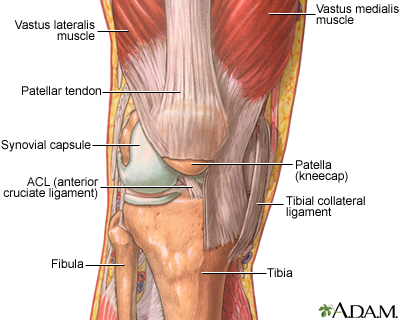
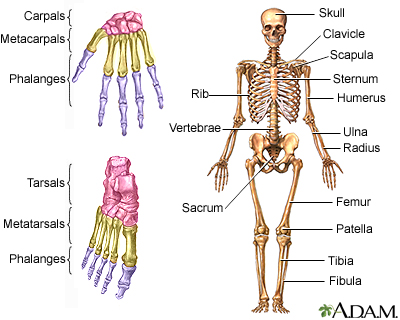
Joint pain can affect one or more joints.
Images
I Would Like to Learn About:
Causes
Joint pain can be caused by many types of injuries or conditions. It may be linked to arthritis, bursitis, and muscle pain. No matter what causes it, joint pain can be very bothersome. Some things that can cause joint pain are:
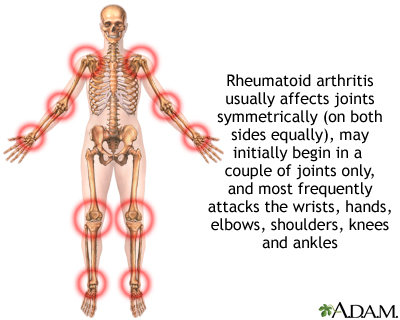
- Autoimmune diseases such as rheumatoid arthritis and lupus
- Bursitis
- Chondromalacia patellae
- Crystals in the joint -- gout (especially found in the big toe) and CPPD arthritis (pseudogout)
- Infections caused by a virus
- Injury, such as a fracture
- Osteoarthritis
- Bone infection (osteomyelitis)
- Joint infection (septic arthritis)
- Tendinitis
- Unusual exertion or overuse, including strains or sprains
Signs of joint inflammation include:
- Swelling
- Warmth
- Tenderness
- Redness
- Pain with movement
Home Care
Follow your health care provider's advice for treating the cause of your pain.
For non-arthritic joint pain, both rest and exercise are important. Warm baths, massage, and stretching exercises should be used as often as possible.
Acetaminophen (Tylenol) may help the soreness feel better.
Nonsteroidal anti-inflammatory drugs (NSAIDs) such as ibuprofen or naproxen may help relieve pain and swelling. Talk to your provider before giving aspirin or NSAIDs such as ibuprofen to children.
When to Contact a Medical Professional
Contact your provider if:
- You have fever that is not associated with flu symptoms.
- You have lost 10 pounds (4.5 kilograms) or more without trying (unintended weight loss).
- Your joint pain lasts for more than several days.
- You have severe, unexplained joint pain and swelling, particularly if you have other unexplained symptoms.
What to Expect at Your Office Visit
Your provider will ask you questions about your medical history and symptoms, including:
- Which joint hurts? Is the pain on one side or both sides?
- What started the pain and how often have you had it? Have you had it before?
- Did this pain begin suddenly and severely, or slowly and mildly?
- Is the pain constant or does it come and go? Has the pain become more severe?
- Have you injured your joint?
- Have you had an illness, rash, or fever?
- Does resting or moving make the pain better or worse? Are certain positions more or less comfortable? Does keeping the joint elevated help?
- Do medicines, massage, or applying heat reduce the pain?
- What other symptoms do you have?
- Is there any numbness?
- Can you bend and straighten the joint? Does the joint feel stiff?
- Are your joints stiff in the morning? If so, for how long does the stiffness last?
- What makes the stiffness better?
A physical exam will be done to look for signs of joint abnormality including:
- Swelling
- Tenderness
- Warmth
- Pain with motion
- Abnormal motion such as limitation, loosening of the joint, grating sensation
Tests that may be done include:
- Complete blood count (CBC) or blood differential
- C-reactive protein
- Sedimentation rate
- Blood tests specific to various autoimmune diseases
- Joint aspiration to obtain joint fluid for culture, white cell count and examination for crystals
- Joint x-ray
Treatments may include:
- Medicines such as NSAIDs including ibuprofen, naproxen, or indomethacin
- Injection of a corticosteroid medicine into the joint
- Antibiotics and often surgical drainage, in case of infection (usually requires hospitalization)
- Physical therapy for muscle and joint rehabilitation
Related Information
ArthritisMuscle aches
Bursitis
Rheumatoid arthritis
Osteoarthritis
References
Bykerk VP, Crow MK. Approach to the patient with rheumatic disease. In: Goldman L, Cooney KA, eds. Goldman-Cecil Medicine. 27th ed. Philadelphia, PA: Elsevier; 2024:chap 236.
Davis JM, Hunder GG. History and physical examination of the musculoskeletal system. In: Firestein GS, McInnes IB, Koretzky GA, Mikuls TR, Neogi T, O'Dell JR, eds. Firestein & Kelley's Textbook of Rheumatology. 12th ed. Philadelphia, PA: Elsevier; 2025:chap 40.
BACK TO TOPReview Date: 1/14/2026
Reviewed By: Linda J. Vorvick, MD, Clinical Professor Emeritus, Department of Family Medicine, UW Medicine, School of Medicine, University of Washington, Seattle, WA. Also reviewed by David C. Dugdale, MD, Medical Director, Brenda Conaway, Editorial Director, and the A.D.A.M. Editorial team.
 | A.D.A.M., Inc. is accredited by URAC, for Health Content Provider (www.urac.org). URAC's accreditation program is an independent audit to verify that A.D.A.M. follows rigorous standards of quality and accountability. A.D.A.M. is among the first to achieve this important distinction for online health information and services. Learn more about A.D.A.M.'s editorial policy, editorial process and privacy policy. A.D.A.M. is also a founding member of Hi-Ethics. This site complies with the HONcode standard for trustworthy health information: verify here. |
The information provided herein should not be used during any medical emergency or for the diagnosis or treatment of any medical condition. A licensed medical professional should be consulted for diagnosis and treatment of any and all medical conditions. Links to other sites are provided for information only -- they do not constitute endorsements of those other sites. No warranty of any kind, either expressed or implied, is made as to the accuracy, reliability, timeliness, or correctness of any translations made by a third-party service of the information provided herein into any other language.
© 1997-
2026 A.D.A.M., a business unit of Ebix, Inc. Any duplication or distribution of the information contained herein is strictly prohibited.
All content on this site including text, images, graphics, audio, video, data, metadata, and compilations is protected by copyright and other intellectual property laws. You may view the content for personal, noncommercial use. Any other use requires prior written consent from Ebix. You may not copy, reproduce, distribute, transmit, display, publish, reverse-engineer, adapt, modify, store beyond ordinary browser caching, index, mine, scrape, or create derivative works from this content. You may not use automated tools to access or extract content, including to create embeddings, vectors, datasets, or indexes for retrieval systems. Use of any content for training, fine-tuning, calibrating, testing, evaluating, or improving AI systems of any kind is prohibited without express written consent. This includes large language models, machine learning models, neural networks, generative systems, retrieval-augmented systems, and any software that ingests content to produce outputs. Any unauthorized use of the content including AI-related use is a violation of our rights and may result in legal action, damages, and statutory penalties to the fullest extent permitted by law. Ebix reserves the right to enforce its rights through legal, technological, and contractual measures.
