

Health Library
Pericardiocentesis
Pericardial tap; Percutaneous pericardiocentesis; Pericarditis - pericardiocentesis; Pericardial effusion - pericardiocentesis
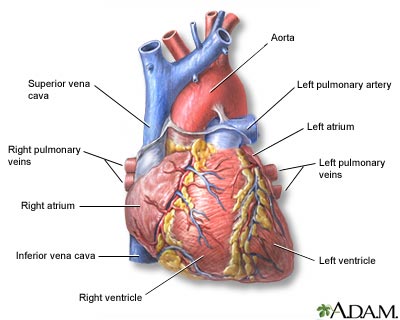
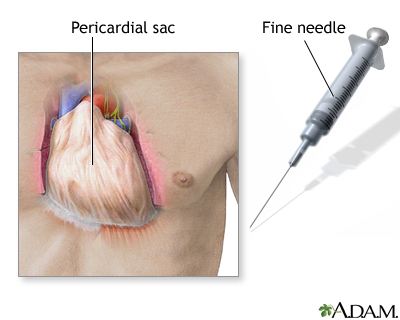
Pericardiocentesis is a procedure that uses a needle to remove fluid from the pericardial sac. This is the tissue that surrounds the heart.
Images
I Would Like to Learn About:
How the Test is Performed
The procedure is most often done in a special procedure room, such as a cardiac catheterization laboratory. It may also be done at a patient's hospital bedside. A health care provider will put an IV into your arm in case fluids or medicines need to be given through a vein. For example, you may be given medicines if your heartbeat slows or your blood pressure drops during the procedure.
The doctor doing the procedure will clean an area just below or next to the breastbone or below the left nipple. Numbing medicine (anesthetic) will be applied to the area.
The doctor will then insert a needle and guide it into tissue that surrounds the heart. Often, echocardiography (ultrasound) is used to help the doctor see the needle and any fluid drainage. An electrocardiogram (ECG) and moving x-ray images (fluoroscopy) may also be used to help with positioning.
Once the needle has reached the correct area, it is removed and replaced with a tube called a catheter. Fluid drains through this tube into containers. Most of the time, the pericardial catheter is left in place so draining may continue for several hours.
Surgical drainage may be needed if the problem is hard to correct or comes back. This is a more invasive procedure in which the pericardium is drained into the chest (pleural) cavity. Alternatively, the fluid may be drained into the peritoneal cavity, but this is less common. This procedure may need to be done under general anesthesia.
How to Prepare for the Test
You may not be able to eat or drink for 6 hours before the test. You must sign a consent form.
How the Test will Feel
You may feel pressure as the needle enters. Some people have chest pain, which may require pain medicine.
Why the Test is Performed
This test may be done to remove and examine fluid that is pressing on the heart. It is most often done to find the cause of a chronic or recurrent pericardial effusion.
It may also be done to treat cardiac tamponade, which is a life-threatening condition.
Normal Results
There is normally a small amount of clear, straw-colored fluid in the pericardial space.
What Abnormal Results Mean
Abnormal findings may indicate the cause of pericardial fluid accumulation, such as:
- Cancer
- Cardiac perforation
- Cardiac trauma
- Congestive heart failure
- Pericarditis
- Renal failure
- Infection
- Rupture of a ventricular aneurysm
Risks
Risks may include:
- Bleeding
- Collapsed lung
- Heart attack
- Infection (pericarditis)
- Irregular heartbeats (arrhythmias)
- Puncture of the heart muscle, coronary artery, lung, liver, or stomach
- Pneumopericardium (air in the pericardial sac)
Related Information
PericarditisCardiac tamponade
Heart failure
Cancer
Aneurysm
References
Hoit BD, Oh JK. Pericardial diseases. In: Goldman L, Cooney KA, eds. Goldman-Cecil Medicine. 27th ed. Philadelphia, PA: Elsevier; 2024:chap 62.
Klein Al, Wang TKM, Lewinter MM, Cremer PC. Pericardial diseases. In: Bonow RO, Mann DL, Tomaselli GF, et al, eds. Braunwald's Heart Disease: A Textbook of Cardiovascular Medicine. 13th ed. Philadelphia, PA: Elsevier; 2026:chap 78.
Tewelde SZ, Menon R. Pericardiocentesis. In: Birnbaumer DM, ed. Roberts and Hedges' Clinical Procedures in Emergency Medicine and Acute Care. 8th ed. Philadelphia, PA: Elsevier; 2026:chap 16.
BACK TO TOPReview Date: 4/28/2026
Reviewed By: Michael A. Chen, MD, PhD, Associate Professor of Medicine, Division of Cardiology, Harborview Medical Center, University of Washington Medical School, Seattle, WA. Also reviewed by David C. Dugdale, MD, Medical Director, Brenda Conaway, Editorial Director, and the A.D.A.M. Editorial team.
 | A.D.A.M., Inc. is accredited by URAC, for Health Content Provider (www.urac.org). URAC's accreditation program is an independent audit to verify that A.D.A.M. follows rigorous standards of quality and accountability. A.D.A.M. is among the first to achieve this important distinction for online health information and services. Learn more about A.D.A.M.'s editorial policy, editorial process and privacy policy. A.D.A.M. is also a founding member of Hi-Ethics. This site complies with the HONcode standard for trustworthy health information: verify here. |
The information provided herein should not be used during any medical emergency or for the diagnosis or treatment of any medical condition. A licensed medical professional should be consulted for diagnosis and treatment of any and all medical conditions. Links to other sites are provided for information only -- they do not constitute endorsements of those other sites. No warranty of any kind, either expressed or implied, is made as to the accuracy, reliability, timeliness, or correctness of any translations made by a third-party service of the information provided herein into any other language.
© 1997-
2026 A.D.A.M., a business unit of Ebix, Inc. Any duplication or distribution of the information contained herein is strictly prohibited.
All content on this site including text, images, graphics, audio, video, data, metadata, and compilations is protected by copyright and other intellectual property laws. You may view the content for personal, noncommercial use. Any other use requires prior written consent from Ebix. You may not copy, reproduce, distribute, transmit, display, publish, reverse-engineer, adapt, modify, store beyond ordinary browser caching, index, mine, scrape, or create derivative works from this content. You may not use automated tools to access or extract content, including to create embeddings, vectors, datasets, or indexes for retrieval systems. Use of any content for training, fine-tuning, calibrating, testing, evaluating, or improving AI systems of any kind is prohibited without express written consent. This includes large language models, machine learning models, neural networks, generative systems, retrieval-augmented systems, and any software that ingests content to produce outputs. Any unauthorized use of the content including AI-related use is a violation of our rights and may result in legal action, damages, and statutory penalties to the fullest extent permitted by law. Ebix reserves the right to enforce its rights through legal, technological, and contractual measures.
