

Health Library
Anti-smooth muscle antibody
Anti-smooth muscle antibody is a blood test that detects the presence of antibodies against smooth muscle. The antibody is useful in making a diagnosis of autoimmune hepatitis.
Images
I Would Like to Learn About:
How the Test is Performed
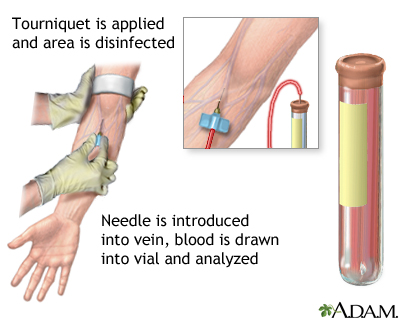
A blood sample is needed. This may be taken through a vein. The procedure is called a venipuncture.
How to Prepare for the Test
No special steps are needed to prepare for this test.
How the Test will Feel
When the needle is inserted to draw blood, some people feel moderate pain. Others may feel only a prick or stinging sensation. Afterward, there may be some throbbing.
Why the Test is Performed
You may need this test if you have signs of certain liver diseases, such as hepatitis and cirrhosis. These conditions can trigger the body to form antibodies against smooth muscle.
Anti-smooth muscle antibodies are not often seen in diseases other than autoimmune hepatitis. Therefore, it is helpful to make the diagnosis. Autoimmune hepatitis is treated with immunosuppressive medicines. People with autoimmune hepatitis often have other autoantibodies. These include:
- Antinuclear antibodies.
- Anti-actin antibodies.
- Anti-soluble liver antigen/liver pancreas (anti-SLA/LP) antibodies.
- Other antibodies may be present, even when the anti-smooth muscle antibodies are absent.
The diagnosis and management of autoimmune hepatitis may require a liver biopsy.
Normal Results
Normally, there are no antibodies present.
Note: Normal value ranges may vary slightly among different laboratories. Talk to your health care provider about the meaning of your specific test results.
What Abnormal Results Mean
A positive test may be due to:
- Chronic active autoimmune hepatitis
- Cirrhosis
- Infectious mononucleosis
The test also helps distinguish autoimmune hepatitis from systemic lupus erythematosus.
Risks
Risks associated with having blood drawn are slight, but may include:
- Excessive bleeding
- Fainting or feeling lightheaded
- Hematoma (blood accumulating under the skin)
- Infection (a slight risk any time the skin is broken)
Related Information
AntibodyHepatitis
Cirrhosis
Mononucleosis
Autoimmune hepatitis
Systemic lupus erythematosus
References
American College of Rheumatology website. Antinuclear antibodies (ANA). rheumatology.org/patients/antinuclear-antibodies-ana. Updated February 2023. Accessed March 6, 2025.
Czaja AJ. Autoimmune hepatitis. In: Feldman M, Friedman LS, Brandt LJ, eds. Sleisenger and Fordtran's Gastrointestinal and Liver Disease. 11th ed. Philadelphia, PA: Elsevier; 2021:chap 90.
Peng SL. Anti-nuclear antibodies. In: Firestein GS, McInnes IB, Koretzky GA, Mikuls TR, Neogi T, O'Dell JR, eds. Firestein & Kelley's Textbook of Rheumatology. 12th ed. Philadelphia, PA: Elsevier; 2025:chap 55.
von Mühlen CA, Chan EKL, Ceribelli A, Fritzler MJ. Clinical and laboratory evaluation of systemic autoimmune rheumatic diseases. In: McPherson RA, Pincus MR, eds. Henry's Clinical Diagnosis and Management by Laboratory Methods. 24th ed. Philadelphia, PA: Elsevier; 2022:chap 53.
BACK TO TOPReview Date: 1/28/2025
Reviewed By: Diane M. Horowitz, MD, Rheumatology and Internal Medicine, Northwell Health, Great Neck, NY. Review provided by VeriMed Healthcare Network. Also reviewed by David C. Dugdale, MD, Medical Director, Brenda Conaway, Editorial Director, and the A.D.A.M. Editorial team.
 | A.D.A.M., Inc. is accredited by URAC, for Health Content Provider (www.urac.org). URAC's accreditation program is an independent audit to verify that A.D.A.M. follows rigorous standards of quality and accountability. A.D.A.M. is among the first to achieve this important distinction for online health information and services. Learn more about A.D.A.M.'s editorial policy, editorial process and privacy policy. A.D.A.M. is also a founding member of Hi-Ethics. This site complies with the HONcode standard for trustworthy health information: verify here. |
The information provided herein should not be used during any medical emergency or for the diagnosis or treatment of any medical condition. A licensed medical professional should be consulted for diagnosis and treatment of any and all medical conditions. Links to other sites are provided for information only -- they do not constitute endorsements of those other sites. No warranty of any kind, either expressed or implied, is made as to the accuracy, reliability, timeliness, or correctness of any translations made by a third-party service of the information provided herein into any other language.
© 1997-
2026 A.D.A.M., a business unit of Ebix, Inc. Any duplication or distribution of the information contained herein is strictly prohibited.
All content on this site including text, images, graphics, audio, video, data, metadata, and compilations is protected by copyright and other intellectual property laws. You may view the content for personal, noncommercial use. Any other use requires prior written consent from Ebix. You may not copy, reproduce, distribute, transmit, display, publish, reverse-engineer, adapt, modify, store beyond ordinary browser caching, index, mine, scrape, or create derivative works from this content. You may not use automated tools to access or extract content, including to create embeddings, vectors, datasets, or indexes for retrieval systems. Use of any content for training, fine-tuning, calibrating, testing, evaluating, or improving AI systems of any kind is prohibited without express written consent. This includes large language models, machine learning models, neural networks, generative systems, retrieval-augmented systems, and any software that ingests content to produce outputs. Any unauthorized use of the content including AI-related use is a violation of our rights and may result in legal action, damages, and statutory penalties to the fullest extent permitted by law. Ebix reserves the right to enforce its rights through legal, technological, and contractual measures.
