

Health Library
Thyroid cancer - papillary carcinoma
Papillary carcinoma of the thyroid; Papillary thyroid cancer; Papillary thyroid carcinoma
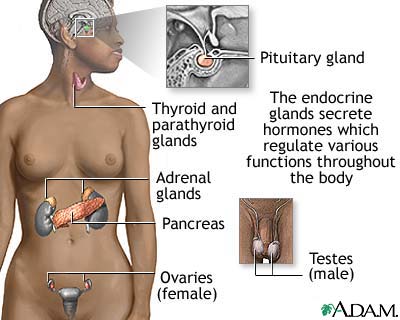
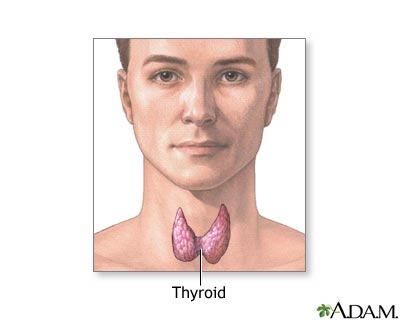
Papillary carcinoma of the thyroid is the most common cancer of the thyroid gland. The thyroid gland is located in front of the lower neck.
Images
I Would Like to Learn About:
Causes
About 85% of all thyroid cancers diagnosed in the United States are the papillary carcinoma type. It is more common in women than in men. It may occur in childhood, but is most often seen in adults between ages 20 and 60.
The cause of this cancer is not known. A genetic variant or family history of the disease may be a risk factor.
Radiation exposure increases the risk for developing thyroid cancer. Exposure may occur from:
- High-dose external radiation treatments to the neck, especially during childhood, used to treat childhood cancer or some noncancerous childhood conditions
- Radiation exposure from nuclear plant disasters
Radiation given through a vein (through an IV) during medical tests and treatments does not increase the risk for developing thyroid cancer.
Symptoms
Thyroid cancer often begins as a small lump (nodule) in the thyroid gland.
While some small lumps may be cancer, most (90%) thyroid nodules are not cancerous.
Most of the time, there are no symptoms from the nodule.
Exams and Tests
If you have a lump on your thyroid, your health care provider may order the following tests:
- Blood tests.
- Ultrasound of the thyroid gland and neck region.
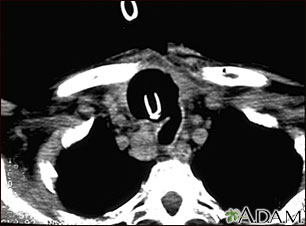
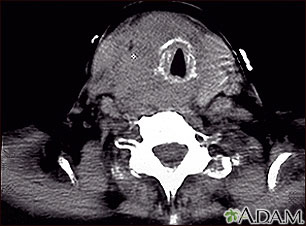
- CT scan of the neck or MRI to determine the size of the tumor.
- An exam of the airway with a fiberoptic scope (laryngoscopy) may show a paralyzed vocal cord.
- Fine needle aspiration biopsy (FNAB) to determine if the lump is cancerous. FNAB may be performed if the ultrasound shows that the lump is less than 0.4 inches (in) or 1 centimeter (cm) in size.
Genetic testing may be done on the biopsy sample to see what genetic changes (mutations) may be present. Knowing this may help guide treatment recommendations.
Thyroid function tests are often normal in people with thyroid cancer.
Treatment
Thyroid cancer treatment may include:
- Surgery
- Radioactive iodine therapy
- Thyroid suppression therapy (thyroid hormone replacement therapy)
- External beam radiation therapy (EBRT)
Surgery is done to remove as much of the cancer as possible. The bigger the lump, the more of the thyroid gland must be removed. Often, the entire gland is taken out.
After the surgery, you may receive radioiodine therapy, which is often taken by mouth. This substance kills any remaining thyroid tissue. It also helps make medical images clearer, so doctors can see if there is any cancer left behind or if it comes back later.
Further management of your cancer will depend on many factors such as:
- Size of any tumor present
- Location of the tumor
- Growth rate of the tumor
- Symptoms you may have
- Your own preferences
If surgery is not an option, external radiation therapy can be useful.
After surgery or radioiodine therapy, you will need to take medicine called levothyroxine for the rest of your life. This replaces the hormone the thyroid would normally make.
Your provider will likely have you take a blood test every several months to check thyroid hormone levels. Other follow-up tests that may be done after treatment for thyroid cancer include:
- Ultrasound of the thyroid
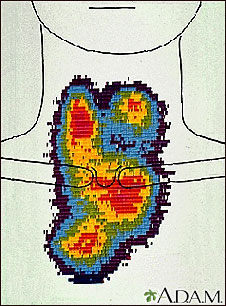
- An imaging test called a radioactive iodine (I-131) uptake scan
- Repeat FNAB
Support Groups
You can ease the stress of illness by joining a cancer support group. Sharing with others who have common experiences and problems can help you not feel alone.
Outlook (Prognosis)
The survival rate for papillary thyroid cancer is excellent. More than 95% of adults with this cancer survive at least 5 years. The prognosis is better for people who are younger than 40 and for those with smaller tumors.
The following factors may decrease the survival rate:
- Older than 55 years of age
- Cancer that has spread to distant parts of the body
- Cancer that has spread to soft tissue around the thyroid
- Large tumor
Possible Complications
Complications include:
- Accidental removal of the parathyroid glands, which help regulate blood calcium levels
- Damage to the nerve that controls the vocal cords
- Spreading of cancer to lymph nodes
- Spreading of cancer to other sites (metastasis) - lung and bone are the most common sites if this occurs
When to Contact a Medical Professional
Contact your provider if you have a lump in your neck.
Related Information
Thyroid cancerAnaplastic thyroid cancer
Thyroid cancer - medullary carcinoma
Cancer
Metastasis
References
Asban A, Patel AJ, Reddy S, Wang T, Balentine CJ, Chen H. Cancer of the endocrine system. In: Niederhuber JE, Armitage JO, Kastan MB, Doroshow JH, Tepper JE, eds. Abeloff's Clinical Oncology. 6th ed. Philadelphia, PA: Elsevier; 2020:chap 68.
National Cancer Institute website. Thyroid cancer treatment (PDQ) - health professional version. www.cancer.gov/types/thyroid/hp/thyroid-treatment-pdq. Updated May 9, 2025. Accessed March 31, 2026.
National Comprehensive Cancer Network website. NCCN clinical practice guidelines in oncology (NCCN guidelines): thyroid carcinoma. Version 2.2026. www.nccn.org/professionals/physician_gls/pdf/thyroid.pdf. Updated June 2, 2026. Accessed July 23, 2026.
Pearce EN, Hollenberg AN. Thyroid. In: Goldman L, Cooney KA, eds. Goldman-Cecil Medicine. 27th ed. Philadelphia, PA: Elsevier; 2024:chap 207.
Ringel MD, Sosa JA, Baloch Z, et al. 2025 American Thyroid Association management guidelines for adults with differentiated thyroid cancer. Thyroid. 2025;35(8):841-985. PMID: 40844370 pubmed.ncbi.nlm.nih.gov/40844370/.
BACK TO TOPReview Date: 1/29/2026
Reviewed By: Warren Brenner, MD, Oncologist, Lynn Cancer Institute, Boca Raton, FL. Review provided by VeriMed Healthcare Network. Also reviewed by David C. Dugdale, MD, Medical Director, Brenda Conaway, Editorial Director, and the A.D.A.M. Editorial team.
 | A.D.A.M., Inc. is accredited by URAC, for Health Content Provider (www.urac.org). URAC's accreditation program is an independent audit to verify that A.D.A.M. follows rigorous standards of quality and accountability. A.D.A.M. is among the first to achieve this important distinction for online health information and services. Learn more about A.D.A.M.'s editorial policy, editorial process and privacy policy. A.D.A.M. is also a founding member of Hi-Ethics. This site complies with the HONcode standard for trustworthy health information: verify here. |
The information provided herein should not be used during any medical emergency or for the diagnosis or treatment of any medical condition. A licensed medical professional should be consulted for diagnosis and treatment of any and all medical conditions. Links to other sites are provided for information only -- they do not constitute endorsements of those other sites. No warranty of any kind, either expressed or implied, is made as to the accuracy, reliability, timeliness, or correctness of any translations made by a third-party service of the information provided herein into any other language.
© 1997-
2026 A.D.A.M., a business unit of Ebix, Inc. Any duplication or distribution of the information contained herein is strictly prohibited.
All content on this site including text, images, graphics, audio, video, data, metadata, and compilations is protected by copyright and other intellectual property laws. You may view the content for personal, noncommercial use. Any other use requires prior written consent from Ebix. You may not copy, reproduce, distribute, transmit, display, publish, reverse-engineer, adapt, modify, store beyond ordinary browser caching, index, mine, scrape, or create derivative works from this content. You may not use automated tools to access or extract content, including to create embeddings, vectors, datasets, or indexes for retrieval systems. Use of any content for training, fine-tuning, calibrating, testing, evaluating, or improving AI systems of any kind is prohibited without express written consent. This includes large language models, machine learning models, neural networks, generative systems, retrieval-augmented systems, and any software that ingests content to produce outputs. Any unauthorized use of the content including AI-related use is a violation of our rights and may result in legal action, damages, and statutory penalties to the fullest extent permitted by law. Ebix reserves the right to enforce its rights through legal, technological, and contractual measures.
