

Health Library
Thyroid gland removal
Total thyroidectomy; Partial thyroidectomy; Thyroidectomy; Subtotal thyroidectomy; Thyroid cancer - thyroidectomy; Papillary cancer - thyroidectomy; Goiter - thyroidectomy; Thyroid nodules - thyroidectomy
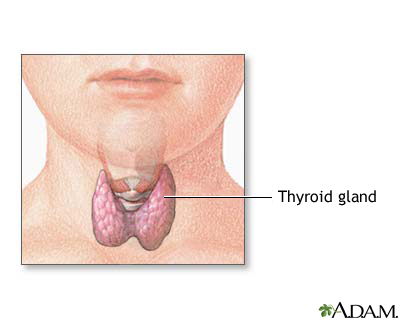
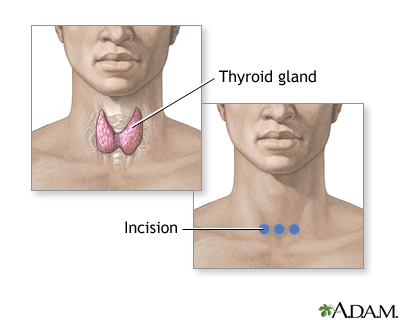
Thyroid gland removal is surgery to remove all or part of the thyroid gland. The thyroid gland is a butterfly-shaped gland located inside the front of the lower neck.
The thyroid gland is part of the hormone (endocrine) system. It helps your body regulate your metabolism.
Images
Presentation

I Would Like to Learn About:
Description
Depending on the reason you are having your thyroid gland removed, the type of thyroidectomy you have will be either a:
- Total thyroidectomy, which removes the entire gland
- Subtotal or partial thyroidectomy, which removes part of the thyroid gland
You will have general anesthesia (asleep and pain-free) for this surgery. In rare cases, the surgery is done with local anesthesia and medicine to relax you. You will be awake, but pain-free.
During the surgery:
- The surgeon makes a horizontal cut in the front of your lower neck just above the collar bones.
- All or part of the gland is removed through the cut.
- The surgeon is careful not to damage the blood vessels and nerves in your neck.
- A small tube (catheter) may be placed into the area to help drain blood and other fluids that build up. The drain will be removed in 1 or 2 days.
- The cuts are closed with sutures (stitches).
Surgery to remove your whole thyroid may take 2 to 3 hours. It may take less time if only part of the thyroid is removed.
Newer techniques that require a smaller incision near the thyroid or at other locations and which involve the use of endoscopy have been developed.
Why the Procedure Is Performed
Your health care provider may recommend thyroid removal if you have any of the following:
- A small thyroid growth (nodule or cyst)
- A thyroid gland that is so overactive it is dangerous (thyrotoxicosis)
- Cancer of the thyroid
- Noncancerous (benign) tumors of the thyroid that are causing symptoms
- Thyroid swelling (nontoxic goiter) that makes it hard for you to breathe or swallow
You may also have surgery if you have an overactive thyroid gland and do not want to have radioactive iodine treatment, or you cannot be treated with antithyroid medicines.
Risks
Risks of anesthesia and surgery in general include:
- Reactions to medicines
- Breathing problems
- Bleeding, blood clots, infection
Risks of thyroidectomy include:
- Injury to the nerves to your vocal cords and larynx.
- Bleeding and possible airway obstruction.
- A sharp rise in thyroid hormone levels (only around the time of surgery).
- Injury to the parathyroid glands (small glands near the thyroid) or to their blood supply. This can cause a low level of calcium in your blood (hypocalcemia).
- Too much thyroid hormone (thyroid storm or hyperthyroidism). If you have an overactive thyroid gland, you will be treated with medicine.
Before the Procedure
Tell your surgeon or nurse if:
- You are or could be pregnant
- You are taking any medicines, including medicines, drugs, supplements, or herbs you bought without a prescription
- You have been drinking a lot of alcohol, more than 1 or 2 drinks a day
- You may need to have tests that show exactly where the abnormal thyroid growth is located. This will help your surgeon find the growth during surgery. You may have a CT scan, ultrasound, or other imaging tests.
- Your provider may also do a fine needle aspiration to find out if the growth is noncancerous or cancerous. Before surgery, your vocal cord function may be checked.
- You may also need thyroid medicine or iodine treatments 1 to 2 weeks before your surgery.
- If you have diabetes, heart disease, or other medical conditions, your surgeon may ask you to see the provider who treats you for these conditions.
- If you smoke, it's important to cut back or quit. Smoking can slow healing and increase the risk for blood clots. Ask your provider for help quitting smoking.
- If needed, prepare your home to make it easier to recover after surgery.
- Ask your surgeon if you need to arrange to have someone drive you home after your surgery.
During the week before your surgery:
- You may be asked to temporarily stop taking medicines that keep your blood from clotting. These medicines are called blood thinners. This includes over-the-counter medicines and supplements such as aspirin, ibuprofen (Advil, Motrin), naproxen (Aleve, Naprosyn), and vitamin E. Many prescription medicines are also blood thinners.
- Ask your surgeon which medicines you should still take on the day of surgery.
- Fill any prescriptions for pain medicine and calcium you will need after surgery.
- Let your surgeon know about any illness you may have before your surgery. This includes COVID-19, a cold, flu, fever, herpes outbreak, or other illness. If you do get sick, your surgery may need to be postponed.
On the day of surgery:
- Follow instructions about when to stop eating and drinking.
- Take the medicines your surgeon told you to take with a small sip of water.
- Arrive at the hospital on time.
After the Procedure
You will probably go home the day of or the day after surgery. In rare cases, you may need to spend up to 3 days in the hospital. You must be able to swallow liquids before you can go home.
Your surgeon may check the calcium level in your blood after surgery. This is done more often when the whole thyroid gland is removed.
You may have some pain after surgery. Ask your surgeon for instructions on how to take pain medicines after you go home.
It should take about 4 to 6 weeks for you to fully recover.
Follow any instructions for taking care of yourself after you go home.
Outlook (Prognosis)
The outcome of this surgery is usually excellent. Most people need to take thyroid hormone pills (thyroid hormone replacement) for the rest of their lives when the whole gland is removed.
Related Information
Endocrine glandsMetabolism
Hypothyroidism
Hyperthyroidism
Thyroid cancer
Simple goiter
Thyroid nodule
Surgical wound care - open
Thyroid gland removal - discharge
References
Pace-Asciak P, Russell JO, Razavi CR, et al. Surgical management of thyroid disease. In: Robertson RP, ed. DeGroot's Endocrinology. 8th ed. Philadelphia, PA: Elsevier; 2023:chap 82.
Patel KN, Yip L, Lubitz CC, et al. Executive summary of the American Association of Endocrine Surgeons guidelines for the definitive surgical management of thyroid disease in adults. Ann Surg. 2020;271(3):399-410. PMID: 32079828 pubmed.ncbi.nlm.nih.gov/32079828/.
Ullmann T, Kim J, Lindeman B, Sosa JA. The thyroid. In: Tyler DS, Hayes-Dixon A, Hines OJ, et al, eds. Sabiston Textbook of Surgery. 22nd ed. Philadelphia, PA: Elsevier; 2026:chap 73.
BACK TO TOPReview Date: 1/1/2026
Reviewed By: Ann M. Rogers, MD, FACS, Professor Emeritus, Department of Surgery, Penn State College of Medicine, Hershey, PA. Also reviewed by David C. Dugdale, MD, Medical Director, Brenda Conaway, Editorial Director, and the A.D.A.M. Editorial team.
 | A.D.A.M., Inc. is accredited by URAC, for Health Content Provider (www.urac.org). URAC's accreditation program is an independent audit to verify that A.D.A.M. follows rigorous standards of quality and accountability. A.D.A.M. is among the first to achieve this important distinction for online health information and services. Learn more about A.D.A.M.'s editorial policy, editorial process and privacy policy. A.D.A.M. is also a founding member of Hi-Ethics. This site complies with the HONcode standard for trustworthy health information: verify here. |
The information provided herein should not be used during any medical emergency or for the diagnosis or treatment of any medical condition. A licensed medical professional should be consulted for diagnosis and treatment of any and all medical conditions. Links to other sites are provided for information only -- they do not constitute endorsements of those other sites. No warranty of any kind, either expressed or implied, is made as to the accuracy, reliability, timeliness, or correctness of any translations made by a third-party service of the information provided herein into any other language.
© 1997-
2026 A.D.A.M., a business unit of Ebix, Inc. Any duplication or distribution of the information contained herein is strictly prohibited.
All content on this site including text, images, graphics, audio, video, data, metadata, and compilations is protected by copyright and other intellectual property laws. You may view the content for personal, noncommercial use. Any other use requires prior written consent from Ebix. You may not copy, reproduce, distribute, transmit, display, publish, reverse-engineer, adapt, modify, store beyond ordinary browser caching, index, mine, scrape, or create derivative works from this content. You may not use automated tools to access or extract content, including to create embeddings, vectors, datasets, or indexes for retrieval systems. Use of any content for training, fine-tuning, calibrating, testing, evaluating, or improving AI systems of any kind is prohibited without express written consent. This includes large language models, machine learning models, neural networks, generative systems, retrieval-augmented systems, and any software that ingests content to produce outputs. Any unauthorized use of the content including AI-related use is a violation of our rights and may result in legal action, damages, and statutory penalties to the fullest extent permitted by law. Ebix reserves the right to enforce its rights through legal, technological, and contractual measures.
