

Renal cell carcinoma
Renal cancer; Kidney cancer; Hypernephroma; Adenocarcinoma of renal cells; Cancer - kidney
Renal cell carcinoma is a type of kidney cancer that starts in the lining of very small tubes (tubules) in the kidney.
Causes
Renal cell carcinoma is the most common type of kidney cancer in adults. It occurs most often in men 60 to 70 years old.
The exact cause is unknown.
The following may increase your risk of kidney cancer:
- Smoking
- Obesity
- Dialysis treatment
- Family history of the disease
- High blood pressure (hypertension)
- Horseshoe kidney
- Long-term use of certain medicines, such as pain pills or water pills (diuretics)
- Polycystic kidney disease
- Von Hippel-Lindau syndrome (a hereditary disease that affects blood vessels in the brain, eyes, and other body parts)
- Birt-Hogg-Dube syndrome (a genetic disease associated with benign skin tumors and lung cysts)




Symptoms
Symptoms of this cancer may include any of the following:
- Abdominal pain and swelling
- Back pain
- Blood in the urine
- Swelling of the veins around a testicle (varicocele)
- Flank pain
- Weight loss
- Fever
- Liver dysfunction
- Elevated erythrocyte sedimentation rate (ESR)
- Excessive hair growth in females
- Pale skin
- Vision problems



Exams and Tests
Your health care provider will perform a physical exam. This may reveal a mass or swelling of the abdomen.
Tests that may be ordered include:
- Abdominal CT scan
- Blood chemistry
- Complete blood count (CBC)
- Intravenous pyelogram (IVP)
- Liver function tests
- Renal arteriography
- Ultrasound of the abdomen and kidney
- Urinalysis


The following tests may be done to see if the cancer has spread:
- Abdominal MRI
- Biopsy
- Bone scan
- Chest x-ray
- Chest CT scan
- PET scan


Treatment
Surgery to remove all or part of the kidney (nephrectomy) is usually recommended. The surrounding tissues or lymph nodes may also be removed. A cure is unlikely unless all of the cancer is removed with surgery. But even if some cancer is left behind, there may be a benefit from surgery.

Chemotherapy is not effective for treating kidney cancer in adults. Newer immune system medicines (immunotherapy) and medicines known as tyrosine kinase inhibitors have improved the outcome for many people. Your provider can tell you more.
Radiation therapy is usually done only when the cancer spreads to the bone or brain.

Support Groups
You can ease the stress of illness by joining a support group whose members share common experiences and problems.
Outlook (Prognosis)
Sometimes, both kidneys are involved. The cancer spreads easily, most often to the lungs and other organs. In about one fourth of people, the cancer has already spread (metastasized) at the time of diagnosis.
How well someone with kidney cancer does depends on how much the cancer has spread and how well treatment works. The survival rate is highest if the tumor is in the early stages and has not spread outside the kidney. If it has spread to the lymph nodes or to other organs, the survival rate is much lower.
Possible Complications
Complications of kidney cancer include:
- High blood pressure
- Too much calcium in the blood (hypercalcemia)
- High red blood cell count (erythrocytosis)
- Spread of the cancer

When to Contact a Medical Professional
Contact your provider any time you see blood in the urine. Also contact your provider if you have any other symptoms of this disorder.
Prevention
Stop smoking. Follow your provider's recommendations in the treatment of kidney disorders, especially those that may require dialysis.
References
Fan AC, Leppert JT. Kidney cancer. In: Luyckx VA, Chertow GM, Yu ASL, Marsden PA, Skorecki K, Taal MW, eds. Brenner and Rector's The Kidney. 12th ed. Philadelphia, PA: Elsevier; 2026:chap 43.
McNamara MA, Zhang T, Harrison MR, George DJ. Cancer of the kidney. In: Niederhuber JE, Armitage JO, Kastan MB, Doroshow JH, Tepper JE, eds. Abeloff's Clinical Oncology. 6th ed. Philadelphia, PA: Elsevier; 2020:chap 79.
National Cancer Institute website. Renal cell cancer treatment (PDQ) -- health professional version. www.cancer.gov/types/kidney/hp/kidney-treatment-pdq. Updated May 13, 2025. Accessed April 1, 2026.
National Comprehensive Cancer Network website. NCCN clinical practice guidelines in oncology (NCCN guidelines): kidney cancer. Version 1. 2026. www.nccn.org/professionals/physician_gls/pdf/kidney.pdf . Updated July 24, 2025. Accessed April 1, 2026.
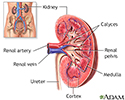
Kidney anatomy - illustration
Kidney anatomy
illustration
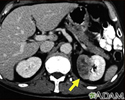
Kidney tumor - CT scan - illustration
Kidney tumor - CT scan
illustration
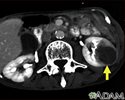
Kidney metastases - CT scan - illustration
Kidney metastases - CT scan
illustration
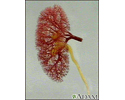
Kidney - blood and urine flow - illustration
Kidney - blood and urine flow
illustration
Review Date: 1/29/2026
Reviewed By: Warren Brenner, MD, Oncologist, Lynn Cancer Institute, Boca Raton, FL. Review provided by VeriMed Healthcare Network. Also reviewed by David C. Dugdale, MD, Medical Director, Brenda Conaway, Editorial Director, and the A.D.A.M. Editorial team.
© 1997- A.D.A.M., a business unit of Ebix, Inc. Any duplication or distribution of the information contained herein is strictly prohibited.
 All rights reserved.