

Health Library
Rocky Mountain spotted fever
Spotted fever
Rocky Mountain spotted fever (RMSF) is a disease caused by a type of bacteria carried by ticks.
Images


I Would Like to Learn About:
Causes
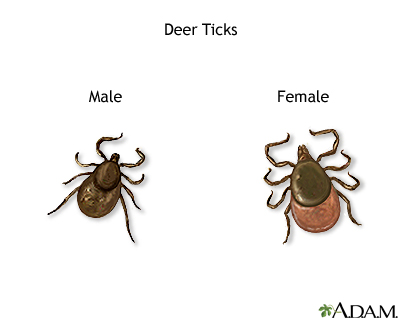
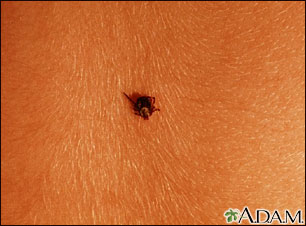
RMSF is caused by the bacterium Rickettsia rickettsii (R Rickettsii), which is carried by ticks. The bacteria spread to humans through a tick bite.
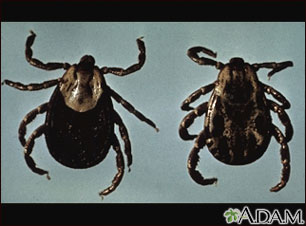
In the western United States, the bacteria are carried by the wood tick. In the eastern US, they are carried by the dog tick. Other ticks spread the infection in the southern US and in Central and South America.
Contrary to the name Rocky Mountain, most recent cases have been reported in the eastern US, including North and South Carolina, Virginia, Georgia, Tennessee, and Oklahoma. Most cases occur in the spring and summer and are found in children.
Risk factors include recent hiking or exposure to ticks in an area where the disease is known to occur. The bacteria are unlikely to be transmitted to a person by a tick that has been attached for less than 20 hours. Only about 1 in 1,000 ticks carry the bacteria. Bacteria can also infect people who crush ticks they have removed from pets with their bare fingers. Not all people will remember getting a tick bite.
Symptoms
Symptoms usually develop about 2 to 14 days after the tick bite. They may include:
- Chills and fever
- Confusion
- Headache
- Muscle pain
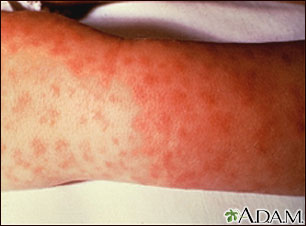
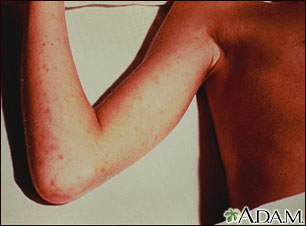
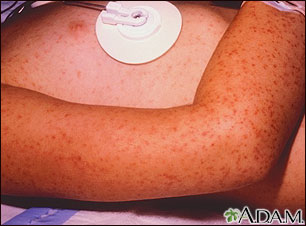
- Rash -- usually starts a few days after the fever; first appears on wrists and ankles as spots that are 1 to 5 mm in diameter, then spreads to most of the body. Some infected people don't get a rash.
Other symptoms that may occur with this disease:
Exams and Tests
Your health care provider will perform a physical examination and ask about your symptoms.
Tests that may be done include:
- Antibody titer by complement fixation or immunofluorescence
- Complete blood count (CBC)
- Kidney function tests
- Partial thromboplastin time (PTT)
- Prothrombin time (PT)
- Skin biopsy taken from the rash to check for R. rickettsii
- Urinalysis to check for blood or protein in the urine
Treatment
Treatment involves antibiotics and carefully removing the tick from the skin. To get rid of the infection, antibiotics such as doxycycline or tetracycline need to be taken. Pregnant women are usually prescribed chloramphenicol.
Outlook (Prognosis)
Treatment usually cures the infection. About 3% of people who get this disease will die.
Possible Complications
Untreated, the infection may lead to health problems such as:
- Brain damage
- Clotting problems
- Heart failure
- Kidney failure
- Lung failure
- Meningitis
- Pneumonitis (lung inflammation)
- Shock
When to Contact a Medical Professional
Contact your provider if you develop symptoms after exposure to ticks or a tick bite. The complications of untreated RMSF are often life threatening.
Prevention
When walking or hiking in tick-infested areas, tuck long pants into socks to protect the legs. Wear shoes and long-sleeved shirts. Ticks will show up on white or light colors better than on dark colors, making them easier to see and remove.
Remove ticks immediately by using tweezers, pulling carefully and steadily. Insect repellent may be helpful. Because only about 1 in 1,000 ticks carry this infection, antibiotics are not usually given after a tick bite.
Related Information
Tick biteRespiratory
Heart failure
Meningitis
References
Blanton LS, Paddock CD, Walker DH. Rickettsia rickettsii and other spotted fever group rickettsiae (Rocky Mountain spotted fever and other spotted fevers). In: Blaser MJ, Cohen JI, Holland SM, et al, eds. Mandell, Douglas, and Bennett's Principles and Practice of Infectious Diseases. 10th ed. Philadelphia, PA: Elsevier; 2026:chap 192.
Fournier P-E, Raoult D. Rickettsial infections. Goldman L, Cooney KA, eds. Goldman-Cecil Medicine. 27th ed. Philadelphia, PA: Elsevier; 2024:chap 302.
BACK TO TOPReview Date: 5/12/2025
Reviewed By: Jatin M. Vyas, MD, PhD, Roy and Diana Vagelos Professor in Medicine, Columbia University Vagelos College of Physicians and Surgeons, Division of Infectious Diseases, Department of Medicine, New York, NY. Also reviewed by David C. Dugdale, MD, Medical Director, Brenda Conaway, Editorial Director, and the A.D.A.M. Editorial team.
 | A.D.A.M., Inc. is accredited by URAC, for Health Content Provider (www.urac.org). URAC's accreditation program is an independent audit to verify that A.D.A.M. follows rigorous standards of quality and accountability. A.D.A.M. is among the first to achieve this important distinction for online health information and services. Learn more about A.D.A.M.'s editorial policy, editorial process and privacy policy. A.D.A.M. is also a founding member of Hi-Ethics. This site complies with the HONcode standard for trustworthy health information: verify here. |
The information provided herein should not be used during any medical emergency or for the diagnosis or treatment of any medical condition. A licensed medical professional should be consulted for diagnosis and treatment of any and all medical conditions. Links to other sites are provided for information only -- they do not constitute endorsements of those other sites. No warranty of any kind, either expressed or implied, is made as to the accuracy, reliability, timeliness, or correctness of any translations made by a third-party service of the information provided herein into any other language.
© 1997-
2026 A.D.A.M., a business unit of Ebix, Inc. Any duplication or distribution of the information contained herein is strictly prohibited.
All content on this site including text, images, graphics, audio, video, data, metadata, and compilations is protected by copyright and other intellectual property laws. You may view the content for personal, noncommercial use. Any other use requires prior written consent from Ebix. You may not copy, reproduce, distribute, transmit, display, publish, reverse-engineer, adapt, modify, store beyond ordinary browser caching, index, mine, scrape, or create derivative works from this content. You may not use automated tools to access or extract content, including to create embeddings, vectors, datasets, or indexes for retrieval systems. Use of any content for training, fine-tuning, calibrating, testing, evaluating, or improving AI systems of any kind is prohibited without express written consent. This includes large language models, machine learning models, neural networks, generative systems, retrieval-augmented systems, and any software that ingests content to produce outputs. Any unauthorized use of the content including AI-related use is a violation of our rights and may result in legal action, damages, and statutory penalties to the fullest extent permitted by law. Ebix reserves the right to enforce its rights through legal, technological, and contractual measures.
