

Health Library
Kidney transplant - series
Normal anatomy
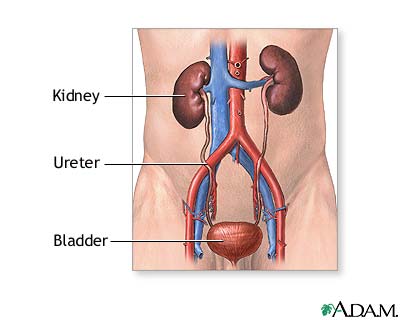
The kidneys are paired organs that lie posterior to the abdomen, in the area of the lower back. The kidneys make urine, which is transported from the kidneys to the bladder by the ureters, long muscular tubes which connect the kidneys with the bladder.
Indications
Kidney transplant may be recommended for patients with kidney failure caused by:
- Severe, uncontrollable high blood pressure (hypertension)
- Infections
- Diabetes mellitus
- Congenital abnormalities of the kidneys
- Other diseases which cause renal failure, such as autoimmune disease
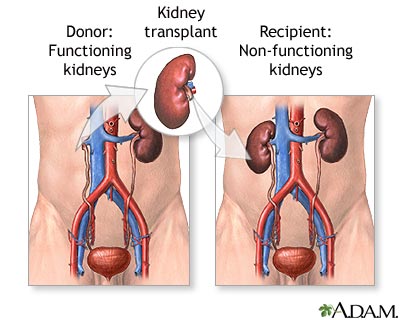
Donor kidneys are obtained from either brain-dead organ donors, or from living relatives or friends of the recipient.
Incision
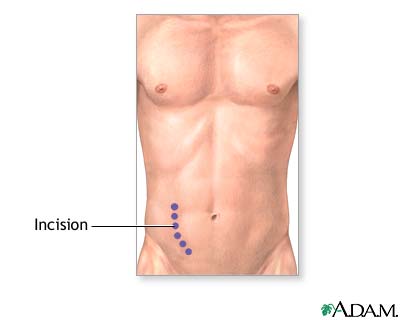
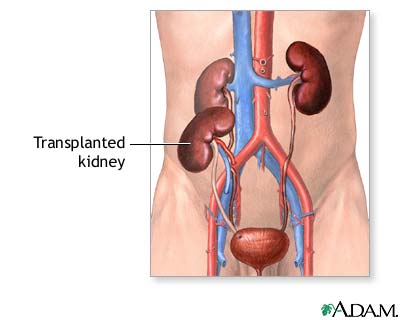
While the patient is deep asleep and pain-free (general anesthesia), an incision is made in the lower right quadrant of the abdomen. The donor kidney is transplanted into the right lower pelvis of the recipient.
Procedure
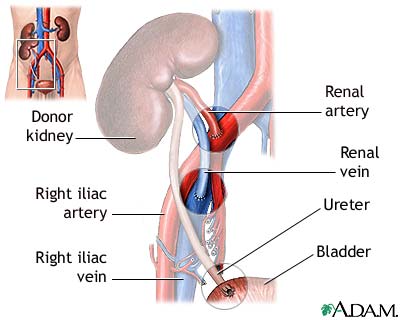
The new kidney is sutured into place. The vessels of the new kidney are connected to the vessels leading to the right leg (the iliac vessels), and the ureter is sutured to the bladder.
Aftercare
In most cases, the recipient's native kidneys are left in place, and the transplanted kidney performs all the functions that both kidneys perform in healthy people. Kidney transplant recipients are required to take immunosuppressive medications for the rest of the lives, to prevent immune rejection of the transplanted organ.
BACK TO TOP
Review Date: 4/1/2025
Reviewed By: Kelly L. Stratton, MD, FACS, Associate Professor, Department of Urology, University of Oklahoma Health Sciences Center, Oklahoma City, OK. Also reviewed by David C. Dugdale, MD, Medical Director, Brenda Conaway, Editorial Director, and the A.D.A.M. Editorial team.
 | A.D.A.M., Inc. is accredited by URAC, for Health Content Provider (www.urac.org). URAC's accreditation program is an independent audit to verify that A.D.A.M. follows rigorous standards of quality and accountability. A.D.A.M. is among the first to achieve this important distinction for online health information and services. Learn more about A.D.A.M.'s editorial policy, editorial process and privacy policy. A.D.A.M. is also a founding member of Hi-Ethics. This site complies with the HONcode standard for trustworthy health information: verify here. |
The information provided herein should not be used during any medical emergency or for the diagnosis or treatment of any medical condition. A licensed medical professional should be consulted for diagnosis and treatment of any and all medical conditions. Links to other sites are provided for information only -- they do not constitute endorsements of those other sites. No warranty of any kind, either expressed or implied, is made as to the accuracy, reliability, timeliness, or correctness of any translations made by a third-party service of the information provided herein into any other language.
© 1997-
2026 A.D.A.M., a business unit of Ebix, Inc. Any duplication or distribution of the information contained herein is strictly prohibited.
All content on this site including text, images, graphics, audio, video, data, metadata, and compilations is protected by copyright and other intellectual property laws. You may view the content for personal, noncommercial use. Any other use requires prior written consent from Ebix. You may not copy, reproduce, distribute, transmit, display, publish, reverse-engineer, adapt, modify, store beyond ordinary browser caching, index, mine, scrape, or create derivative works from this content. You may not use automated tools to access or extract content, including to create embeddings, vectors, datasets, or indexes for retrieval systems. Use of any content for training, fine-tuning, calibrating, testing, evaluating, or improving AI systems of any kind is prohibited without express written consent. This includes large language models, machine learning models, neural networks, generative systems, retrieval-augmented systems, and any software that ingests content to produce outputs. Any unauthorized use of the content including AI-related use is a violation of our rights and may result in legal action, damages, and statutory penalties to the fullest extent permitted by law. Ebix reserves the right to enforce its rights through legal, technological, and contractual measures.
