

Health Library
Heterochromia
Differently colored eyes; Eyes - different colors
Heterochromia is different colored eyes in the same person.
Images
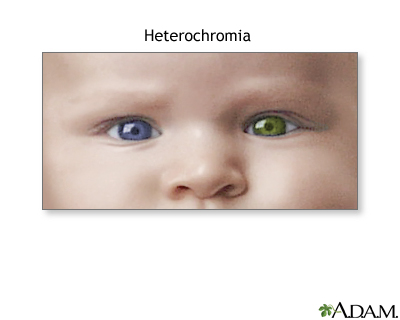
I Would Like to Learn About:
Considerations
Heterochromia is uncommon in humans. However, it is quite common in dogs (such as Dalmatians and Australian sheep dogs), cats, and horses.
Causes
Most cases of heterochromia are hereditary, caused by a disease or syndrome, or due to an injury. Sometimes, one eye may change color following certain diseases or injuries.
Specific causes of eye color changes include:
- Bleeding (hemorrhage)
- Familial heterochromia
- Foreign object in the eye
- Glaucoma, or some medicines used to treat it
- Injury
- Mild inflammation affecting only one eye
- Neurofibromatosis
- Waardenburg syndrome
When to Contact a Medical Professional
Talk to your health care provider if you notice new changes in the color of one eye, or two differently colored eyes in your infant. A thorough eye exam is needed to rule out a medical problem.
Some conditions and syndromes associated with heterochromia, such as pigmentary glaucoma, can only be detected by a thorough eye exam.
What to Expect at Your Office Visit
Your provider may ask the following questions to help evaluate the cause:
- Did you notice the two different eye colors when the child was born, shortly after the birth, or recently?
- Are any other symptoms present?
An infant with heterochromia should be examined by both a pediatrician and an ophthalmologist for other possible problems.
A complete eye exam can rule out most causes of heterochromia. If there doesn't seem to be an underlying disorder, no further testing may be needed. If another disorder is suspected diagnostic tests, such as blood tests or chromosome studies, may be done to confirm the diagnosis.
References
Nischal KK. Ophthalmology. In: Zitelli BJ, McIntire SC, Nowalk AJ, Garrison J, eds. Zitelli and Davis' Atlas of Pediatric Physical Diagnosis. 8th ed. Philadelphia, PA: Elsevier; 2023:chap 20.
Olitsky SE, Marsh JD. Abnormalities of pupil and iris. In: Kliegman RM, St. Geme JW, Blum NJ, et al, eds. Nelson Textbook of Pediatrics. 22nd ed. Philadelphia, PA: Elsevier; 2025:chap 662.
Örge FH, Salem ZM. Examination and common problems in the neonatal eye. In: Martin RJ, Fanaroff AA, eds. Fanaroff and Martin's Neonatal-Perinatal Medicine. 12th ed. Philadelphia, PA: Elsevier; 2025:chap 99.
BACK TO TOPReview Date: 10/1/2025
Reviewed By: Charles I. Schwartz, MD, FAAP, Clinical Assistant Professor of Pediatrics, Regional Medical Director of Penn Medicine Primary and Specialty Care, Perelman School of Medicine at the University of Pennsylvania, General Pediatrician at PennCare for Kids, Phoenixville, PA. Also reviewed by David C. Dugdale, MD, Medical Director, Brenda Conaway, Editorial Director, and the A.D.A.M. Editorial team.
 | A.D.A.M., Inc. is accredited by URAC, for Health Content Provider (www.urac.org). URAC's accreditation program is an independent audit to verify that A.D.A.M. follows rigorous standards of quality and accountability. A.D.A.M. is among the first to achieve this important distinction for online health information and services. Learn more about A.D.A.M.'s editorial policy, editorial process and privacy policy. A.D.A.M. is also a founding member of Hi-Ethics. This site complies with the HONcode standard for trustworthy health information: verify here. |
The information provided herein should not be used during any medical emergency or for the diagnosis or treatment of any medical condition. A licensed medical professional should be consulted for diagnosis and treatment of any and all medical conditions. Links to other sites are provided for information only -- they do not constitute endorsements of those other sites. No warranty of any kind, either expressed or implied, is made as to the accuracy, reliability, timeliness, or correctness of any translations made by a third-party service of the information provided herein into any other language.
© 1997-
2026 A.D.A.M., a business unit of Ebix, Inc. Any duplication or distribution of the information contained herein is strictly prohibited.
All content on this site including text, images, graphics, audio, video, data, metadata, and compilations is protected by copyright and other intellectual property laws. You may view the content for personal, noncommercial use. Any other use requires prior written consent from Ebix. You may not copy, reproduce, distribute, transmit, display, publish, reverse-engineer, adapt, modify, store beyond ordinary browser caching, index, mine, scrape, or create derivative works from this content. You may not use automated tools to access or extract content, including to create embeddings, vectors, datasets, or indexes for retrieval systems. Use of any content for training, fine-tuning, calibrating, testing, evaluating, or improving AI systems of any kind is prohibited without express written consent. This includes large language models, machine learning models, neural networks, generative systems, retrieval-augmented systems, and any software that ingests content to produce outputs. Any unauthorized use of the content including AI-related use is a violation of our rights and may result in legal action, damages, and statutory penalties to the fullest extent permitted by law. Ebix reserves the right to enforce its rights through legal, technological, and contractual measures.
