

Health Library
Pityriasis rubra pilaris
PRP; Pityriasis pilaris; Lichen ruber acuminatus; Devergie disease
Pityriasis rubra pilaris (PRP) is a rare skin disorder that causes inflammation and scaling (exfoliation) of the skin.
Images
I Would Like to Learn About:
Causes
There are several subtypes of PRP. The cause is unknown, although genetic factors and an abnormal immune response may be involved. One subtype is associated with HIV/AIDS.
Symptoms
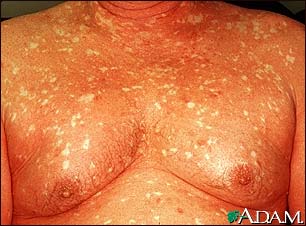
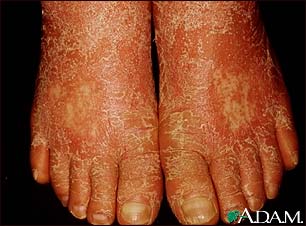
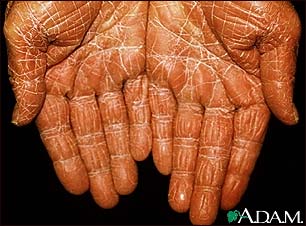
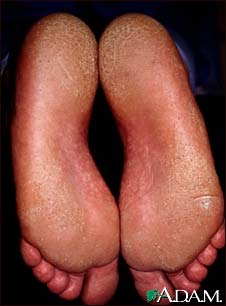
PRP is a chronic skin condition in which orange or salmon-colored scaly patches with thick skin develop on the hands and feet.
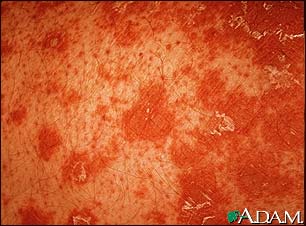
The scaly areas may cover much of the body. Small islands of normal skin (called islands of sparing) are seen within the areas of the scaly skin. The scaly areas may be itchy. There may be changes in the nails.
PRP can be severe. Although it's not life threatening, PRP can greatly reduce quality of life and limit activities of daily living.
Exams and Tests
Your health care provider will examine your skin. The diagnosis is usually made by the presence of the unique skin lesions (an abnormal area on the skin). Your provider may take samples (biopsies) of the affected skin to confirm the diagnosis and check for conditions that may look like PRP.
Treatment
Topical creams containing urea, lactic acid, retinoids, and steroids may help. More commonly, treatment includes pills taken by mouth such as isotretinoin, acitretin, or methotrexate. Exposure to ultraviolet light (light therapy) may also help. Medicines that affect the body's immune system are currently being studied and may be effective for PRP.
Support Groups
More information and support for people with PRP disorder and their families can be found at:
- National Institute of Health. Genetic and Rare Diseases Information Center -- rarediseases.info.nih.gov/diseases/7401/pityriasis-rubra-pilaris
- National Organization for Rare Disorders -- rarediseases.org/rare-diseases/pityriasis-rubra-pilaris/
When to Contact a Medical Professional
Contact your provider if you develop symptoms of PRP. Also contact your provider if you have the condition and symptoms worsen.
Related Information
ScalesReferences
James WD. Papulosquamous, pustular and keratotic disorders. In: James WD, ed. Andrews' Diseases of the Skin: Clinical Dermatology. 14th ed. Philadelphia, PA: Elsevier; 2026:chap 10.
Patterson JW. Disorders of pigmentation. In: Patterson JW, ed. Weedon's Skin Pathology. 6th ed. Philadelphia, PA: Elsevier; 2025:chap 11.
Whittaker S. Erythroderma. In: Bolognia JL, Schaffer JV, Cerroni L, eds. Dermatology. 5th ed. Philadelphia, PA: Elsevier; 2025:chap 10.
BACK TO TOPReview Date: 4/1/2025
Reviewed By: Elika Hoss, MD, Assistant Professor of Dermatology, Mayo Clinic, Scottsdale, AZ. Also reviewed by David C. Dugdale, MD, Medical Director, Brenda Conaway, Editorial Director, and the A.D.A.M. Editorial team.
 | A.D.A.M., Inc. is accredited by URAC, for Health Content Provider (www.urac.org). URAC's accreditation program is an independent audit to verify that A.D.A.M. follows rigorous standards of quality and accountability. A.D.A.M. is among the first to achieve this important distinction for online health information and services. Learn more about A.D.A.M.'s editorial policy, editorial process and privacy policy. A.D.A.M. is also a founding member of Hi-Ethics. This site complies with the HONcode standard for trustworthy health information: verify here. |
The information provided herein should not be used during any medical emergency or for the diagnosis or treatment of any medical condition. A licensed medical professional should be consulted for diagnosis and treatment of any and all medical conditions. Links to other sites are provided for information only -- they do not constitute endorsements of those other sites. No warranty of any kind, either expressed or implied, is made as to the accuracy, reliability, timeliness, or correctness of any translations made by a third-party service of the information provided herein into any other language.
© 1997-
2026 A.D.A.M., a business unit of Ebix, Inc. Any duplication or distribution of the information contained herein is strictly prohibited.
All content on this site including text, images, graphics, audio, video, data, metadata, and compilations is protected by copyright and other intellectual property laws. You may view the content for personal, noncommercial use. Any other use requires prior written consent from Ebix. You may not copy, reproduce, distribute, transmit, display, publish, reverse-engineer, adapt, modify, store beyond ordinary browser caching, index, mine, scrape, or create derivative works from this content. You may not use automated tools to access or extract content, including to create embeddings, vectors, datasets, or indexes for retrieval systems. Use of any content for training, fine-tuning, calibrating, testing, evaluating, or improving AI systems of any kind is prohibited without express written consent. This includes large language models, machine learning models, neural networks, generative systems, retrieval-augmented systems, and any software that ingests content to produce outputs. Any unauthorized use of the content including AI-related use is a violation of our rights and may result in legal action, damages, and statutory penalties to the fullest extent permitted by law. Ebix reserves the right to enforce its rights through legal, technological, and contractual measures.
