

Health Library
Obesity hypoventilation syndrome (OHS)
Pickwickian syndrome
Obesity hypoventilation syndrome (OHS) causes poor breathing in some people with obesity. It leads to lower oxygen and higher carbon dioxide levels in the blood.
Images
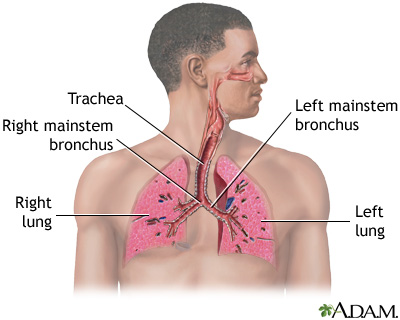
I Would Like to Learn About:
Causes
The exact cause of OHS is not known. It is believed that OHS results from a defect in the brain's control over breathing. Excess weight against the chest wall also makes it harder for the muscles to draw in a deep breath and to breathe quickly enough. This worsens the brain's breathing control. As a result, the blood contains too much carbon dioxide and not enough oxygen.
Over time, the kidneys help the body compensate for the carbon dioxide that builds up.
Symptoms
The main symptoms of OHS are due to lack of sleep and include:
- Poor sleep quality
- Sleep apnea
- Daytime sleepiness
- Depression
- Headaches
- Tiredness
Symptoms of low blood oxygen level (chronic hypoxia) and high carbon dioxide can occur. Symptoms include shortness of breath or feeling tired after little effort.
Exams and Tests
People with OHS have obesity (body mass index of 30 kg/m2 or greater). A physical exam may show:
- Bluish color in the lips, fingers, toes, or skin (cyanosis)
- Reddish skin
- Signs of right-sided heart failure (cor pulmonale), such as swollen legs or feet, shortness of breath, or feeling tired after little effort
- Signs of extreme sleepiness
Tests used to help diagnose OHS include:
- Arterial blood gas
- Chest x-ray or CT scan of the chest to check for other possible causes
- Lung function tests (pulmonary function tests)
- Sleep study (polysomnography)
- Echocardiogram (ultrasound of the heart)
Health care providers can tell OHS from obstructive sleep apnea because a person with OHS has a high carbon dioxide level in their blood when awake.
Treatment
Treatment involves breathing assistance using special machines (mechanical ventilation). Options include:
- Noninvasive mechanical ventilation such as continuous positive airway pressure (CPAP) or bilevel positive airway pressure (BiPAP) through a mask that fits tightly over the nose or nose and mouth (mainly for sleep)
- Breathing help through an opening in the neck (tracheostomy) for severe cases
Oxygen therapy, by itself, is not a treatment for obesity hypoventilation syndrome. Treatment is started in the hospital or as an outpatient.
Other treatments are aimed at weight loss, which can reverse OHS, although it is often difficult to achieve.
Outlook (Prognosis)
Untreated, OHS can lead to serious heart and blood vessel problems, severe disability, or death.
Possible Complications
OHS complications related to a lack of sleep may include:
- Depression, agitation, irritability
- Increased risk for accidents or mistakes at work
- Problems with intimacy and sex
OHS can also cause heart problems, such as:
- High blood pressure (hypertension)
- Right-sided heart failure (cor pulmonale)
- High blood pressure in the lungs (pulmonary hypertension)
When to Contact a Medical Professional
Contact your provider if you are very tired during the day or have any other symptoms that suggest OHS.
Prevention
Maintain a healthy weight. Use your CPAP or BiPAP treatment as your provider prescribed.
Related Information
Obstructive sleep apnea - adultsRespiratory acidosis
Blue discoloration of the skin
High blood pressure in adults - hypertension
References
Malhotra A, Powell F. Disorders of ventilatory control. In: Goldman L, Cooney KA, eds. Goldman-Cecil Medicine. 27th ed. Philadelphia, PA: Elsevier; 2024:chap 74.
Mokhlesi B, Tamisier R. Obesity-hypoventilation syndrome. In: Kryger M, Roth T, Goldstein CA, Dement WC, eds. Principles and Practice of Sleep Medicine. 7th ed. Philadelphia, PA: Elsevier; 2022:chap 138.
Mokhlesi B, Masa JF, Brozek JL, et al. Evaluation and management of obesity hypoventilation syndrome. An official American Thoracic Society clinical practice guideline. Am J Respir Crit Care Med. 2019;200(3):e6-e24. PMID: 31368798 pubmed.ncbi.nlm.nih.gov/31368798/.
Redline S. Sleep-disordered breathing and cardiac disease. In: Libby P, Bonow RO, Mann DL, Tomaselli GF, Bhatt DL, Solomon SD, eds. Braunwald's Heart Disease: A Textbook of Cardiovascular Medicine. 12th ed. Philadelphia, PA: Elsevier; 2022:chap 89.
BACK TO TOPReview Date: 7/25/2025
Reviewed By: David A. Kaufman, MD, Director of Clinical Innovation and Education, Medical Critical Care, NYU Langone Medical Center, Tisch Hospital, NYU School of Medicine, New York, NY. Review provided by VeriMed Healthcare Network. Also reviewed by David C. Dugdale, MD, Medical Director, Brenda Conaway, Editorial Director, and the A.D.A.M. Editorial team.
 | A.D.A.M., Inc. is accredited by URAC, for Health Content Provider (www.urac.org). URAC's accreditation program is an independent audit to verify that A.D.A.M. follows rigorous standards of quality and accountability. A.D.A.M. is among the first to achieve this important distinction for online health information and services. Learn more about A.D.A.M.'s editorial policy, editorial process and privacy policy. A.D.A.M. is also a founding member of Hi-Ethics. This site complies with the HONcode standard for trustworthy health information: verify here. |
The information provided herein should not be used during any medical emergency or for the diagnosis or treatment of any medical condition. A licensed medical professional should be consulted for diagnosis and treatment of any and all medical conditions. Links to other sites are provided for information only -- they do not constitute endorsements of those other sites. No warranty of any kind, either expressed or implied, is made as to the accuracy, reliability, timeliness, or correctness of any translations made by a third-party service of the information provided herein into any other language.
© 1997-
2026 A.D.A.M., a business unit of Ebix, Inc. Any duplication or distribution of the information contained herein is strictly prohibited.
All content on this site including text, images, graphics, audio, video, data, metadata, and compilations is protected by copyright and other intellectual property laws. You may view the content for personal, noncommercial use. Any other use requires prior written consent from Ebix. You may not copy, reproduce, distribute, transmit, display, publish, reverse-engineer, adapt, modify, store beyond ordinary browser caching, index, mine, scrape, or create derivative works from this content. You may not use automated tools to access or extract content, including to create embeddings, vectors, datasets, or indexes for retrieval systems. Use of any content for training, fine-tuning, calibrating, testing, evaluating, or improving AI systems of any kind is prohibited without express written consent. This includes large language models, machine learning models, neural networks, generative systems, retrieval-augmented systems, and any software that ingests content to produce outputs. Any unauthorized use of the content including AI-related use is a violation of our rights and may result in legal action, damages, and statutory penalties to the fullest extent permitted by law. Ebix reserves the right to enforce its rights through legal, technological, and contractual measures.
