

Nikolsky sign
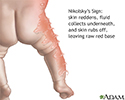
Nikolsky sign is a skin finding in which the top layers of the skin slip away from the lower layers when rubbed. A positive result is usually a sign of a blistering skin condition.
This sign is more common in newborn babies and in children under 5 years of age. It often begins in the mouth and on the neck, shoulder, arm pit, and genital areas. A child may be lethargic, irritable, and feverish. They may develop red painful blisters on the skin, which break easily.
Adults with disturbed kidney functions or with a weak immune system may have this sign. Your health care provider may use a pencil eraser or finger to test for Nikolsky sign. The skin is pulled to the side with a shearing pressure on the surface, or by rotating the eraser back and forth.
If the test result is positive, the very thin top layer of skin will shear off, leaving skin that is pink and moist, and usually very tender.
Causes
The Nikolsky sign can be often found in people with:
- Autoimmune blistering conditions such as pemphigus vulgaris
- Bacterial infections such as scalded skin syndrome
- Drug reactions such as erythema multiforme


When to Contact a Medical Professional
Contact your provider if you or your child develops painful loosening, redness, and blistering of the skin, for which you do not know the cause (for example, a skin burn).
What to Expect at Your Office Visit
The conditions associated with Nikolsky sign can be serious. Some people need to be admitted to the hospital. You will be asked about your medical history and given a physical exam.

The treatment will depend on the cause of the condition.
You may be given:
- Fluids and antibiotics through a vein (intravenously)
- Petroleum jelly to decrease pain
- Local wound care
Healing of the skin blisters occurs in about 1 to 2 weeks with no scarring.
References
James WD. Bacterial infections. In: James WD, ed. Andrews' Diseases of the Skin: Clinical Dermatology. 14th ed. Philadelphia, PA: Elsevier; 2026:chap 12.
James WD. Chronic blistering dermatoses. In: James WD, ed. Andrews' Diseases of the Skin: Clinical Dermatology. 14th ed. Philadelphia, PA: Elsevier; 2026:chap 16.
Joyce JC. Vesiculobullous disorders. In: Kliegman RM, St. Geme JW, Blum NJ, et al, eds. Nelson Textbook of Pediatrics. 22nd ed. Philadelphia, PA: Elsevier; 2025:chap 695.
Marco CA. Dermatologic presentations. In: Walls RM, ed. Rosen's Emergency Medicine: Concepts and Clinical Practice. 10th ed. Philadelphia, PA: Elsevier; 2023:chap 107.
Review Date: 1/28/2026
Reviewed By: Ramin Fathi, MD, FAAD, Director, Phoenix Surgical Dermatology Group, Phoenix, AZ. Also reviewed by David C. Dugdale, MD, Medical Director, Brenda Conaway, Editorial Director, and the A.D.A.M. Editorial team.
© 1997- A.D.A.M., a business unit of Ebix, Inc. Any duplication or distribution of the information contained herein is strictly prohibited.
 All rights reserved.