
Lima Memorial Health System Logo
Approximate ER WAIT TIME WAIT TIME MACRO

Health Library

Low nasal bridge
     
Print-Friendly
Bookmarks

Low nasal bridge

Saddle nose


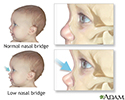
A low nasal bridge is the flattening of the top part of the nose.

Considerations


Genetic diseases or infections may cause decreased growth of the bridge of nose.

A decrease in the height of the bridge of nose is best seen from a side view of the face.


Causes


Causes may include:

  • Cleidocranial dysostosis
  • Congenital syphilis
  • Down syndrome
  • Normal variation
  • Other syndromes that are present at birth (congenital)
  • Williams syndrome


When to Contact a Medical Professional


Contact your health care provider if you have questions about the shape of your child's nose.


What to Expect at Your Office Visit


The provider will do a physical exam. The provider may ask questions about your child's family and medical history.

Laboratory studies may include:

  • Chromosome studies
  • Enzyme assays (blood tests to measure specific enzyme levels)
  • Metabolic studies
  • X-rays


References

Chambers C, Friedman JM. Teratogenesis and environmental exposure. In: Lockwood CJ, Copel JA, Dugoff L, et al, eds. Creasy and Resnik's Maternal-Fetal Medicine: Principles and Practice. 9th ed. Philadelphia, PA: Elsevier; 2023:chap 31.

Haddad J. Congenital disorders of the nose. In: Kliegman RM, St. Geme JW, Blum NJ, et al, eds. Nelson Textbook of Pediatrics. 22nd ed. Philadelphia, PA: Elsevier; 2025:chap 425.

Madan-Khetarpal S, Arnold G, Ortiz D. Genetic disorders and dysmorphic conditions. In: Zitelli BJ, McIntire SC, Nowalk AJ, Garrison J, eds. Zitelli and Davis' Atlas of Pediatric Physical Diagnosis. 8th ed. Philadelphia, PA: Elsevier; 2023:chap 1.

Slavotinek AM. Dysmorphology, phenotyping, and sequences. In: Kliegman RM, St. Geme JW, Blum NJ, et al, eds. Nelson Textbook of Pediatrics. 22nd ed. Philadelphia, PA: Elsevier; 2025:chap 100.
BACK TO TOPText only

 
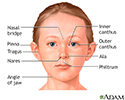
  • The face

    The face

    illustration

  • Low nasal bridge

    Low nasal bridge

    illustration

    • The face

      The face

      illustration

    • Low nasal bridge

      Low nasal bridge

      illustration

    A Closer Look


      Talking to your MD


        Self Care


          Tests for Low nasal bridge


            Review Date: 1/2/2026

            Reviewed By: Neil K. Kaneshiro, MD, MHA, Clinical Professor of Pediatrics, University of Washington School of Medicine, Seattle, WA. Also reviewed by David C. Dugdale, MD, Medical Director, Brenda Conaway, Editorial Director, and the A.D.A.M. Editorial team.

            The information provided herein should not be used during any medical emergency or for the diagnosis or treatment of any medical condition. A licensed medical professional should be consulted for diagnosis and treatment of any and all medical conditions. Links to other sites are provided for information only -- they do not constitute endorsements of those other sites. No warranty of any kind, either expressed or implied, is made as to the accuracy, reliability, timeliness, or correctness of any translations made by a third-party service of the information provided herein into any other language.

            © 1997- A.D.A.M., a business unit of Ebix, Inc. Any duplication or distribution of the information contained herein is strictly prohibited.

            All content on this site including text, images, graphics, audio, video, data, metadata, and compilations is protected by copyright and other intellectual property laws. You may view the content for personal, noncommercial use. Any other use requires prior written consent from Ebix. You may not copy, reproduce, distribute, transmit, display, publish, reverse-engineer, adapt, modify, store beyond ordinary browser caching, index, mine, scrape, or create derivative works from this content. You may not use automated tools to access or extract content, including to create embeddings, vectors, datasets, or indexes for retrieval systems. Use of any content for training, fine-tuning, calibrating, testing, evaluating, or improving AI systems of any kind is prohibited without express written consent. This includes large language models, machine learning models, neural networks, generative systems, retrieval-augmented systems, and any software that ingests content to produce outputs. Any unauthorized use of the content including AI-related use is a violation of our rights and may result in legal action, damages, and statutory penalties to the fullest extent permitted by law. Ebix reserves the right to enforce its rights through legal, technological, and contractual measures.
            © 1997- adam.comAll rights reserved.