

Rectal prolapse
Rectal procidentia; Rectal intussusception
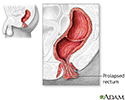
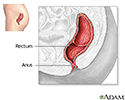
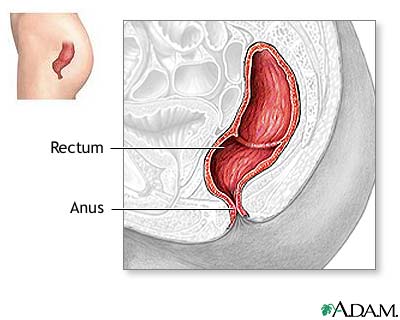
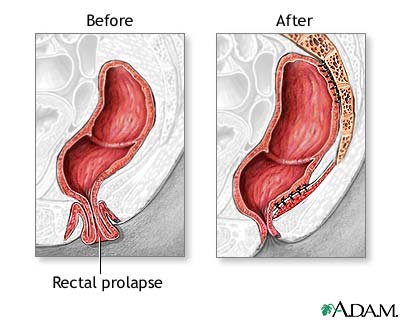
Rectal prolapse occurs when the rectum sags and comes through the anal opening.
Causes
The exact cause of rectal prolapse is unclear. Possible causes may include any of the following:
- An enlarged opening due to relaxed muscles in the pelvic floor, which is formed of muscles around the rectum
- Loose muscles of the anal sphincter
- An abnormally long colon
- Downward movement of the abdominal cavity between the rectum and uterus
- Prolapse of the small intestine
- Constipation
- Diarrhea
- Chronic coughing and sneezing


A prolapse can be partial or complete:
- With a partial prolapse, the inner lining of the rectum bulges partly from the anus.
- With a complete prolapse, the entire rectum bulges through the anus.
Rectal prolapses occur most often in children under age 6 years. Health problems that may lead to prolapse include:
- Cystic fibrosis
- Intestinal worm infections
- Long-term diarrhea
- Other health problems present at birth

In adults, it usually occurs in people with constipation, or with a muscle or nerve problem in the pelvic or genital area.
Symptoms
The main symptom is a reddish-colored mass that sticks out from the opening of the anus, especially after a bowel movement. This reddish mass is actually the inner lining of the rectum. It may bleed slightly and can be uncomfortable and painful.
Exams and Tests
Your health care provider will perform a physical exam, which will include a rectal exam. To check for prolapse, the provider may ask the person to bear down while sitting on a toilet.

Tests that may be done include:
- Colonoscopy to confirm the diagnosis
- Blood test to check for anemia if there is bleeding from the rectum
- Cinedefecography, a real-time X-ray test to evaluate the function of the rectum and pelvic floor


Treatment
Contact your provider if a rectal prolapse occurs.
In some cases, the prolapse can be treated at home. Follow your provider's instructions on how to do this. The rectum must be pushed back inside manually. A soft, warm, wet cloth is used to apply gentle pressure to the mass to push it back through the anal opening. The person should lie on one side in a knee-chest position before applying pressure. This position allows gravity to help put the rectum back into position.
Immediate surgery is rarely needed. In children, treating the cause often solves the problem. For example, if the cause is straining because of dry stools, laxatives may help. If the prolapse continues, surgery may be needed.
In adults, the only cure for a rectal prolapse is a procedure that repairs the weakened anal sphincter and pelvic muscles, and removes or repositions part of the colon and rectum.

Outlook (Prognosis)
In children, treating the cause cures rectal prolapses. In adults, surgery usually cures the prolapse.
When a rectal prolapse is not treated, constipation and loss of bowel control may develop.

When to Contact a Medical Professional
Contact your provider right away if there is a rectal prolapse.
Prevention
In children, treating the cause usually prevents a rectal prolapse from happening again.
References
Bleier JIS, Hernandez PT, Lowenfeld L. Benign anorectal disorders. In: Tyler DS, Hayes-Dixon A, Hines OJ, et al, eds. Sabiston Textbook of Surgery: The Biological Basis of Modern Surgical Practice. 22nd ed. Philadelphia, PA: Elsevier; 2026:chap 97.
Kliegman RM, St. Geme JW, Blum NJ, et al. Surgical conditions of the anus and rectum. In: Kliegman RM, St. Geme JW, Blum NJ, et al, eds. Nelson Textbook of Pediatrics. 22nd ed. Philadelphia, PA: Elsevier; 2025:chap 392.
Madoff RD, Melton GB. Diseases of the rectum and anus. In: Goldman L, Cooney KA, eds. Goldman-Cecil Medicine. 27th ed. Philadelphia, PA: Elsevier; 2024:chap 131.


Review Date: 4/11/2026
Reviewed By: Ann M. Rogers, MD, FACS, Professor Emeritus, Department of Surgery, Penn State College of Medicine, Hershey, PA. Also reviewed by David C. Dugdale, MD, Medical Director, Brenda Conaway, Editorial Director, and the A.D.A.M. Editorial team.
© 1997- A.D.A.M., a business unit of Ebix, Inc. Any duplication or distribution of the information contained herein is strictly prohibited.
 All rights reserved.