

Hereditary ovalocytosis
Ovalocytosis - hereditary
Hereditary ovalocytosis is a rare condition passed down through families (inherited). The blood cells are oval-shaped instead of round. It is a form of hereditary elliptocytosis.

Causes
Hereditary ovalocytosis is mainly found in Southeast Asian populations.
Symptoms
Newborn infants with hereditary ovalocytosis may have anemia and jaundice. Adults most often do not show symptoms.

Exams and Tests
An exam by your health care provider may show an enlarged spleen.
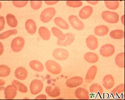
This condition is diagnosed by looking at the shape of blood cells under a microscope. The following tests may also be done:
- Bilirubin level may be high.
- Blood smear may show oval red blood cells.
- Complete blood count (CBC) may show anemia or signs of red blood cell destruction.
- Lactate dehydrogenase level may be high.
- Ultrasound of the abdomen may show gallstones.





Treatment
In severe cases, the disease may be treated by removal of the spleen (splenectomy).

Outlook (Prognosis)
Most people with hereditary ovalocytosis have no problems. They often do not know they have the condition.
Possible Complications
The condition may be associated with gallstones or kidney problems.
When to Contact a Medical Professional
Contact your provider if you have jaundice that does not go away or symptoms of anemia or gallstones.
Prevention
Genetic counseling may be appropriate for people with a family history of this disease who wish to become parents.

References
Gallagher PG. Hemolytic anemias: red blood cell membrane and metabolic defects. In: Goldman L, Cooney KA, eds. Goldman-Cecil Medicine. 27th ed. Philadelphia, PA: Elsevier; 2024:chap 147.
Gallagher PG. Red blood cell membrane disorders. In: Hoffman R, Benz EJ, Silberstein LE, et al, eds. Hematology: Basic Principles and Practice. 8th ed. Philadelphia, PA: Elsevier; 2018:chap 46.
Prozora S, Gallagher PG. Hereditary elliptocytosis, hereditary pyropoikilocytosis, and related disorders. In: Kliegman RM, St. Geme JW, Blum NJ, et al, eds. Nelson Textbook of Pediatrics. 22nd ed. Philadelphia, PA: Elsevier; 2025:chap 508.
Review Date: 1/29/2026
Reviewed By: Warren Brenner, MD, Oncologist, Lynn Cancer Institute, Boca Raton, FL. Review provided by VeriMed Healthcare Network. Also reviewed by David C. Dugdale, MD, Medical Director, Brenda Conaway, Editorial Director, and the A.D.A.M. Editorial team.
© 1997- A.D.A.M., a business unit of Ebix, Inc. Any duplication or distribution of the information contained herein is strictly prohibited.
 All rights reserved.