

Cholangiocarcinoma
Bile duct cancer
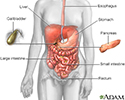
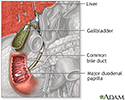
Cholangiocarcinoma (CCA) is a rare cancerous (malignant) growth in one of the ducts that carries bile from the liver to the small intestine.

Causes
The exact cause of CCA isn't known. However, many of these tumors are already quite advanced by the time they are found.
CCA may start anywhere along the bile ducts. These tumors block off the bile ducts.
Both men and women are affected. Most people are between 50 and 75, although there is an increasing incidence in younger people, especially women.
People with the following health problems may have a higher chance of developing CCA:
- Bile duct (choledochal) cysts
- Chronic biliary and liver inflammation
- History of infection with a parasitic worm called a liver fluke
- Primary sclerosing cholangitis
- Ulcerative colitis
- History of hepatitis B or C


Symptoms
Symptoms of CCA may include any of the following:
- Fever and chills
- Clay-colored stools and dark urine
- Itching
- Loss of appetite
- Pain in the upper right abdomen that may radiate to the back
- Weight loss
- Yellowing of the skin (jaundice)




Exams and Tests
Your health care provider will perform a physical exam. Tests will be done to check for a tumor or blockage in the bile duct. These may include:
- Abdominal CT scan
- Abdominal ultrasound
- Procedure that uses a viewing scope to look at the bile ducts (endoscopic retrograde cholangiopancreatography or ERCP), during which tissue may be taken and looked at under a microscope (biopsy)


Blood tests that may be done include:
- Liver function tests (especially alkaline phosphatase or bilirubin levels)
- Complete blood count (CBC)


Treatment
The goal is to treat the cancer and the blockage it causes. When possible, surgery to remove the tumor is the treatment of choice and may result in a cure. Often the cancer has already spread locally or to another area of the body by the time it is diagnosed. In this situation, surgery to cure the cancer is not possible.
Chemotherapy or radiation may be given after surgery to decrease the risk of the cancer returning.


Chemotherapy, immunotherapy, and targeted treatments are also used if the cancer has advanced.
In select cases, a liver transplant can be tried.
Endoscopic therapy with stent placement can temporarily relieve blockages in the biliary ducts. This may also relieve jaundice when the tumor cannot be removed.
Outlook (Prognosis)
Completely removing the tumor allows some people to survive with the possibility of complete cure.
The survival time varies greatly from several months to several years. The outlook depends on:
- The location of CCA
- The cell type of CCA
- The stage of the tumor
- The person's age and general health
- Whether surgery is an option
- The person's response to treatment
If the tumor cannot be completely removed, a cure is generally not possible. With treatment, about one half of affected people live a year, and about one half live longer, but only 10% of people live 5 years. You and your family may want to start thinking about end-of-life planning, such as:

Possible Complications
Complications of CCA include:
- Infection
- Liver failure
- Spread (metastasis) of tumor to other organs

When to Contact a Medical Professional
Contact your provider if you have jaundice or other symptoms of cholangiocarcinoma.
References
Abou-Alfa GK, Jarnagin W, El Dika I, et al. Liver and bile duct cancer. In: Niederhuber JE, Armitage JO, Kastan MB, Doroshow JH, Tepper JE, eds. Abeloff's Clinical Oncology. 6th ed. Philadelphia, PA: Elsevier; 2020:chap 77.
Fogel EL, Sherman S. Diseases of the gallbladder and bile ducts. In: Goldman L, Cooney KA, eds. Goldman-Cecil Medicine. 27th ed. Philadelphia, PA: Elsevier; 2024:chap 141.
Ilyas SI, Gores GJ. Tumors of the bile ducts, gallbladder, and ampulla. In: Chung RT, Rubin DT, Wilcox CM, eds. Sleisenger and Fordtran's Gastrointestinal and Liver Disease. 12th ed. Philadelphia, PA: Elsevier; 2026:chap 71.
National Cancer Institute website. Bile duct cancer (cholangiocarcinoma) treatment (PDQ) -- health professional version. www.cancer.gov/types/liver/hp/bile-duct-treatment-pdq. Updated March 28, 2025. Accessed May 12, 2026.
Review Date: 5/1/2026
Reviewed By: Warren Brenner, MD, Oncologist, Lynn Cancer Institute, Boca Raton, FL. Review provided by VeriMed Healthcare Network. Also reviewed by David C. Dugdale, MD, Medical Director, Brenda Conaway, Editorial Director, and the A.D.A.M. Editorial team.
© 1997- A.D.A.M., a business unit of Ebix, Inc. Any duplication or distribution of the information contained herein is strictly prohibited.
 All rights reserved.