

Health Library
Benign positional vertigo - aftercare
Vertigo - positional - aftercare; Benign paroxysmal positional vertigo - aftercare; BPPV - aftercare; Dizziness - positional vertigo
Images
I Would Like to Learn About:
Description
You may have seen your health care provider because you have had benign positional vertigo. It is also called benign paroxysmal positional vertigo, or BPPV. BPPV is the most common cause of vertigo and the easiest to treat.
What to Expect
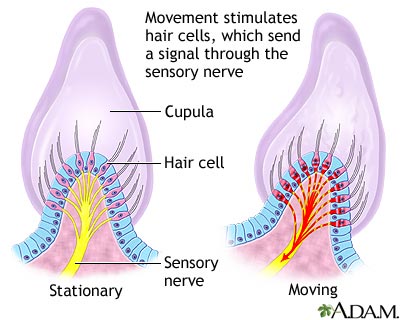
Your provider may have treated your vertigo with the Epley maneuver. This involves head movements that very often correct the inner ear problem that causes BPPV. After you go home:
- Do not bend over for the rest of the day.
- Do not sleep on the side that triggers symptoms for several days after treatment.
- Follow any other specific instructions your provider gave you.
Most of the time, treatment will cure BPPV. Sometimes, vertigo may return after a few weeks. About half the time, BPPV will come back later on. If this happens, you will need to be treated again. Your provider may prescribe medicines that can help relieve spinning sensations. But these medicines often do not work well for treating the actual vertigo.
Self-care
If vertigo returns, remember that you can easily lose your balance, fall, and hurt yourself. To help keep symptoms from getting worse and to help keep you safe:
- Sit down right away when you feel dizzy.
- To get up from a lying position, slowly sit up and stay seated for a few moments before standing.
- Make sure you hold on to something when standing.
- Avoid sudden movements or position changes.
- Ask your provider about using a cane or other walking aid when you have a vertigo attack.
- Avoid bright lights, TV, and reading during a vertigo attack. They may make symptoms worse.
- Avoid activities such as driving, operating heavy machinery, and climbing while you are having symptoms.
To keep your symptoms from getting worse, avoid the positions or movements that trigger it. Your provider may show you how to treat yourself at home for BPPV. A physical therapist may be able to teach you other exercises to reduce your symptoms.
When to Call the Doctor
You should contact your provider if:
- Symptoms of vertigo return
- You have new symptoms
- Your symptoms are getting worse
- Home treatment does not work
References
Baloh RW, Jen JC. Hearing and equilibrium. In: Goldman L, Cooney KA, eds. Goldman-Cecil Medicine. 27th ed. Philadelphia, PA: Elsevier; 2024:chap 396.
Bhattacharyya N, Gubbels SP, Schwartz SR, et al. Clinical practice guideline: benign paroxysmal positional vertigo (update) executive summary. Otolaryngol Head Neck Surg. 2017;156(3):403-416. PMID: 28248602 pubmed.ncbi.nlm.nih.gov/28248602/.
Crowson MG, Crane BT. Peripheral vestibular disorders. In: Francis HW, Haughey BH, Hillel AT, et al, eds. Cummings Otolaryngology: Head & Neck Surgery. 8th ed. Philadelphia, PA: Elsevier; 2026:chap 164.
BACK TO TOPReview Date: 4/10/2026
Reviewed By: Linda J. Vorvick, MD, Clinical Professor Emeritus, Department of Family Medicine, UW Medicine, School of Medicine, University of Washington, Seattle, WA. Also reviewed by David C. Dugdale, MD, Medical Director, Brenda Conaway, Editorial Director, and the A.D.A.M. Editorial team.
 | A.D.A.M., Inc. is accredited by URAC, for Health Content Provider (www.urac.org). URAC's accreditation program is an independent audit to verify that A.D.A.M. follows rigorous standards of quality and accountability. A.D.A.M. is among the first to achieve this important distinction for online health information and services. Learn more about A.D.A.M.'s editorial policy, editorial process and privacy policy. A.D.A.M. is also a founding member of Hi-Ethics. This site complies with the HONcode standard for trustworthy health information: verify here. |
The information provided herein should not be used during any medical emergency or for the diagnosis or treatment of any medical condition. A licensed medical professional should be consulted for diagnosis and treatment of any and all medical conditions. Links to other sites are provided for information only -- they do not constitute endorsements of those other sites. No warranty of any kind, either expressed or implied, is made as to the accuracy, reliability, timeliness, or correctness of any translations made by a third-party service of the information provided herein into any other language.
© 1997-
2026 A.D.A.M., a business unit of Ebix, Inc. Any duplication or distribution of the information contained herein is strictly prohibited.
All content on this site including text, images, graphics, audio, video, data, metadata, and compilations is protected by copyright and other intellectual property laws. You may view the content for personal, noncommercial use. Any other use requires prior written consent from Ebix. You may not copy, reproduce, distribute, transmit, display, publish, reverse-engineer, adapt, modify, store beyond ordinary browser caching, index, mine, scrape, or create derivative works from this content. You may not use automated tools to access or extract content, including to create embeddings, vectors, datasets, or indexes for retrieval systems. Use of any content for training, fine-tuning, calibrating, testing, evaluating, or improving AI systems of any kind is prohibited without express written consent. This includes large language models, machine learning models, neural networks, generative systems, retrieval-augmented systems, and any software that ingests content to produce outputs. Any unauthorized use of the content including AI-related use is a violation of our rights and may result in legal action, damages, and statutory penalties to the fullest extent permitted by law. Ebix reserves the right to enforce its rights through legal, technological, and contractual measures.
