

Health Library
Antihistamines for allergies
Allergic rhinitis - antihistamine; Hives - antihistamine; Allergic conjunctivitis - antihistamine; Urticaria - antihistamine; Dermatitis - antihistamine; Eczema - antihistamine
Images
Animation

I Would Like to Learn About:
Description
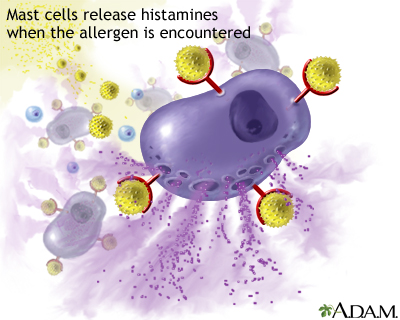
An allergy is an immune response, or reaction, to substances (allergens) that are usually not harmful. In someone with allergies, the immune response is oversensitive. When it recognizes an allergen, the immune system launches a response. Chemicals such as histamines are released. These chemicals cause allergy symptoms.
One type of medicine that helps relieve allergy symptoms is an antihistamine.
What are Antihistamines?
Antihistamines are medicines that treat allergy symptoms by blocking the effects of histamine. Antihistamines come as pills, chewable tablets, capsules, liquids, nasal sprays, and eye drops. There are also injectable forms used mainly in health care settings.
How Antihistamines Help
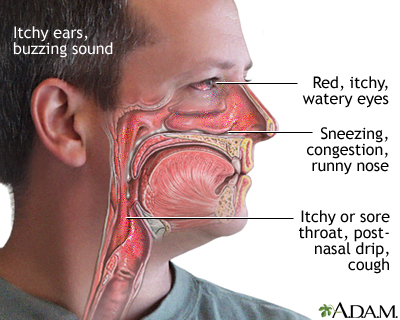
Antihistamines treat these allergy symptoms:
- Congestion, runny nose, sneezing, or itching
- Swelling of the nasal passages
- Hives and other skin rashes
- Itchy, runny eyes
Treating symptoms can help you or your child to feel better during the day and sleep better at night.
How to Take Antihistamines
Depending on your symptoms, you can take antihistamines:
- Every day, to help keep daily symptoms under control
- Only when you have symptoms
- Before being exposed to things that often cause your allergy symptoms, such as a pet or certain plants
For many people with allergies, symptoms are the worst around 4 a.m. to 6 a.m. Taking an antihistamine at bedtime may help you or your child feel better in the morning during allergy season.
What Antihistamine is Right for you?
You can buy many different brands and forms of antihistamines without a prescription.
- Some work for only 4 to 6 hours, while others last for 12 to 24 hours.
- Some are combined with a decongestant, a medicine that dries up your nasal passages.
Ask your health care provider what type of antihistamine and what exact dosage is right for you or your child. Make sure you understand how much to use and how many times a day to use it. Be sure to read the label carefully. Or ask your pharmacist or provider if you have questions.
- Some antihistamines cause less sleepiness than others. These include cetirizine (Zyrtec), desloratadine (Clarinex), fexofenadine (Allegra), levocetirizine (Xyzal), and loratadine (Claritin).
- Do not drink alcohol when you are taking antihistamines.
Also, remember:
- Store antihistamines at room temperature, away from heat, direct light, and moisture.
- Do not freeze antihistamines.
- Keep all medicines where children cannot reach them.
Side Effects of Antihistamines
Antihistamines are thought to be safe for adults. Most antihistamines are also safe for children 2 years old or older. Ask your provider if antihistamines are safe for you or your child, what side effects to watch for, and how antihistamines may affect other medicines you or your child take.
Also, remember to:
- Ask your provider if antihistamines are safe for you, if you are breastfeeding or pregnant.
- Find out how the medicine affects you before driving or using machinery.
- Make sure the medicine is not affecting your child's ability to learn.
There may be special precautions for using antihistamines if you have:
- Diabetes
- An enlarged prostate or problems passing urine
- Epilepsy
- Heart disease or high blood pressure
- Increased pressure in your eye (glaucoma)
- An overactive thyroid
Side effects of antihistamines may include:
- Changes in vision, such as blurry vision
- Constipation
- Decreased appetite
- Dizziness
- Drowsiness
- Dry mouth
- Feeling nervous, excited, or irritable
- Increased difficulty urinating if you already have some difficulty urinating
When to Call the Doctor
Contact your provider if:
- Your nose is irritated, you are having nosebleeds, or you have any other new nasal symptoms
- Your allergy symptoms are not getting better
- You are having trouble taking your antihistamines
References
Corren J, Baroody FM, Togias A. Allergic and nonallergic rhinitis. In: Burks AW, Holgate ST, O'Hehir RE, et al, eds. Middleton's Allergy: Principles and Practice. 9th ed. Philadelphia, PA: Elsevier; 2020:chap 40.
Dykewicz MS, Wallace DV, Amrol DJ, et al. Rhinitis 2020: A practice parameter update. J Allergy Clin Immunol. 2020;146(4):721-767. PMID: 32707227 pubmed.ncbi.nlm.nih.gov/32707227/.
Murr AH, Pletcher SD. Approach to the patient with nose, sinus, and ear disorders. In: Goldman L, Cooney KA, eds. Goldman-Cecil Medicine. 27th ed. Philadelphia, PA: Elsevier; 2024:chap 394.
BACK TO TOPReview Date: 4/10/2026
Reviewed By: Linda J. Vorvick, MD, Clinical Professor Emeritus, Department of Family Medicine, UW Medicine, School of Medicine, University of Washington, Seattle, WA. Also reviewed by David C. Dugdale, MD, Medical Director, Brenda Conaway, Editorial Director, and the A.D.A.M. Editorial team.
 | A.D.A.M., Inc. is accredited by URAC, for Health Content Provider (www.urac.org). URAC's accreditation program is an independent audit to verify that A.D.A.M. follows rigorous standards of quality and accountability. A.D.A.M. is among the first to achieve this important distinction for online health information and services. Learn more about A.D.A.M.'s editorial policy, editorial process and privacy policy. A.D.A.M. is also a founding member of Hi-Ethics. This site complies with the HONcode standard for trustworthy health information: verify here. |
The information provided herein should not be used during any medical emergency or for the diagnosis or treatment of any medical condition. A licensed medical professional should be consulted for diagnosis and treatment of any and all medical conditions. Links to other sites are provided for information only -- they do not constitute endorsements of those other sites. No warranty of any kind, either expressed or implied, is made as to the accuracy, reliability, timeliness, or correctness of any translations made by a third-party service of the information provided herein into any other language.
© 1997-
2026 A.D.A.M., a business unit of Ebix, Inc. Any duplication or distribution of the information contained herein is strictly prohibited.
All content on this site including text, images, graphics, audio, video, data, metadata, and compilations is protected by copyright and other intellectual property laws. You may view the content for personal, noncommercial use. Any other use requires prior written consent from Ebix. You may not copy, reproduce, distribute, transmit, display, publish, reverse-engineer, adapt, modify, store beyond ordinary browser caching, index, mine, scrape, or create derivative works from this content. You may not use automated tools to access or extract content, including to create embeddings, vectors, datasets, or indexes for retrieval systems. Use of any content for training, fine-tuning, calibrating, testing, evaluating, or improving AI systems of any kind is prohibited without express written consent. This includes large language models, machine learning models, neural networks, generative systems, retrieval-augmented systems, and any software that ingests content to produce outputs. Any unauthorized use of the content including AI-related use is a violation of our rights and may result in legal action, damages, and statutory penalties to the fullest extent permitted by law. Ebix reserves the right to enforce its rights through legal, technological, and contractual measures.
