

Health Library
High blood sugar - self-care
Hyperglycemia - self care; High blood glucose - self care; Diabetes - high blood sugar
Images
I Would Like to Learn About:
Description
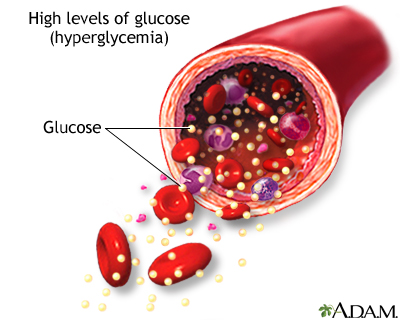
High blood sugar is also called high blood glucose, or hyperglycemia.
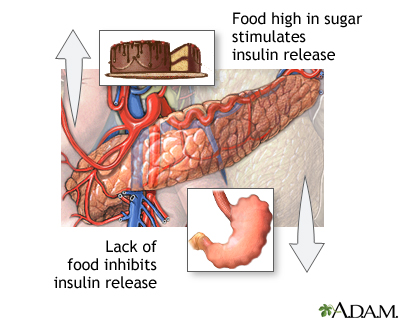
High blood sugar almost always happens in people who have diabetes. High blood sugar occurs when:
- Your body makes too little insulin.
- Your body does not respond to the signal insulin is sending.
Insulin is a hormone that helps the body move glucose (sugar) from the blood into muscle or fat, where it is stored for later use when energy is needed.
Sometimes high blood sugar occurs due to stress from surgery, infection, trauma, or medicines. After the stress is over, blood sugar returns to normal.
Symptoms of High Blood Sugar
Symptoms of a high blood sugar can include:
- Being very thirsty or having a dry mouth
- Having blurry vision
- Having dry skin
- Feeling weak or tired
- Needing to urinate a lot, or needing to get up more often than usual at night to urinate
You may have other, more serious symptoms if your blood sugar becomes very high or remains high for a long time. Over time, high blood sugar weakens your immune system and makes it more likely for you to get infections.
What to Think About When Your Blood Sugar is High
High blood sugar can harm you. If your blood sugar is high, you need to know how to bring it down. If you have diabetes, here are some questions to ask yourself when your blood sugar is high:
- Are you eating right?
- Are you eating too much?
- Have you been following your diabetes meal plan?
- Did you have a meal or a snack with a lot of carbohydrates, starches, or simple sugars?
Are you taking your diabetes medicines correctly?
- Has your health care provider changed your medicines?
- If you take insulin, have you been taking the correct dose? Is the insulin expired? Or has it been stored in a hot or cold place?
- Are you afraid of having low blood sugar? Is that causing you to eat too much or take too little insulin or other diabetes medicine?
- Have you injected insulin into a scar or an overused area? Have you been rotating sites? Was the injection into a lump or numb spot under the skin?
What else has changed?
- Have you been less active than usual?
- Do you have a fever, cold, flu, or another illness?
- Are you dehydrated?
- Have you had some stress?
- Have you been checking your blood sugar regularly?
- Have you gained weight?
- Have you started taking any new medicines such as for high blood pressure or other medical problems?
- Have you had an injection into a joint or other area with a glucocorticoid medicine?
Preventing High Blood Sugar
To prevent high blood sugar, you will need to:
- Follow your meal plan
- Stay physically active
- Take your diabetes medicines as instructed
You and your provider will:
- Set a target goal for your blood sugar levels for different times during the day. This helps you manage your blood sugar.
- Decide how often you need to check your blood sugar at home.
If you have type 2 diabetes and your blood sugar is higher than your goals over 3 days and you don't know why, check your urine for ketones. If you have ketones, contact your provider or seek emergency medical care.
If you have type 1 diabetes and your blood sugar is higher than your goals over 6 hours and you don't know why, check your urine for ketones. If you have ketones, contact your provider or seek emergency medical care.
When to Call the Doctor
Contact your provider if your blood sugar is too high or too low and you do not understand why. When your blood sugar is in your target range, you will feel better and your health will be better.
References
Ahmann AJ, Riddle MC. Therapeutics of type 2 diabetes mellitus. In: Melmed S, Auchus RJ, Goldfine AB, Rosen CJ, Kopp PA, eds. Williams Textbook of Endocrinology. 15th ed. Philadelphia, PA: Elsevier; 2025:chap 34.
American Diabetes Association Professional Practice Committee for Diabetes. 5. Facilitating positive health behaviors and well-being to improve health outcomes: standards of care in diabetes-2026. Diabetes Care. 2026;49(Supplement_1):S89-S131. PMID: 41358898 pubmed.ncbi.nlm.nih.gov/41358898/.
American Diabetes Association Professional Practice Committee for Diabetes. 6. Glycemic goals, hypoglycemia, and hyperglycemic crises: standards of care in diabetes-2026. Diabetes Care. 2026;49(Supplement_1):S132-S149. PMID: 41358894 pubmed.ncbi.nlm.nih.gov/41358894/.
Dhatariya KK, Umpierrez GE, Crandall JP. Diabetes. In: Goldman L, Cooney KA, eds. Goldman-Cecil Medicine. 27th ed. Philadelphia, PA: Elsevier; 2024:chap 210.
Gillard P, Atkinson MA, Mathieu C. Type 1 diabetes mellitus. In: Melmed S, Auchus RJ, Goldfine AB, Rosen CJ, Kopp PA, eds. Williams Textbook of Endocrinology. 15th ed. Philadelphia, PA: Elsevier; 2025:chap 35.
National Institute of Diabetes and Digestive and Kidney Diseases website. Healthy living with diabetes. www.niddk.nih.gov/health-information/diabetes/overview/healthy-living-with-diabetes. Reviewed October 2023. Accessed March 3, 2026.
BACK TO TOPReview Date: 1/25/2026
Reviewed By: Sandeep K. Dhaliwal, MD, board-certified in Diabetes, Endocrinology, and Metabolism, Springfield, VA. Also reviewed by David C. Dugdale, MD, Medical Director, Brenda Conaway, Editorial Director, and the A.D.A.M. Editorial team.
 | A.D.A.M., Inc. is accredited by URAC, for Health Content Provider (www.urac.org). URAC's accreditation program is an independent audit to verify that A.D.A.M. follows rigorous standards of quality and accountability. A.D.A.M. is among the first to achieve this important distinction for online health information and services. Learn more about A.D.A.M.'s editorial policy, editorial process and privacy policy. A.D.A.M. is also a founding member of Hi-Ethics. This site complies with the HONcode standard for trustworthy health information: verify here. |
The information provided herein should not be used during any medical emergency or for the diagnosis or treatment of any medical condition. A licensed medical professional should be consulted for diagnosis and treatment of any and all medical conditions. Links to other sites are provided for information only -- they do not constitute endorsements of those other sites. No warranty of any kind, either expressed or implied, is made as to the accuracy, reliability, timeliness, or correctness of any translations made by a third-party service of the information provided herein into any other language.
© 1997-
2026 A.D.A.M., a business unit of Ebix, Inc. Any duplication or distribution of the information contained herein is strictly prohibited.
All content on this site including text, images, graphics, audio, video, data, metadata, and compilations is protected by copyright and other intellectual property laws. You may view the content for personal, noncommercial use. Any other use requires prior written consent from Ebix. You may not copy, reproduce, distribute, transmit, display, publish, reverse-engineer, adapt, modify, store beyond ordinary browser caching, index, mine, scrape, or create derivative works from this content. You may not use automated tools to access or extract content, including to create embeddings, vectors, datasets, or indexes for retrieval systems. Use of any content for training, fine-tuning, calibrating, testing, evaluating, or improving AI systems of any kind is prohibited without express written consent. This includes large language models, machine learning models, neural networks, generative systems, retrieval-augmented systems, and any software that ingests content to produce outputs. Any unauthorized use of the content including AI-related use is a violation of our rights and may result in legal action, damages, and statutory penalties to the fullest extent permitted by law. Ebix reserves the right to enforce its rights through legal, technological, and contractual measures.
