

Health Library
How to breathe when you are short of breath
Pursed lip breathing; COPD - pursed lip breathing; Emphysema - pursed lip breathing; Chronic bronchitis - pursed lip breathing; Pulmonary fibrosis - pursed lip breathing; Interstitial lung disease - pursed lip breathing; Hypoxia - pursed lip breathing; Chronic respiratory failure - pursed lip breathing
Images
I Would Like to Learn About:
Description
Pursed lip breathing is a breathing technique that helps you use less energy to breathe. It can help you relax. When you are short of breath, it helps you slow the pace of your breathing and can help you feel less short of breath.
When to use Pursed lip Breathing
Use pursed lip breathing when you do things that make you short of breath, such as when you:
- Exercise
- Bend
- Lift
- Climb stairs
- Feel anxious
You can practice pursed lip breathing anytime. Try to practice 4 or 5 times a day when you:
- Watch TV
- Use your computer
- Read a newspaper
How to do Pursed lip Breathing
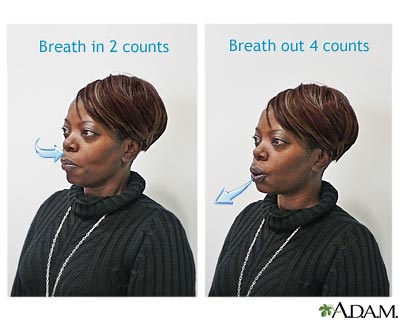
The steps to do pursed lip breathing are:
- Relax the muscles in your neck and shoulders.
- Sit in a comfortable chair with your feet on the floor.
- Inhale slowly through your nose for 2 counts.
- Feel your belly get larger as you breathe in.
- Pucker your lips, as if you were going to whistle or blow out a candle.
- Exhale slowly through your lips for 4 or more counts.
Exhale normally. Do not force the air out. Do not hold your breath when you are doing pursed lip breathing. Repeat these steps until your breathing slows.
Related Information
Lung surgeryChronic obstructive pulmonary disease (COPD)
Cystic fibrosis
Interstitial lung disease
Community-acquired pneumonia in adults
Bronchiolitis
Breathing difficulty
Chronic obstructive pulmonary disease - adults - discharge
Interstitial lung disease - adults - discharge
COPD - control drugs
COPD - quick-relief drugs
Lung surgery - discharge
References
Minichiello VJ. Therapeutic breathing. In: Rakel D, Minichiello VJ, eds. Integrative Medicine. 5th ed. Philadelphia, PA: Elsevier; 2023:chap 89.
Rochester CL, Nici L. Pulmonary rehabilitation. In: Broaddus VC, Ernst JD, King TE, et al, eds. Murray and Nadel's Textbook of Respiratory Medicine. 7th ed. Philadelphia, PA: Elsevier; 2022:chap 139.
Schwartzstein RM, Adams L. Dyspnea. In: Broaddus VC, Ernst JD, King TE, et al, eds. Murray and Nadel's Textbook of Respiratory Medicine. 7th ed. Philadelphia, PA: Elsevier; 2022:chap 36.
BACK TO TOPReview Date: 1/14/2026
Reviewed By: Linda J. Vorvick, MD, Clinical Professor Emeritus, Department of Family Medicine, UW Medicine, School of Medicine, University of Washington, Seattle, WA. Also reviewed by David C. Dugdale, MD, Medical Director, Brenda Conaway, Editorial Director, and the A.D.A.M. Editorial team.
 | A.D.A.M., Inc. is accredited by URAC, for Health Content Provider (www.urac.org). URAC's accreditation program is an independent audit to verify that A.D.A.M. follows rigorous standards of quality and accountability. A.D.A.M. is among the first to achieve this important distinction for online health information and services. Learn more about A.D.A.M.'s editorial policy, editorial process and privacy policy. A.D.A.M. is also a founding member of Hi-Ethics. This site complies with the HONcode standard for trustworthy health information: verify here. |
The information provided herein should not be used during any medical emergency or for the diagnosis or treatment of any medical condition. A licensed medical professional should be consulted for diagnosis and treatment of any and all medical conditions. Links to other sites are provided for information only -- they do not constitute endorsements of those other sites. No warranty of any kind, either expressed or implied, is made as to the accuracy, reliability, timeliness, or correctness of any translations made by a third-party service of the information provided herein into any other language.
© 1997-
2026 A.D.A.M., a business unit of Ebix, Inc. Any duplication or distribution of the information contained herein is strictly prohibited.
All content on this site including text, images, graphics, audio, video, data, metadata, and compilations is protected by copyright and other intellectual property laws. You may view the content for personal, noncommercial use. Any other use requires prior written consent from Ebix. You may not copy, reproduce, distribute, transmit, display, publish, reverse-engineer, adapt, modify, store beyond ordinary browser caching, index, mine, scrape, or create derivative works from this content. You may not use automated tools to access or extract content, including to create embeddings, vectors, datasets, or indexes for retrieval systems. Use of any content for training, fine-tuning, calibrating, testing, evaluating, or improving AI systems of any kind is prohibited without express written consent. This includes large language models, machine learning models, neural networks, generative systems, retrieval-augmented systems, and any software that ingests content to produce outputs. Any unauthorized use of the content including AI-related use is a violation of our rights and may result in legal action, damages, and statutory penalties to the fullest extent permitted by law. Ebix reserves the right to enforce its rights through legal, technological, and contractual measures.
