

Health Library
Exercise-induced asthma
Wheezing - exercise-induced; Reactive airway disease - exercise; Exercise-induced bronchoconstriction
Images
I Would Like to Learn About:
Description
Sometimes exercise triggers asthma symptoms. This is called exercise-induced bronchoconstriction (EIB). In the past, this was called exercise-induced asthma. Exercise does not cause asthma, but it can cause airways to constrict (narrow). Most people with asthma have EIB, but not everyone with EIB has asthma.
The symptoms of EIB are coughing, wheezing, a feeling of tightness in your chest, or shortness of breath. Most times, these symptoms start soon after you stop exercising. Some people may have symptoms while they are exercising.
Be Careful Where and When you Exercise
Having asthma symptoms when you exercise does not mean you cannot or should not exercise. But be aware of your EIB triggers.
Cold or dry air may trigger asthma symptoms. If you do exercise in cold or dry air:
- Breathe through your nose.
- Wear a scarf or mask over your mouth.
Do not exercise when the air is polluted. Avoid exercising near fields or lawns that have just been mowed.
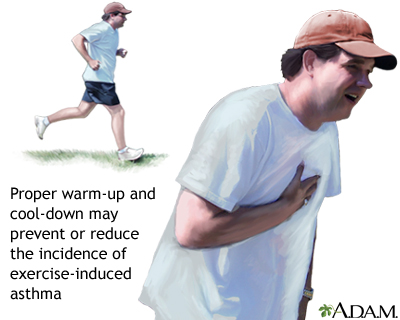
Warm up before you exercise, and cool down afterward:
- To warm up, walk or do your exercise activity slowly before you speed up.
- The longer you warm up, the better.
- To cool down, walk or do your exercise activity slowly for several minutes.
Some kinds of exercise may be less likely to trigger asthma symptoms than others.
- Swimming is a good sport for people with EIB. The warm, moist air helps keep asthma symptoms away.
- Football, baseball, and other sports with periods when you do not move fast are less likely to trigger your asthma symptoms.
Activities that keep you moving fast all the time are more likely to trigger asthma symptoms, such as running, basketball, or soccer.
Use Your Asthma Medicine Before you Exercise
Take your short-acting, or quick-relief, inhaled medicines before you exercise.
- Take them 10 to 15 minutes before exercise.
- They can help for up to 4 hours.
Long-acting, inhaled medicines may also help.
- Use them at least 30 minutes before exercise.
- They can help for up to 12 hours. Children can take this medicine before school, and it will help for the whole day.
- Be aware that using this kind of medicine every day before exercise may make it less effective over time.
Follow your health care provider's advice on which medicines to use and when.
Related Information
AsthmaAsthma in children
Asthma and allergy resources
Wheezing
Asthma - child - discharge
Asthma - control drugs
Asthma - quick-relief drugs
Exercising and asthma at school
Make peak flow a habit
Signs of an asthma attack
Stay away from asthma triggers
How to use a nebulizer
Asthma and school
How to use an inhaler - no spacer
How to use an inhaler - with spacer
How to use your peak flow meter
Asthma in adults - what to ask the doctor
Asthma in children - what to ask your doctor
References
Brannan JD, Kaminsky DA, Hallstrand TS. Approach to the patient with exercise-induced bronchoconstriction. In: Burks AW, Holgate ST, O'Hehir RE, et al, eds. Middleton's Allergy: Principles and Practice. 9th ed. Philadelphia, PA: Elsevier; 2020:chap 54.
Liu AH, Bacharier LB, Fitzpatrick AM, Sicherer SH. Childhood asthma. In: Kliegman RM, St. Geme JW, Blum NJ, et al, eds. Nelson Textbook of Pediatrics. 22nd ed. Philadelphia, PA: Elsevier; 2025:chap 185.
Lugogo N, Que LG, Carr TF, Kraft M. Asthma: diagnosis and management. In: Broaddus VC, Ernst JD, King TE, et al, eds. Murray and Nadel's Textbook of Respiratory Medicine. 7th ed. Philadelphia, PA: Elsevier; 2022:chap 62.
National Heart, Lung and Blood Institute website. Asthma management guidelines: focused updates 2020. www.nhlbi.nih.gov/health-topics/asthma-management-guidelines-2020-updates. Updated February 4, 2021. Accessed March 9, 2026.
Vohra TT, Nowak RM. Asthma. In: Walls RM, ed. Rosen's Emergency Medicine: Concepts and Clinical Practice. 10th ed. Philadelphia, PA: Elsevier; 2023:chap 59.
BACK TO TOPReview Date: 2/27/2026
Reviewed By: Jacob Berman, MD, MPH, Associate Professor of Medicine, Division of General Internal Medicine, University of Washington School of Medicine, Seattle, WA. Also reviewed by David C. Dugdale, MD, Medical Director, Brenda Conaway, Editorial Director, and the A.D.A.M. Editorial team.
 | A.D.A.M., Inc. is accredited by URAC, for Health Content Provider (www.urac.org). URAC's accreditation program is an independent audit to verify that A.D.A.M. follows rigorous standards of quality and accountability. A.D.A.M. is among the first to achieve this important distinction for online health information and services. Learn more about A.D.A.M.'s editorial policy, editorial process and privacy policy. A.D.A.M. is also a founding member of Hi-Ethics. This site complies with the HONcode standard for trustworthy health information: verify here. |
The information provided herein should not be used during any medical emergency or for the diagnosis or treatment of any medical condition. A licensed medical professional should be consulted for diagnosis and treatment of any and all medical conditions. Links to other sites are provided for information only -- they do not constitute endorsements of those other sites. No warranty of any kind, either expressed or implied, is made as to the accuracy, reliability, timeliness, or correctness of any translations made by a third-party service of the information provided herein into any other language.
© 1997-
2026 A.D.A.M., a business unit of Ebix, Inc. Any duplication or distribution of the information contained herein is strictly prohibited.
All content on this site including text, images, graphics, audio, video, data, metadata, and compilations is protected by copyright and other intellectual property laws. You may view the content for personal, noncommercial use. Any other use requires prior written consent from Ebix. You may not copy, reproduce, distribute, transmit, display, publish, reverse-engineer, adapt, modify, store beyond ordinary browser caching, index, mine, scrape, or create derivative works from this content. You may not use automated tools to access or extract content, including to create embeddings, vectors, datasets, or indexes for retrieval systems. Use of any content for training, fine-tuning, calibrating, testing, evaluating, or improving AI systems of any kind is prohibited without express written consent. This includes large language models, machine learning models, neural networks, generative systems, retrieval-augmented systems, and any software that ingests content to produce outputs. Any unauthorized use of the content including AI-related use is a violation of our rights and may result in legal action, damages, and statutory penalties to the fullest extent permitted by law. Ebix reserves the right to enforce its rights through legal, technological, and contractual measures.
