

Health Library
Abdominal exploration - series
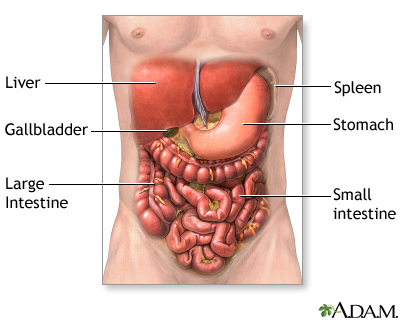
Normal anatomy
The abdomen contains many vital organs: the stomach, the small intestine (jejunum and ileum), the large intestine (colon), the liver, the spleen, the gallbladder, the pancreas, the uterus, the fallopian tubes, the ovaries, the kidneys, the ureters, the bladder, and many blood vessels (arteries and veins).
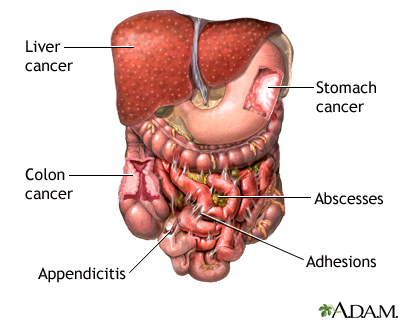
Indication
The surgical exploration of the abdomen, also called an exploratory laparotomy, may be recommended when there is abdominal disease from an unknown cause (to diagnose), or trauma to the abdomen (gunshot or stab-wounds, or "blunt trauma").
Diseases that may be discovered by exploratory laparotomy include:
- Inflammation of the appendix (acute appendicitis)
- Inflammation of the pancreas (acute or chronic pancreatitis)
- Pockets of infection (retroperitoneal abscess, abdominal abscess, pelvic abscess))
- Presence of uterine tissue (endometrium) in the abdomen (endometriosis)
- Inflammation of the Fallopian tubes (salpingitis)
- Scar tissue in the abdomen (adhesions)
- Cancer (of the ovary, colon, pancreas, liver)
- Inflammation of an intestinal pocket (diverticulitis)
- Hole in the intestine (intestinal perforation)
- Pregnancy in the abdomen instead of uterus (ectopic pregnancy)
- To determine the extent of certain cancers (Hodgkin's lymphoma)
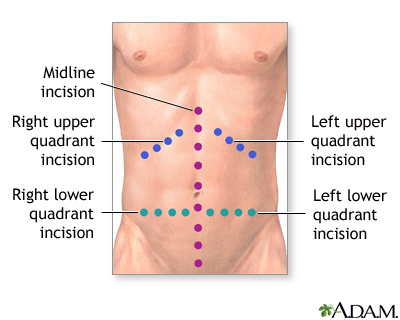
Procedure
While the patient is deep asleep and pain-free (general anesthesia), the surgeon makes an incision into the abdomen and examines the abdominal organs. Different incisions are sometimes used depending on the circumstance. Common incisions include a vertical midline incision, and right or left upper or lower quadrant transverse incisions. Tissue samples (biopsies) can be taken and diseased areas can be evaluated. When the treatment is complete, the incision is closed with either sutures or skin staples.
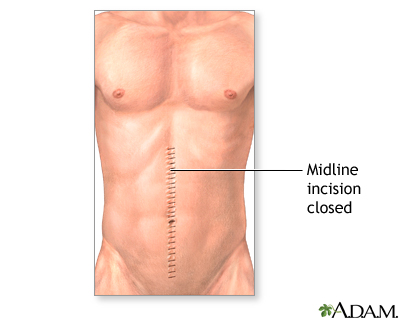
Aftercare
The outcome from surgery varies with the disease process, as does the course and duration of recovery. Exploratory laparotomy is most commonly performed for trauma, severe abdominal pain of unknown cause, intestinal obstruction, inflammatory diseases like appendicitis and diverticulitis, and cancer of any of the abdominal organs.
BACK TO TOP
Review Date: 1/1/2026
Reviewed By: Ann M. Rogers, MD, FACS, Professor Emeritus, Department of Surgery, Penn State College of Medicine, Hershey, PA. Also reviewed by David C. Dugdale, MD, Medical Director, Brenda Conaway, Editorial Director, and the A.D.A.M. Editorial team.
 | A.D.A.M., Inc. is accredited by URAC, for Health Content Provider (www.urac.org). URAC's accreditation program is an independent audit to verify that A.D.A.M. follows rigorous standards of quality and accountability. A.D.A.M. is among the first to achieve this important distinction for online health information and services. Learn more about A.D.A.M.'s editorial policy, editorial process and privacy policy. A.D.A.M. is also a founding member of Hi-Ethics. This site complies with the HONcode standard for trustworthy health information: verify here. |
The information provided herein should not be used during any medical emergency or for the diagnosis or treatment of any medical condition. A licensed medical professional should be consulted for diagnosis and treatment of any and all medical conditions. Links to other sites are provided for information only -- they do not constitute endorsements of those other sites. No warranty of any kind, either expressed or implied, is made as to the accuracy, reliability, timeliness, or correctness of any translations made by a third-party service of the information provided herein into any other language.
© 1997-
2026 A.D.A.M., a business unit of Ebix, Inc. Any duplication or distribution of the information contained herein is strictly prohibited.
All content on this site including text, images, graphics, audio, video, data, metadata, and compilations is protected by copyright and other intellectual property laws. You may view the content for personal, noncommercial use. Any other use requires prior written consent from Ebix. You may not copy, reproduce, distribute, transmit, display, publish, reverse-engineer, adapt, modify, store beyond ordinary browser caching, index, mine, scrape, or create derivative works from this content. You may not use automated tools to access or extract content, including to create embeddings, vectors, datasets, or indexes for retrieval systems. Use of any content for training, fine-tuning, calibrating, testing, evaluating, or improving AI systems of any kind is prohibited without express written consent. This includes large language models, machine learning models, neural networks, generative systems, retrieval-augmented systems, and any software that ingests content to produce outputs. Any unauthorized use of the content including AI-related use is a violation of our rights and may result in legal action, damages, and statutory penalties to the fullest extent permitted by law. Ebix reserves the right to enforce its rights through legal, technological, and contractual measures.
