

Health Library
Neuromyelitis optica spectrum disorder
NMO; NMOD; Neuromyelitis optica; Devic disease; Optic neuritis; Demyelinating disorder; Transverse myelitis
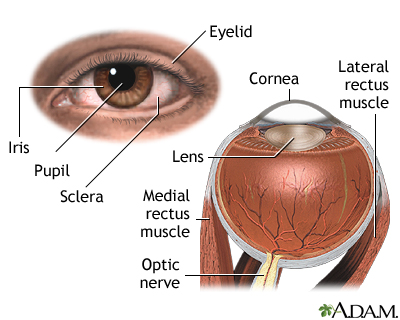
Neuromyelitis optica spectrum disorder (NMOSD) is a disorder of the central nervous system. The central nervous system consists of the brain and spinal cord. NMOSD causes inflammation and damage to the optic nerve and spinal cord. The optic nerve sends signals from the back of the eye (retina) to the brain. In some cases, NMOSD also may affect the brain.
Images
Animation

I Would Like to Learn About:
Causes
NMOSD is a type of autoimmune disorder.
- Autoimmune disorders are conditions where the body's immune system destroys healthy cells and tissues.
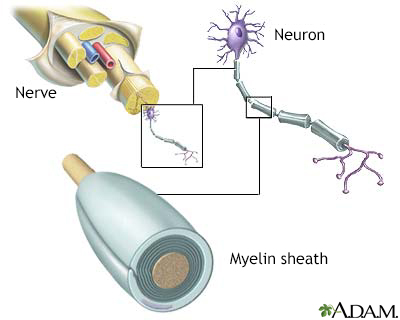
- NMOSD causes damage to a type of nerve cell called astrocytes as well as the myelin sheath of nerve cells. This sheath is the protective covering that surrounds nerve cells. When this nerve covering is damaged, nerve signals slow or stop. This can occur anywhere along the optic nerve and spinal cord.
- NMOSD is often confused with and misdiagnosed as multiple sclerosis (MS) because they have similar symptoms. However, the two conditions are different and have different treatments.
There is no identifiable cause for NMOSD. The disease tends to develop in childhood or in a person's 40s. It may occur after an infection. People with a personal or family history of autoimmune disorders may also be at risk.
There are two main types of NMOSD:
- Relapsing NMOSD is the most common form. It has flare-ups that occur between periods of recovery. Women are more likely to get this form of NMO.
- Monophasic NMOSD is much less common and affects men and women equally. It involves a single attack that may last for 1 to 2 months and does not recur.
Symptoms
NMOSD may cause different symptoms that range in severity.
One main symptom is inflammation of one or both optic nerves (optic neuritis). Optic nerves transmit images from the eyes to the brain. Swelling and inflammation of the optic nerve may cause eye problems such as:
- Eye pain
- Blurred vision
- Partial vision loss
- Blindness in one or both eyes
Other symptoms include:
- Inflammation of the spinal cord (myelitis)
- Pain around the chest and waist
- Unexplained hiccups
- Persistent nausea or vomiting
- Uncontrollable itching
- Difficulty in swallowing (dysphagia)
- Respiratory disorders
- Problems with movement and coordination (motor or sensory dysfunction)
- Inability to hold stool or urine (bowel or bladder incontinence)
- Brain damage (encephalopathy)
- Double vision
- Sleep disorders such as disturbed sleep, decreased sleep quality, or restless legs syndrome
- Sexual dysfunction
- Recurrent attacks of visual, motor, and sensory dysfunction
- Weakness, numbness, or paralysis of the arms and legs
Exams and Tests
Your health care provider will do a physical exam and ask about your symptoms and medical history.
Various tests are needed to distinguish NMOSD from other central nervous system diseases such as multiple sclerosis.
Blood tests may include:
You may have a blood test to detect aquaporin-4 (AQP4) antibodies or myelin oligodendrocyte glycoprotein (MOG) antibodies. The presence of aquaporin-4 antibodies in the blood is a specific sign of NMOSD and can help distinguish it from MS. However, not everyone with NMOSD has these antibodies. MOG antibodies help identify Myelin oligodendrocyte glycoprotein antibody-associated disease (MOGAD).
Other tests may include:
- Magnetic resonance imaging (MRI) to detect lesions of the optic nerves, brain, and spinal cord
- Computed tomography (CT)
- Eye tests and retinal scans
- Lumbar puncture (spinal tap)
Neurological exams may be done to assess your motor or sensory reflexes:
- Limb movement and coordination
- Thinking and memory
- Speech
- Hearing
- Swallowing
- Taste
- Vision
Treatment
There is no cure for NMOSD. Treatment is focused on relieving symptoms, preventing damage, and preventing attacks long-term.
Treatment during attacks involves:
- Anti-inflammatory medicines such as corticosteroids to treat pain and inflammation during NMOSD attacks
- Plasma exchange (plasmapheresis) to remove antibodies from the blood if corticosteroids don't work or attacks are severe
Long-term management helps suppress the disease and prevent attacks:
- Monoclonal antibody medicines help prevent attacks of the disease.
- Immunosuppressive medicines help prevent attacks.
You will also receive therapy to help you manage any lasting effects of the disease such as vision loss and paralysis.
Support Groups
More information and support for people with NMOSD condition and their families can be found at:
- The Guthy-Jackson Charitable Foundation -- guthyjacksonfoundation.org/nmoresources/
- Siegel Rare Neuroimmune Association -- wearesrna.org/
- The Sumaira Foundation -- www.sumairafoundation.org/
Outlook (Prognosis)
NMOSD is a chronic disease.
Most people experience recurring NMOSD attacks (relapsing) while some people may get a one-time attack (monophasic).
Early diagnosis and timely treatment with immunosuppressive medicines improve the outlook. Medicines and therapies can ease the symptoms and people with NMOSD may live for many years.
People who have monophasic NMOSD have a better prognosis than those with relapsing NMOSD.
Possible Complications
Complications may include:
- Severe optic nerve damage leading to vision loss or blindness
- Permanent limb disability
- Paralysis
- Acute respiratory failure
When to Contact a Medical Professional
If you are diagnosed with NMOSD you should remain in touch with your provider to avoid any further progression in the condition.
Contact your provider immediately if you experience:
- Blurred vision
- Numb limbs
- Severe headache
- Immobility
- Depression
Prevention
There is no known preventive treatment available.
References
Alobeidi F, Thurnher MM, Jäger HR. Non-tumoural spinal cord lesions. In: Adam A, Dixon AK, Gillard JH, Schaefer CM, eds. Grainger & Allison's Diagnostic Radiology. 7th ed. Philadelphia, PA: Elsevier; 2021:chap 50.
Fabian MT, Krieger SC, Lublin FD. Multiple sclerosis and other inflammatory demyelinating diseases of the central nervous system. In: Jankovic J, Mazziotta JC, Pomeroy SL, Newman NJ, eds. Bradley and Daroff's Neurology in Clinical Practice. 8th ed. Philadelphia, PA: Elsevier; 2022:chap 80.
Gospe SM, Chen JJ, Bhatti MT. Neuromyelitis optica spectrum disorder and myelin oligodendrocyte glycoprotein associated disorder-optic neuritis: a comprehensive review of diagnosis and treatment. Eye (Lond). 2021;35(3):753-768. PMID: 33323985 pubmed.ncbi.nlm.nih.gov/33323985/.
BACK TO TOPReview Date: 1/27/2026
Reviewed By: Joseph V. Campellone, MD, Department of Neurology, Cooper Medical School at Rowan University, Camden, NJ. Review provided by VeriMed Healthcare Network. Also reviewed by David C. Dugdale, MD, Medical Director, Brenda Conaway, Editorial Director, and the A.D.A.M. Editorial team.
 | A.D.A.M., Inc. is accredited by URAC, for Health Content Provider (www.urac.org). URAC's accreditation program is an independent audit to verify that A.D.A.M. follows rigorous standards of quality and accountability. A.D.A.M. is among the first to achieve this important distinction for online health information and services. Learn more about A.D.A.M.'s editorial policy, editorial process and privacy policy. A.D.A.M. is also a founding member of Hi-Ethics. This site complies with the HONcode standard for trustworthy health information: verify here. |
The information provided herein should not be used during any medical emergency or for the diagnosis or treatment of any medical condition. A licensed medical professional should be consulted for diagnosis and treatment of any and all medical conditions. Links to other sites are provided for information only -- they do not constitute endorsements of those other sites. No warranty of any kind, either expressed or implied, is made as to the accuracy, reliability, timeliness, or correctness of any translations made by a third-party service of the information provided herein into any other language.
© 1997-
2026 A.D.A.M., a business unit of Ebix, Inc. Any duplication or distribution of the information contained herein is strictly prohibited.
All content on this site including text, images, graphics, audio, video, data, metadata, and compilations is protected by copyright and other intellectual property laws. You may view the content for personal, noncommercial use. Any other use requires prior written consent from Ebix. You may not copy, reproduce, distribute, transmit, display, publish, reverse-engineer, adapt, modify, store beyond ordinary browser caching, index, mine, scrape, or create derivative works from this content. You may not use automated tools to access or extract content, including to create embeddings, vectors, datasets, or indexes for retrieval systems. Use of any content for training, fine-tuning, calibrating, testing, evaluating, or improving AI systems of any kind is prohibited without express written consent. This includes large language models, machine learning models, neural networks, generative systems, retrieval-augmented systems, and any software that ingests content to produce outputs. Any unauthorized use of the content including AI-related use is a violation of our rights and may result in legal action, damages, and statutory penalties to the fullest extent permitted by law. Ebix reserves the right to enforce its rights through legal, technological, and contractual measures.
