

Health Library
Testicular self-exam
Screening - testicular cancer - self-exam; Testicular cancer - screening - self-exam
Testicular self-exam is an examination of the testicles that you do on yourself.
Images
I Would Like to Learn About:
How the Test is Performed
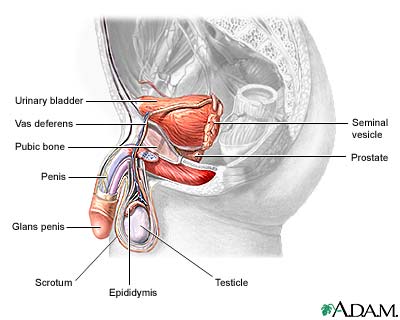
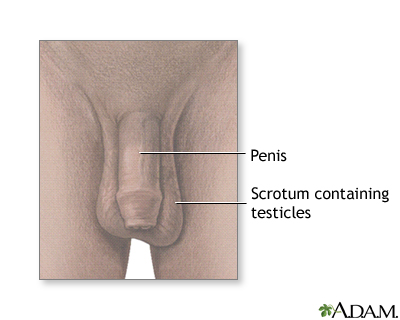
The testicles (also called the testes) are the male reproductive organs that produce sperm and the hormone testosterone. They are located in the scrotum under the penis.
You can do this test during or after a shower. This way, the scrotal skin is warm and relaxed. It is best to do the test while standing.
- Gently feel your scrotal sac to locate a testicle.
- Use one hand to stabilize the testicle. Use your fingers and thumb of the other hand to firmly but gently feel the testicle. Feel the entire surface.
- Check the other testicle in the same way.
Why the Test is Performed
A testicular self-exam is done to check for testicular cancer.
Testicles have blood vessels and other structures that can make the exam confusing. If you notice any lumps or changes in a testicle, contact your health care provider right away.
Your provider may recommend that you do a testicular self-exam every month if you have any of the following risk factors:
- Family history of testicular cancer
- Past testicular tumor
- Undescended testicle
However, if a man has no risk factors or symptoms, experts do not know if doing testicular self-exam lowers the chance of dying of this cancer. The US Preventive Services Task Force recommends against testicular exams by a provider or by the person in men with no symptoms and no risk factors for testicular cancer.
Normal Results
Each testicle should feel firm, but not rock hard. One testicle may be lower or slightly larger than the other.
Talk to your provider if you have questions.
What Abnormal Results Mean
If you find a small, hard lump (like a pea), have an enlarged testicle, or notice any other differences that do not seem normal, see your provider right away.
Contact your provider if:
- You cannot find one or both testicles. The testicles may not have descended properly in the scrotum.
- There is a soft collection of thin tubes above the testicle. This may be a collection of widened veins (varicocele).
- You have pain or swelling in the scrotum. This may be an infection or a fluid-filled sac (hydrocele) causing a blockage of blood flow to the area. It may be difficult to feel the testicle if there is fluid in the scrotum.
Sudden, severe (acute) pain in the scrotum or testicle that lasts for more than a few minutes is an emergency. If you have this type of pain, seek medical attention right away.
A lump in the testicle is often the first sign of testicular cancer. If you find a lump, see a provider right away. Most testicular cancers are very treatable. Keep in mind that some cases of testicular cancer do not show symptoms until they reach an advanced stage.
Risks
There are no risks with this self-exam.
Related Information
TestesTestosterone
Undescended testicle
Testicular cancer
Varicocele
Hydrocele
References
American Cancer Society website. Can testicular cancer be found early? www.cancer.org/cancer/testicular-cancer/detection-diagnosis-staging/detection.html www.cancer.org/cancer/types/testicular-cancer/detection-diagnosis-staging/detection.html. Updated August 10, 2025. Accessed November 12, 2025.
Friedlander TW, Small E. Testicular cancer. In: Niederhuber JE, Armitage JO, Kastan MB, Doroshow JH, Tepper JE, eds. Abeloff's Clinical Oncology. 6th ed. Philadelphia, PA: Elsevier; 2020:chap 83.
National Cancer Institute website. Testicular cancer screening (PDQ) - health professional version. www.cancer.gov/types/testicular/hp/testicular-screening-pdq. Updated April 7, 2025. Accessed July 11, 2025.
Park JH, Leitner DV, Elsamra SE. Evaluation of the urologic patient: history and physical examination. In: Dmochowski RR, Kavoussi LR, Peters CA, et al, eds. Campbell-Walsh-Wein Urology. 13th ed. Philadelphia, PA: Elsevier; 2026:chap 2.
US Preventive Services Task Force. Screening for testicular cancer: US Preventive Services Task Force reaffirmation recommendation statement. Ann Intern Med. 2011;154(7):483-486. PMID: 21464350 pubmed.ncbi.nlm.nih.gov/21464350/.
BACK TO TOPReview Date: 7/1/2025
Reviewed By: Kelly L. Stratton, MD, FACS, Associate Professor, Department of Urology, University of Oklahoma Health Sciences Center, Oklahoma City, OK. Also reviewed by David C. Dugdale, MD, Medical Director, Brenda Conaway, Editorial Director, and the A.D.A.M. Editorial team.
 | A.D.A.M., Inc. is accredited by URAC, for Health Content Provider (www.urac.org). URAC's accreditation program is an independent audit to verify that A.D.A.M. follows rigorous standards of quality and accountability. A.D.A.M. is among the first to achieve this important distinction for online health information and services. Learn more about A.D.A.M.'s editorial policy, editorial process and privacy policy. A.D.A.M. is also a founding member of Hi-Ethics. This site complies with the HONcode standard for trustworthy health information: verify here. |
The information provided herein should not be used during any medical emergency or for the diagnosis or treatment of any medical condition. A licensed medical professional should be consulted for diagnosis and treatment of any and all medical conditions. Links to other sites are provided for information only -- they do not constitute endorsements of those other sites. No warranty of any kind, either expressed or implied, is made as to the accuracy, reliability, timeliness, or correctness of any translations made by a third-party service of the information provided herein into any other language.
© 1997-
2026 A.D.A.M., a business unit of Ebix, Inc. Any duplication or distribution of the information contained herein is strictly prohibited.
All content on this site including text, images, graphics, audio, video, data, metadata, and compilations is protected by copyright and other intellectual property laws. You may view the content for personal, noncommercial use. Any other use requires prior written consent from Ebix. You may not copy, reproduce, distribute, transmit, display, publish, reverse-engineer, adapt, modify, store beyond ordinary browser caching, index, mine, scrape, or create derivative works from this content. You may not use automated tools to access or extract content, including to create embeddings, vectors, datasets, or indexes for retrieval systems. Use of any content for training, fine-tuning, calibrating, testing, evaluating, or improving AI systems of any kind is prohibited without express written consent. This includes large language models, machine learning models, neural networks, generative systems, retrieval-augmented systems, and any software that ingests content to produce outputs. Any unauthorized use of the content including AI-related use is a violation of our rights and may result in legal action, damages, and statutory penalties to the fullest extent permitted by law. Ebix reserves the right to enforce its rights through legal, technological, and contractual measures.
