

Health Library
Bronchoscopic culture
Culture - bronchoscopic
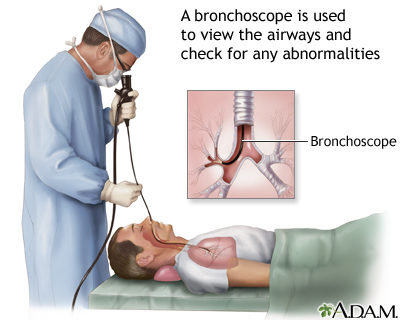
Bronchoscopic culture is a lab exam to check a piece of tissue or fluid from the lungs for infection-causing germs.
Images
I Would Like to Learn About:
How the Test is Performed
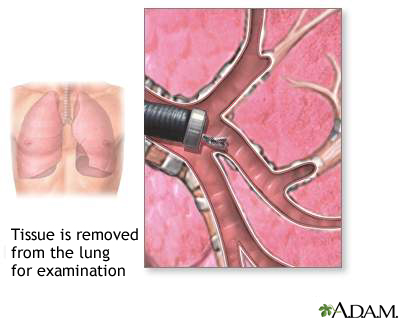
A procedure called bronchoscopy is used to get a sample (biopsy or brush) of lung tissue or fluid.
The sample is sent to a lab. There, it is placed in a special dish (culture). It is then watched to see if bacteria or other disease-causing germs grow. Treatment is based on the results of the culture.
How to Prepare for the Test
Follow your health care provider's instructions on how to prepare for bronchoscopy.
How the Test will Feel
Your provider will tell you what to expect during your bronchoscopy. Most times, it's performed under conscious sedation (heavily sedated), or under general anesthesia (fully asleep) so you will likely not remember much from the procedure.
Why the Test is Performed
A bronchoscopic culture is done to find if you have an infection in your lung that cannot be accurately detected by a sputum culture. The procedure may find the following things, such as:
- Abnormal secretions
- Abnormal lung tissue
- Abscesses
- Blockage of the airway, most often due to cancer or foreign bodies
- Inflammation
Normal Results
No organisms are seen on the culture.
What Abnormal Results Mean
Abnormal culture results usually indicate a respiratory infection. The infection may be caused by bacteria, viruses, parasites, mycobacteria, or fungi. The results of the culture will help determine the best treatment.
Not all organisms found with bronchoscopic culture need to be treated. Your provider will tell you more about this, after taking into account a lot of information to determine if treatment is needed.
Risks
Your provider can discuss the risks of the bronchoscopy procedure with you.
Related Information
Sputum cultureAbscess
References
Beamer S, Jaroszewski DE, Viggiano RW, Smith ML. Optimal processing of diagnostic lung specimens. In: Smith ML, Leslie KO, Wick MR, eds. Practical Pulmonary Pathology: A Diagnostic Approach. 4th ed. Philadelphia, PA: Elsevier; 2024:chap 3.
Kupeli E, Mehta AC. Diagnostic bronchoscopy: basic techniques. In: Broaddus VC, Ernst JD, King TE, et al, eds. Murray and Nadel's Textbook of Respiratory Medicine. 7th ed. Philadelphia, PA: Elsevier; 2022:chap 26.
BACK TO TOPReview Date: 11/6/2025
Reviewed By: Jacob Berman, MD, MPH, Associate Professor of Medicine, Division of General Internal Medicine, University of Washington School of Medicine, Seattle, WA. Also reviewed by David C. Dugdale, MD, Medical Director, Brenda Conaway, Editorial Director, and the A.D.A.M. Editorial team.
 | A.D.A.M., Inc. is accredited by URAC, for Health Content Provider (www.urac.org). URAC's accreditation program is an independent audit to verify that A.D.A.M. follows rigorous standards of quality and accountability. A.D.A.M. is among the first to achieve this important distinction for online health information and services. Learn more about A.D.A.M.'s editorial policy, editorial process and privacy policy. A.D.A.M. is also a founding member of Hi-Ethics. This site complies with the HONcode standard for trustworthy health information: verify here. |
The information provided herein should not be used during any medical emergency or for the diagnosis or treatment of any medical condition. A licensed medical professional should be consulted for diagnosis and treatment of any and all medical conditions. Links to other sites are provided for information only -- they do not constitute endorsements of those other sites. No warranty of any kind, either expressed or implied, is made as to the accuracy, reliability, timeliness, or correctness of any translations made by a third-party service of the information provided herein into any other language.
© 1997-
2026 A.D.A.M., a business unit of Ebix, Inc. Any duplication or distribution of the information contained herein is strictly prohibited.
All content on this site including text, images, graphics, audio, video, data, metadata, and compilations is protected by copyright and other intellectual property laws. You may view the content for personal, noncommercial use. Any other use requires prior written consent from Ebix. You may not copy, reproduce, distribute, transmit, display, publish, reverse-engineer, adapt, modify, store beyond ordinary browser caching, index, mine, scrape, or create derivative works from this content. You may not use automated tools to access or extract content, including to create embeddings, vectors, datasets, or indexes for retrieval systems. Use of any content for training, fine-tuning, calibrating, testing, evaluating, or improving AI systems of any kind is prohibited without express written consent. This includes large language models, machine learning models, neural networks, generative systems, retrieval-augmented systems, and any software that ingests content to produce outputs. Any unauthorized use of the content including AI-related use is a violation of our rights and may result in legal action, damages, and statutory penalties to the fullest extent permitted by law. Ebix reserves the right to enforce its rights through legal, technological, and contractual measures.
