

Health Library
Nasopharyngeal culture
Culture - nasopharyngeal; Swab for respiratory viruses; Swab for staph carriage
Nasopharyngeal culture is a test that examines a sample of secretions from the uppermost part of the throat, behind the nose, to detect organisms that can cause disease.
Images
I Would Like to Learn About:
How the Test is Performed
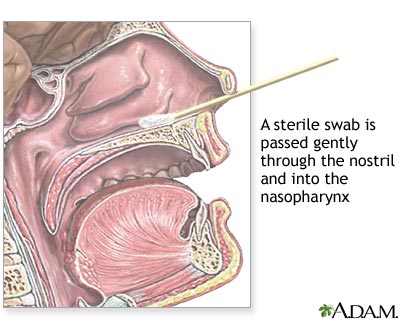
You will be asked to cough before the test begins and then tilt your head back. A sterile cotton-tipped swab is gently passed through a nostril and into your nasopharynx. This is the part of the pharynx that covers the roof of the mouth. The swab is quickly rotated and removed. The sample is sent to a lab. There, it is placed in a special dish (culture). It is then watched to see if bacteria, viruses, or other disease-causing organisms grow.
How to Prepare for the Test
No special preparation is needed.
How the Test will Feel
You may have slight discomfort and may gag.
Why the Test is Performed
The test identifies viruses and bacteria that cause upper respiratory tract symptoms. These include:
- Bordetella pertussis, the bacteria that cause whooping cough.
- Neisseria meningitidis, the bacteria that cause meningococcal meningitis.
- Staphylococcus aureus, the bacteria that cause staph infections.
- Methicillin-resistant Staphylococcus aureus (MRSA).
- Viral infections such as influenza, respiratory syncytial virus, or SARS-CoV-2 (COVID-19). This is the most common reason the test is used.
The culture may be used to help determine which antibiotic is appropriate to treat an infection due to bacteria.
Normal Results
The presence of organisms commonly found in the nasopharynx is normal.
What Abnormal Results Mean
The presence of any disease-causing virus, bacteria, or fungus means these organisms may be causing your infection.
Sometimes, organisms like Staphylococcus aureus can be present without causing disease. This test can help identify resistant strains of this organism (MRSA) so that people can be isolated when necessary.
Risks
A minor nose bleed can occur, but it is rare.
References
Nayak JL, Treanor JJ. Influenza viruses, including avian influenza and swine influenza. In: Blaser MJ, Cohen JI, Holland SM, et al, eds. Mandell, Douglas, and Bennett's Principles and Practice of Infectious Diseases. 10th ed. Philadelphia, PA: Elsevier; 2026:chap 172.
Patel R. The clinician and the microbiology laboratory: test ordering, specimen collection, and result interpretation. In: Blaser MJ, Cohen JI, Holland SM, et al, eds. Mandell, Douglas, and Bennett's Principles and Practice of Infectious Diseases. 10th ed. Philadelphia, PA: Elsevier; 2026:chap 16.
Roginski MA, Atchinson PR. Upper respiratory tract infections. In: Walls RM, ed. Rosen's Emergency Medicine: Concepts and Clinical Practice. 10th ed. Philadelphia, PA: Elsevier; 2023:chap 61.
BACK TO TOPReview Date: 11/6/2025
Reviewed By: Jacob Berman, MD, MPH, Associate Professor of Medicine, Division of General Internal Medicine, University of Washington School of Medicine, Seattle, WA. Also reviewed by David C. Dugdale, MD, Medical Director, Brenda Conaway, Editorial Director, and the A.D.A.M. Editorial team.
 | A.D.A.M., Inc. is accredited by URAC, for Health Content Provider (www.urac.org). URAC's accreditation program is an independent audit to verify that A.D.A.M. follows rigorous standards of quality and accountability. A.D.A.M. is among the first to achieve this important distinction for online health information and services. Learn more about A.D.A.M.'s editorial policy, editorial process and privacy policy. A.D.A.M. is also a founding member of Hi-Ethics. This site complies with the HONcode standard for trustworthy health information: verify here. |
The information provided herein should not be used during any medical emergency or for the diagnosis or treatment of any medical condition. A licensed medical professional should be consulted for diagnosis and treatment of any and all medical conditions. Links to other sites are provided for information only -- they do not constitute endorsements of those other sites. No warranty of any kind, either expressed or implied, is made as to the accuracy, reliability, timeliness, or correctness of any translations made by a third-party service of the information provided herein into any other language.
© 1997-
2026 A.D.A.M., a business unit of Ebix, Inc. Any duplication or distribution of the information contained herein is strictly prohibited.
All content on this site including text, images, graphics, audio, video, data, metadata, and compilations is protected by copyright and other intellectual property laws. You may view the content for personal, noncommercial use. Any other use requires prior written consent from Ebix. You may not copy, reproduce, distribute, transmit, display, publish, reverse-engineer, adapt, modify, store beyond ordinary browser caching, index, mine, scrape, or create derivative works from this content. You may not use automated tools to access or extract content, including to create embeddings, vectors, datasets, or indexes for retrieval systems. Use of any content for training, fine-tuning, calibrating, testing, evaluating, or improving AI systems of any kind is prohibited without express written consent. This includes large language models, machine learning models, neural networks, generative systems, retrieval-augmented systems, and any software that ingests content to produce outputs. Any unauthorized use of the content including AI-related use is a violation of our rights and may result in legal action, damages, and statutory penalties to the fullest extent permitted by law. Ebix reserves the right to enforce its rights through legal, technological, and contractual measures.
