

Health Library
Metopic ridge
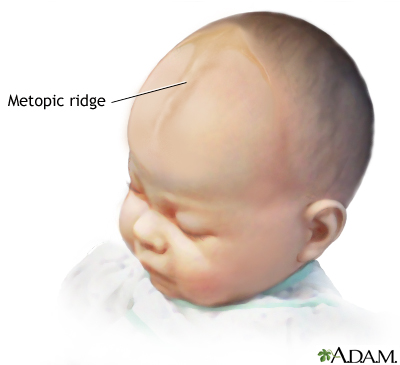
A metopic ridge is an abnormal shape of the skull. The ridge can be seen on the forehead.
Images
I Would Like to Learn About:
Considerations
The skull of an infant is made up of bony plates. The gaps between the plates allow for growth of the skull. The places where these plates connect are called sutures or suture lines. They usually do not fully close (which joins the bony plates) until the 2nd or 3rd year of life.
A metopic ridge occurs when the 2 bony plates in the middle of the forehead join together too early.
The metopic suture remains unclosed throughout life in 1 in 10 people.
Causes
It is usually unclear why a metopic ridge occurs. Often it will diminish as the child grows. Sometimes it is part of a more serious syndrome called craniosynostosis which can be associated with other congenital skeletal defects. A metopic ridge, by itself, is usually only a cosmetic concern.
When to Contact a Medical Professional
Contact your health care provider if you notice a ridge along your infant's forehead or a ridge forming on the skull.
The provider will perform a physical exam and ask questions about the child's medical history.
Tests may include:
A metopic ridge must be differentiated from metopic synostosis, which is part of craniosynostosis, a more serious condition. Parents can find information and support at www.cappskids.org/metopic-ridge/.
The only treatment is surgery, but is rarely necessary if it is the only skull abnormality, unless it causes a cosmetic problem..
Related Information
Sutures - ridgedReferences
Bloch K, Geoffroy M, Taverne M, et al. New diagnostic criteria for metopic ridges and trigonocephaly: a 3D geometric approach. Orphanet J Rare Dis. 2024;19(1):204. PMID: 38762603 pubmed.ncbi.nlm.nih.gov/38762603/.
Craniosynostosis and Positional Plagiocephaly Support (CAPPS) website. The metopic ridge/benign or surgical? www.cappskids.org/metopic-ridge/. Accessed November 21, 2025.
Graham JM, Sanchez-Lara PA. Craniosynostosis: general. In: Graham JM, Sanchez-Lara PA, eds. Smith's Recognizable Patterns of Human Deformation. 5th ed. Philadelphia, PA: Elsevier; 2025:chap 29.
Jha RT, Magge SN, Keating RF. Diagnosis and surgical options for craniosynostosis. In: Ellenbogen RG, Sekhar LN, Kitchen ND, da Silva HB, eds. Principles of Neurological Surgery. 4th ed. Philadelphia, PA: Elsevier; 2018:chap 9.
Shakir S, Taylor JA. Nonsyndromic craniosynostosis. In: Losee JE, Hopper RA, eds. Plastic Surgery, Volume 3: Craniofacial, Head and Neck Surgery and Pediatric Plastic Surgery. 5th ed. Philadelphia, PA: Elsevier; 2024:chap 25.2.
Trowbridge SK, Yang E, Yuskaitis CJ. Congenital anomalies of the central nervous system. In: Kliegman RM, St. Geme JW, Blum NJ, et al, eds. Nelson Textbook of Pediatrics. 22nd ed. Philadelphia, PA: Elsevier; 2025:chap 631.
BACK TO TOPReview Date: 10/20/2025
Reviewed By: Franklin W. Lusby, MD, Ophthalmologist, Lusby Vision Institute, La Jolla, CA. Also reviewed by David C. Dugdale, MD, Medical Director, Brenda Conaway, Editorial Director, and the A.D.A.M. Editorial team.
 | A.D.A.M., Inc. is accredited by URAC, for Health Content Provider (www.urac.org). URAC's accreditation program is an independent audit to verify that A.D.A.M. follows rigorous standards of quality and accountability. A.D.A.M. is among the first to achieve this important distinction for online health information and services. Learn more about A.D.A.M.'s editorial policy, editorial process and privacy policy. A.D.A.M. is also a founding member of Hi-Ethics. This site complies with the HONcode standard for trustworthy health information: verify here. |
The information provided herein should not be used during any medical emergency or for the diagnosis or treatment of any medical condition. A licensed medical professional should be consulted for diagnosis and treatment of any and all medical conditions. Links to other sites are provided for information only -- they do not constitute endorsements of those other sites. No warranty of any kind, either expressed or implied, is made as to the accuracy, reliability, timeliness, or correctness of any translations made by a third-party service of the information provided herein into any other language.
© 1997-
2026 A.D.A.M., a business unit of Ebix, Inc. Any duplication or distribution of the information contained herein is strictly prohibited.
All content on this site including text, images, graphics, audio, video, data, metadata, and compilations is protected by copyright and other intellectual property laws. You may view the content for personal, noncommercial use. Any other use requires prior written consent from Ebix. You may not copy, reproduce, distribute, transmit, display, publish, reverse-engineer, adapt, modify, store beyond ordinary browser caching, index, mine, scrape, or create derivative works from this content. You may not use automated tools to access or extract content, including to create embeddings, vectors, datasets, or indexes for retrieval systems. Use of any content for training, fine-tuning, calibrating, testing, evaluating, or improving AI systems of any kind is prohibited without express written consent. This includes large language models, machine learning models, neural networks, generative systems, retrieval-augmented systems, and any software that ingests content to produce outputs. Any unauthorized use of the content including AI-related use is a violation of our rights and may result in legal action, damages, and statutory penalties to the fullest extent permitted by law. Ebix reserves the right to enforce its rights through legal, technological, and contractual measures.
