

Health Library
Hemolytic crisis
Hemolysis - acute
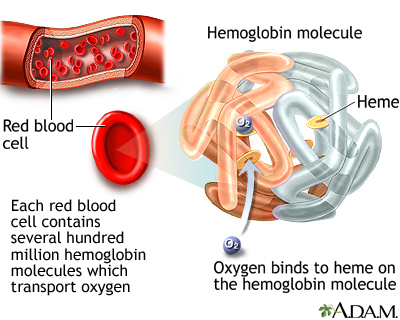
Hemolytic crisis occurs when large numbers of red blood cells are destroyed over a short time. The loss of red blood cells occurs much faster than the body can produce new red blood cells.
Images
I Would Like to Learn About:
Considerations
During a hemolytic crisis, the body cannot make enough red blood cells to replace those that are destroyed. This causes acute and often severe anemia.
The part of red blood cells that carries oxygen (hemoglobin) is released into the bloodstream. This can lead to kidney damage.
Causes
Causes of hemolysis include:
- A lack of certain proteins inside red blood cells
- Autoimmune diseases
- Certain infections
- Defects in the hemoglobin molecules inside red blood cells
- Defects of the proteins that make up the internal framework of red blood cells
- Side effects of certain medicines
- Reactions to blood transfusions
When to Contact a Medical Professional
Contact your health care provider if you have:
- Symptoms of anemia, including pale skin or fatigue, especially if these symptoms get worse
- Urine that is red, red-brown, or brown (tea-colored)
What to Expect at Your Office Visit
Emergency treatment may be necessary. This may include a hospital stay, oxygen, blood transfusions, and other treatments.
When your condition is stable, your provider will perform a physical exam and ask about your medical history and symptoms. The physical exam may show swelling of the spleen (splenomegaly).
Tests that may be done include:
Treatment depends on the cause of hemolysis.
Related Information
HemolysisHemolytic anemia
Anemia
Hematocrit
Glucose-6-phosphate dehydrogenase deficiency
Acute
Hemoglobin
References
Elghetany MT, Banki K. Erythrocytic disorders. In: McPherson RA, Pincus MR, eds. Henry's Clinical Diagnosis and Management by Laboratory Methods. 24th ed. Philadelphia, PA: Elsevier; 2022:chap 33.
Gallagher PG. Hemolytic anemias: red blood cell membrane and metabolic defects. In: Goldman L, Cooney KA, eds. Goldman-Cecil Medicine. 27th ed. Philadelphia, PA: Elsevier; 2024:chap 147.
Michel M. Autoimmune and intravascular hemolytic anemias. In: Goldman L, Cooney KA, eds. Goldman-Cecil Medicine. 27th ed. Philadelphia, PA: Elsevier; 2024:chap 146.
Michel M, Jäger U. Autoimmune hemolytic anemia. In: Hoffman R, Benz EJ, Silberstein LE, et al, eds. Hematology: Basic Principles and Practice. 8th ed. Philadelphia, PA: Elsevier; 2023:chap 47.
BACK TO TOPReview Date: 1/29/2026
Reviewed By: Warren Brenner, MD, Oncologist, Lynn Cancer Institute, Boca Raton, FL. Review provided by VeriMed Healthcare Network. Also reviewed by David C. Dugdale, MD, Medical Director, Brenda Conaway, Editorial Director, and the A.D.A.M. Editorial team.
 | A.D.A.M., Inc. is accredited by URAC, for Health Content Provider (www.urac.org). URAC's accreditation program is an independent audit to verify that A.D.A.M. follows rigorous standards of quality and accountability. A.D.A.M. is among the first to achieve this important distinction for online health information and services. Learn more about A.D.A.M.'s editorial policy, editorial process and privacy policy. A.D.A.M. is also a founding member of Hi-Ethics. This site complies with the HONcode standard for trustworthy health information: verify here. |
The information provided herein should not be used during any medical emergency or for the diagnosis or treatment of any medical condition. A licensed medical professional should be consulted for diagnosis and treatment of any and all medical conditions. Links to other sites are provided for information only -- they do not constitute endorsements of those other sites. No warranty of any kind, either expressed or implied, is made as to the accuracy, reliability, timeliness, or correctness of any translations made by a third-party service of the information provided herein into any other language.
© 1997-
2026 A.D.A.M., a business unit of Ebix, Inc. Any duplication or distribution of the information contained herein is strictly prohibited.
All content on this site including text, images, graphics, audio, video, data, metadata, and compilations is protected by copyright and other intellectual property laws. You may view the content for personal, noncommercial use. Any other use requires prior written consent from Ebix. You may not copy, reproduce, distribute, transmit, display, publish, reverse-engineer, adapt, modify, store beyond ordinary browser caching, index, mine, scrape, or create derivative works from this content. You may not use automated tools to access or extract content, including to create embeddings, vectors, datasets, or indexes for retrieval systems. Use of any content for training, fine-tuning, calibrating, testing, evaluating, or improving AI systems of any kind is prohibited without express written consent. This includes large language models, machine learning models, neural networks, generative systems, retrieval-augmented systems, and any software that ingests content to produce outputs. Any unauthorized use of the content including AI-related use is a violation of our rights and may result in legal action, damages, and statutory penalties to the fullest extent permitted by law. Ebix reserves the right to enforce its rights through legal, technological, and contractual measures.
