

Health Library
Urination - difficulty with flow
Delayed urination; Hesitancy; Difficulty initiating urination
Difficulty starting or maintaining a urine stream is called urinary hesitancy.
Images
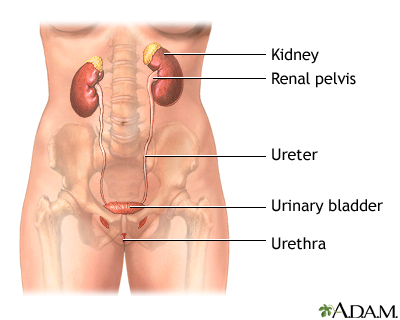
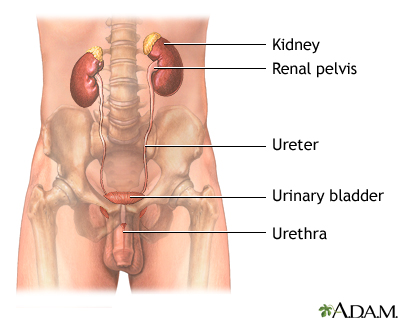
I Would Like to Learn About:
Considerations
Urinary hesitancy affects people of all ages and occurs in both sexes. However, it is most common in older men with an enlarged prostate gland.
Urinary hesitancy most often develops slowly over time. You may not notice it until you are unable to urinate (called urinary retention). This causes swelling and discomfort in your bladder.
Causes
The most common cause of urinary hesitancy in older men is an enlarged prostate. Almost all older men have some trouble with dribbling, weak urine stream, and starting urination.
Another common cause is infection of the prostate or urinary tract. Symptoms of a possible infection include:
- Burning or pain with urination
- Frequent urination
- Cloudy urine
- Urinary urgency (strong, sudden urge to urinate)
- Blood in the urine
The problem can also be caused by:
- Some medicines (such as remedies for colds and allergies, tricyclic antidepressants, some medicines used for incontinence, and some vitamins and supplements)
- Nervous system disorders or problems with the spinal cord
- Side effects of surgery
- Scar tissue (stricture) in the tube leading from the bladder (urethra)
- Spastic muscles in the pelvis
Home Care
Steps you can take to care for yourself include:
- Keep track of your urination patterns and bring the record to your health care provider.
- Apply heat to your lower abdomen (below your belly button and above the pubic bone). This is where the bladder sits. The heat relaxes muscles and aids urination.
- Massage or apply light pressure over your bladder to help the bladder empty.
- Take a warm bath or shower to help stimulate urination.
When to Contact a Medical Professional
Contact your provider if you notice urinary hesitancy, dribbling, or a weak urine stream.
Contact your provider right away if:
- You have a fever, vomiting, side or back pain, shaking chills, or are passing little urine for 1 to 2 days.
- You have blood in your urine, cloudy urine, a frequent or urgent need to urinate, or a discharge from the penis or vagina.
- You are unable to pass urine.
What to Expect at Your Office Visit
Your provider will take your medical history and do an exam to look at your pelvis, genitals, rectum, abdomen, and lower back.
You may be asked questions such as:
- How long have you had the problem?
- Is it worse in the morning or at night?
- Has the force of your urine flow decreased? Do you have dribbling or leaking urine?
- Does anything help or make the problem worse?
- Do you have symptoms of an infection?
- Have you had other medical conditions or surgeries that could affect your urine flow?
- What medicines do you take?
Tests that may be performed include:
- Blood urea nitrogen test
- Creatinine (serum)
- Electrolytes (serum)
- Catheterization of the bladder to determine how much urine remains in your bladder after trying to urinate and to get urine for culture (a catheterized urine specimen)
- Cystometrogram or urodynamic study
- Transrectal ultrasound of the prostate
- Urethral swab for culture
- Urinalysis and culture
- Voiding cystourethrogram
- A bladder scan and ultrasound (measures urine left behind without catheterization)
- Cystoscopy
Treatment for urinary hesitancy depends on the cause, and may include:
- Medicines to relieve the symptoms of an enlarged prostate.
- Antibiotics to treat any infection. Be sure to take all your medicines as directed.
- Surgery to relieve a prostate blockage called transurethral resection of the prostate (TURP).
- Procedure to dilate or cut scar tissue in the urethra.
References
Carter C. Urinary tract disorders. In: Rakel RE, Rakel DP, eds. Textbook of Family Medicine. 9th ed. Philadelphia, PA: Elsevier; 2016:chap 40.
Kaplan SA. Benign prostatic hyperplasia and prostatitis. In: Goldman L, Cooney KA, eds. Goldman-Cecil Medicine. 27th ed. Philadelphia, PA: Elsevier; 2024:chap 114.
Park JH, Leitner DV, Elsamra SE. Evaluation of the urologic patient: history and physical examination. In: Dmochowski RR, Kavoussi LR, Peters CA, et al, eds. Campbell-Walsh-Wein Urology. 13th ed. Philadelphia, PA: Elsevier; 2026:chap 2.
Smith PP, Kuchel GA. Aging of the urinary tract. In: Fillit HM, Rockwood K, Young J, eds. Brocklehurst's Textbook of Geriatric Medicine and Gerontology. 8th ed. Philadelphia, PA: Elsevier, 2017:chap 22..
BACK TO TOPReview Date: 7/1/2025
Reviewed By: Kelly L. Stratton, MD, FACS, Associate Professor, Department of Urology, University of Oklahoma Health Sciences Center, Oklahoma City, OK. Also reviewed by David C. Dugdale, MD, Medical Director, Brenda Conaway, Editorial Director, and the A.D.A.M. Editorial team.
 | A.D.A.M., Inc. is accredited by URAC, for Health Content Provider (www.urac.org). URAC's accreditation program is an independent audit to verify that A.D.A.M. follows rigorous standards of quality and accountability. A.D.A.M. is among the first to achieve this important distinction for online health information and services. Learn more about A.D.A.M.'s editorial policy, editorial process and privacy policy. A.D.A.M. is also a founding member of Hi-Ethics. This site complies with the HONcode standard for trustworthy health information: verify here. |
The information provided herein should not be used during any medical emergency or for the diagnosis or treatment of any medical condition. A licensed medical professional should be consulted for diagnosis and treatment of any and all medical conditions. Links to other sites are provided for information only -- they do not constitute endorsements of those other sites. No warranty of any kind, either expressed or implied, is made as to the accuracy, reliability, timeliness, or correctness of any translations made by a third-party service of the information provided herein into any other language.
© 1997-
2026 A.D.A.M., a business unit of Ebix, Inc. Any duplication or distribution of the information contained herein is strictly prohibited.
All content on this site including text, images, graphics, audio, video, data, metadata, and compilations is protected by copyright and other intellectual property laws. You may view the content for personal, noncommercial use. Any other use requires prior written consent from Ebix. You may not copy, reproduce, distribute, transmit, display, publish, reverse-engineer, adapt, modify, store beyond ordinary browser caching, index, mine, scrape, or create derivative works from this content. You may not use automated tools to access or extract content, including to create embeddings, vectors, datasets, or indexes for retrieval systems. Use of any content for training, fine-tuning, calibrating, testing, evaluating, or improving AI systems of any kind is prohibited without express written consent. This includes large language models, machine learning models, neural networks, generative systems, retrieval-augmented systems, and any software that ingests content to produce outputs. Any unauthorized use of the content including AI-related use is a violation of our rights and may result in legal action, damages, and statutory penalties to the fullest extent permitted by law. Ebix reserves the right to enforce its rights through legal, technological, and contractual measures.
