

Health Library
Vasectomy
Sterilization surgery - male; No-scalpel vasectomy; NSV; Family planning - vasectomy; Contraception - vasectomy
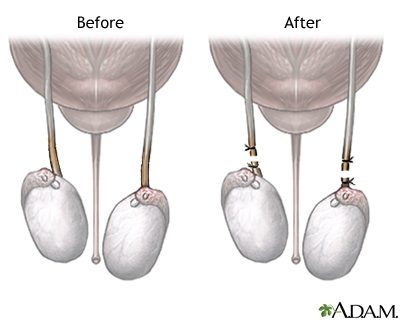
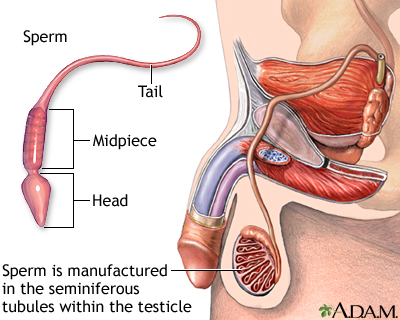
A vasectomy is surgery to cut the vas deferens. These are the tubes that carry sperm from the testicles to a man's urethra. After a vasectomy, sperm cannot move out of the testes. A man who has had a successful vasectomy cannot make a woman pregnant.
Images
Presentation

Animation

I Would Like to Learn About:
Description
Vasectomy is most often done in the surgeon's office using local anesthesia. You will be awake but not feel any pain.
- After your scrotum is shaved and cleaned, the surgeon will inject numbing medicine into the area.
- The surgeon will make a small cut in the upper part of your scrotum. The vas deferens will then be tied off or clipped and cut apart.
- The wound will be closed with stitches or surgical glue.
You may have a vasectomy without a surgical cut. This is called a no-scalpel vasectomy (NSV). For this procedure:
- The surgeon will find the vas deferens by feeling your scrotum.
- You will get numbing medicine.
- The surgeon will then make a tiny hole in the skin of your scrotum and then tie off and cut a part of the vas deferens.
In a regular vasectomy, a small incision is made on each side of the scrotum. In a no-scalpel vasectomy, a sharp instrument is used to pierce the skin and make a single opening. A stitch or surgical glue is used to seal the openings in both forms of the procedure.
Why the Procedure Is Performed
Vasectomy may be recommended for men who are sure they do not want to get a woman pregnant in the future. A vasectomy makes a man sterile (unable to get a woman pregnant).
A vasectomy is not recommended as a short-term form of birth control. The procedure to reverse a vasectomy is a much more complicated operation, may not work, and may not be covered by insurance.
Vasectomy may be a good choice for a man who:
- Is in a relationship, and both partners agree that they do not want children or additional children. They do not want to use, or cannot use, other forms of birth control.
- Is in a relationship and a pregnancy would be unsafe for the woman partner because of health problems.
- Is in a relationship, and one or both partners have genetic disorders that they do not want to pass on.
- Does not want to be bothered by having to use other forms of birth control during sexual activity.
Vasectomy may not be a good choice for a man who:
- Is in a relationship with someone who has not decided on whether to have children in the future.
- Is in an unstable or stressful relationship.
- Is considering the operation just to please a partner.
- Wants to have children later by storing sperm or by reversing the vasectomy.
- Is young and may want to make a different decision in the future.
- Is single when deciding to have a vasectomy. This includes men who are divorced, widowed, or separated.
Risks
There is no serious risk to vasectomy. Your semen will be tested in the months after the operation to make sure it does not contain sperm.
As with any surgical procedure, infection, swelling, or prolonged pain can occur. Carefully following aftercare instructions reduces these risks significantly.
Very rarely, the vas deferens can grow back together again. If this happens, sperm can mix with semen. This would make it possible for you to make a woman pregnant.
Before the Procedure
Tell your surgeon or nurse if:
- You are taking any medicines, including medicines, drugs, supplements, or herbs you bought without a prescription
- You have been drinking a lot of alcohol, more than 2 drinks a day
Planning for your surgery:
- If you have diabetes, heart disease, or other medical conditions, your surgeon may ask you to see your health care provider who treats you for these conditions.
- If you smoke, it's important to cut back or quit. Smoking can slow healing and increase the risk for blood clots. Ask your provider for help quitting smoking.
- If needed, prepare your home to make it easier to recover after surgery.
- Ask your surgeon if you need to arrange to have someone drive you home after your surgery.
During the week before your surgery:
- You may be asked to temporarily stop taking medicines that keep your blood from clotting. These medicines are called blood thinners. This includes over-the-counter medicines and supplements such as aspirin, ibuprofen (Advil, Motrin), naproxen (Aleve, Naprosyn), and vitamin E. Many prescription medicines are also blood thinners.
- Ask your surgeon which medicines you should still take on the day of surgery.
- Let your surgeon know about any illness you may have before your surgery. This includes COVID-19, a cold, flu, fever, herpes outbreak, or other illness. If you do get sick, your surgery may need to be postponed.
On the day of surgery:
- Follow instructions about when to stop eating and drinking.
- Take the medicines your surgeon told you to take with a small sip of water.
- Bring a scrotal support with you to the surgery.
- Wear loose, comfortable clothes. Clean your scrotum area well.
- Follow instructions on when to arrive at the hospital. Be sure to arrive on time.
After the Procedure
You should be able to return home as soon as you feel well. You can return to work the next day if you do not do heavy physical work. Most men return to work within 2 to 3 days. You should be able to return to your normal physical activities in 3 to 7 days. It is normal to have some swelling and bruising of the scrotum after the procedure. It should go away within 2 weeks.
You should wear a scrotal support for 3 to 4 days after the procedure. You can use an ice pack to reduce swelling. Pain medicine, such as acetaminophen (Tylenol), may help relieve discomfort. You can have sexual intercourse as soon as you feel ready, most often about a week after the surgery. You must use some form of birth control to prevent unwanted pregnancy until you know your semen is free of sperm.
The vasectomy is considered successful only after your semen has been tested to make sure no more sperm are in it. It is safe to stop using other forms of birth control at this point.
Outlook (Prognosis)
Vasectomy does not affect a man's ability to have an erection or orgasm, or to ejaculate semen. A vasectomy does not prevent the spread of sexually transmitted infections (STIs).
A vasectomy does not increase your risk of prostate cancer or testicular disease.
Your sperm count gradually decreases after a vasectomy. After about 3 months, sperm are no longer present in the semen. You must continue to use birth control to prevent pregnancy until your semen sample is totally free of sperm.
Most men are satisfied with vasectomy. Most couples enjoy not having to use birth control.
Related Information
TestesScrotum
Birth control and family planning
References
Brugh VM. Vasectomy. In: Smith JA, Dmochowski RR, Thomas JC, Preminger GM, eds. Hinman's Atlas of Urologic Surgery. 5th ed. Philadelphia, PA: Elsevier; 2026:chap 110.
Campbell JA, DuComb W, Herati AS. Surgery of the scrotum and seminal vesicles. In: Dmochowski RR, Kavoussi LR, Peters CA, et al, eds. Campbell-Walsh-Wein Urology. 13th ed. Philadelphia, PA: Elsevier; 2026:chap 87.
Wilson CL. Vasectomy. In: Fowler GC, ed. Pfenninger and Fowler's Procedures for Primary Care. 4th ed. Philadelphia, PA: Elsevier; 2020:chap 111.
BACK TO TOPReview Date: 1/12/2026
Reviewed By: Kelly L. Stratton, MD, FACS, Associate Professor, Department of Urology, University of Oklahoma Health Sciences Center, Oklahoma City, OK. Also reviewed by David C. Dugdale, MD, Medical Director, Brenda Conaway, Editorial Director, and the A.D.A.M. Editorial team.
 | A.D.A.M., Inc. is accredited by URAC, for Health Content Provider (www.urac.org). URAC's accreditation program is an independent audit to verify that A.D.A.M. follows rigorous standards of quality and accountability. A.D.A.M. is among the first to achieve this important distinction for online health information and services. Learn more about A.D.A.M.'s editorial policy, editorial process and privacy policy. A.D.A.M. is also a founding member of Hi-Ethics. This site complies with the HONcode standard for trustworthy health information: verify here. |
The information provided herein should not be used during any medical emergency or for the diagnosis or treatment of any medical condition. A licensed medical professional should be consulted for diagnosis and treatment of any and all medical conditions. Links to other sites are provided for information only -- they do not constitute endorsements of those other sites. No warranty of any kind, either expressed or implied, is made as to the accuracy, reliability, timeliness, or correctness of any translations made by a third-party service of the information provided herein into any other language.
© 1997-
2026 A.D.A.M., a business unit of Ebix, Inc. Any duplication or distribution of the information contained herein is strictly prohibited.
All content on this site including text, images, graphics, audio, video, data, metadata, and compilations is protected by copyright and other intellectual property laws. You may view the content for personal, noncommercial use. Any other use requires prior written consent from Ebix. You may not copy, reproduce, distribute, transmit, display, publish, reverse-engineer, adapt, modify, store beyond ordinary browser caching, index, mine, scrape, or create derivative works from this content. You may not use automated tools to access or extract content, including to create embeddings, vectors, datasets, or indexes for retrieval systems. Use of any content for training, fine-tuning, calibrating, testing, evaluating, or improving AI systems of any kind is prohibited without express written consent. This includes large language models, machine learning models, neural networks, generative systems, retrieval-augmented systems, and any software that ingests content to produce outputs. Any unauthorized use of the content including AI-related use is a violation of our rights and may result in legal action, damages, and statutory penalties to the fullest extent permitted by law. Ebix reserves the right to enforce its rights through legal, technological, and contractual measures.
